Best way to mix pancake batter
At Pancakes World, the best way to mix pancake batter is to prepare the pan first, distribute flour, leavener, salt and sugar evenly in one bowl, combine the formula’s wet ingredients in another, then add one mixture to the other and stir gently only until the recipe’s endpoint—usually “just moistened” or “just combined.” Scrape the bottom once, fold in fruit last, and stop even if small lumps remain when the source allows them. Rest the batter only when the formula specifies a rest. Never taste it raw. Cook one small pancake to check surface heat, spread and doneness before portioning the rest of the batch.
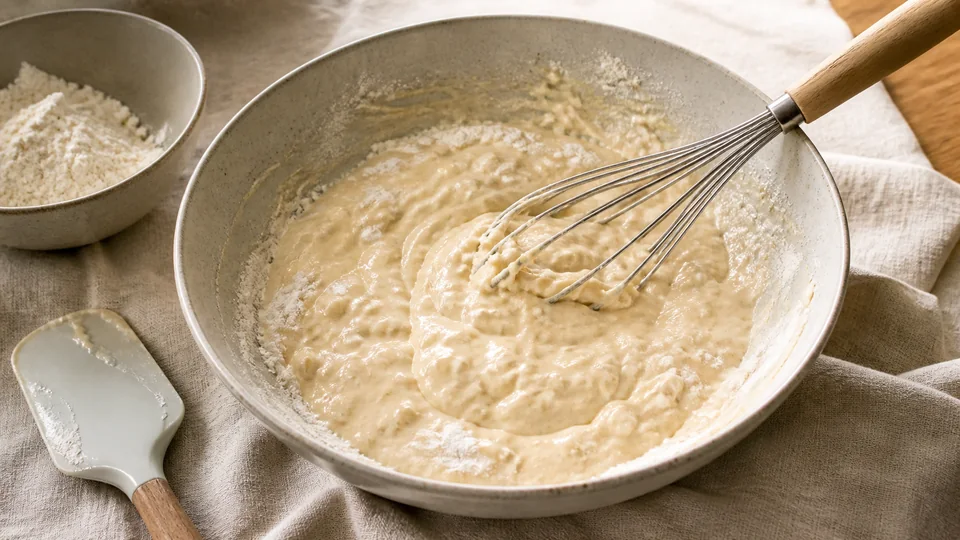
There is no universal stir count, lump size or rest time. A thick yogurt pancake, an oatmeal pancake, a thin crêpe and a sheet-pan pancake are different batters. The reliable method is the one attached to a complete formula. This guide explains the decisions and observable cues without claiming a Pancake World test or inventing a recipe. The pancake science hub covers the wider technique cluster; Pancake World opens the full collection.
| Guide sections |
|---|
| Why mixing method matters |
| Set the cooking station before the bowls |
| Measure before you mix |
| Stage the dry bowl |
For broader context, continue with Pancake Ingredients and Substitutions.
Why mixing method matters
Pancake batter is a temporary structure. Dry particles need enough liquid contact to hydrate, leavener needs even distribution, eggs and fats need incorporation, and any fruit or nuts need placement without endless agitation.
Too little mixing can leave pockets of dry flour or concentrated baking powder. Too much mixing can change the texture of wheat-based formulas. University of Illinois Extension specifically cautions that overmixing its yogurt pancake batter can produce tough, chewy pancakes, while several Extension recipes direct the cook to stop when dry ingredients are just moistened.
The useful target is not visual perfection. It is complete enough distribution with the least handling required by the selected recipe.
Set the cooking station before the bowls
Do not hydrate the batter and then search for a skillet, spatula or measuring cup.
Prepare:
- the complete recipe or package panel;
- the specified bowls and whisk, spoon or spatula;
- accurate dry and liquid measuring tools or a scale;
- the stated pan, griddle or sheet pan;
- cooking fat or spray if the formula uses it;
- a consistent scoop for portions;
- a turner sized for the pancakes;
- a clean plate or rack;
- a cloth for spills and a safe place for raw utensils.
Preheat at the point the recipe directs. A batter that sits accidentally while the cook clears the stove has not received a controlled rest; it has simply waited under unknown conditions.
Read the formula from beginning to end. Identify whether it says “add wet to dry,” “add dry to wet,” “fold,” “whisk,” “rest,” or “cook immediately.” Those verbs and sequence are part of the formula.
Measure before you mix
Flour and dry ingredients
Use weights when supplied. If using cups, follow the source’s measuring method. A cup packed by scooping directly from a bag can hold a different amount from a lightly filled and leveled cup.
Measure leavener and salt with the correct spoon. Level small measures rather than estimating a mound. A small error has greater impact in a small batch.
Liquids
Use a liquid measuring cup on a level surface for water or milk when volume is specified. Read at eye level. Measure oil separately so the amount is clear.
Eggs
Crack eggs into the wet bowl or a separate small bowl as the source directs, not into the flour container. This prevents shell fragments or a spoiled egg from contaminating the entire dry supply.
Temperature
Some formulas expect melted butter that has cooled enough not to cook the egg, or dairy at a particular temperature. Follow the instruction. Very cold ingredients can cause melted fat to solidify; very hot fat can damage the mixture.
Stage the dry bowl
Place flour and grain ingredients in a bowl large enough for later folding. Add baking powder, baking soda, salt, sugar and dry spices exactly as listed.
Use a whisk or spoon to distribute them. Pay attention to small white powders, which can hide against flour. Break obvious compacted leavener lumps before liquid enters.
University of Illinois Extension’s blueberry pancake method mixes flour, baking powder and sugar in the dry bowl. Utah State University Extension’s whole-wheat pancake source sifts its dry group. The action differs, but the purpose is the same: uniform distribution before hydration.
Do not assume sifting is always mandatory. It can aerate and break clumps, but the selected formula may call only for whisking. Conversely, do not skip sifting when the recipe uses it to obtain the stated measure or texture.
Stage the wet bowl
Combine milk, buttermilk, water, egg, oil, melted butter, yogurt, puree or sweetener in the order supplied.
Whisk only until the wet ingredients reach the recipe’s cue. Utah State University Extension’s peach sheet-pan pancakes combine yogurt, milk, eggs, sugar and melted butter until smooth before adding the dry ingredients. Illinois Extension’s blueberry pancakes combine milk, beaten egg, melted butter and blueberries, then add that group to dry ingredients. These examples show why one universal sequence is inappropriate: even fruit placement varies.
If a formula places fruit in the wet mixture, follow it. If it says fold fruit after the base batter is mixed, preserve that order.
Make the final combination
Create space
If the recipe directs a well in the dry ingredients, make one. This gives wet ingredients a central pool and allows flour to enter gradually from the sides.
Add in the directed orientation
Wet-to-dry is common but not universal. Add the designated mixture steadily rather than splashing it across the counter.
Use deliberate strokes
With a whisk, spoon or flexible spatula, draw through the center and around the bowl. Lift dry material from the bottom. Rotate the bowl if useful. Avoid fast beating unless the source explicitly asks for it.
Scrape the bottom and sides
One or two controlled scrapes can expose hidden flour. This is different from continuing to stir because the surface is not perfectly smooth.
Stop at the written cue
“Just moistened” means no large dry pockets remain. “Just combined” means the ingredient groups have joined without extended beating. A specific formula may tolerate small lumps; another, such as a thin blended batter, may ask for smoothness. The recipe decides.
Do not count 10 or 20 strokes as a universal method. Bowl shape, batch size, utensil and flour change what one stroke accomplishes.
Choose the right hand tool
Whisk
A whisk distributes dry leavener well and combines thin wet ingredients efficiently. It can also encourage overworking if used rapidly after flour enters. Use broad slow strokes for final combination when the formula permits a whisk.
Spoon
A sturdy spoon is useful for thick batter and packaged mix. It has less cutting action than a whisk but may leave dry pockets along the bowl. Scrape deliberately.
Flexible spatula
A spatula reaches the bottom and folds additions gently. It is especially useful after initial whisking or for fruit, nuts and chocolate pieces.
Electric mixer
Do not use one by default. Most cited Extension pancake formulas use hand mixing. A mixer can process a small batter quickly and make the endpoint harder to see. Use it only when the tested source specifies speed and duration.
Blender
A blender is appropriate for a recipe designed around it, such as some oat, cottage-cheese or crêpe batters. It is not a universal upgrade for standard wheat pancake batter. Blending changes particle size, aeration and mixing intensity.
Fold additions at the correct moment
Berries
Fresh and thawed frozen berries do not behave identically. Illinois Extension’s blueberry source combines thawed berries with wet ingredients. Other formulas fold fruit at the end or place pieces on individual pancakes. Use the documented method to control streaking and water.
Mashed banana, pumpkin or applesauce
Purees contribute liquid and solids. They cannot be added casually to a finished base without changing consistency. Use a variation with adjusted milk and leavener where required.
Nuts and chips
Fold them after the batter is mostly combined when the source says so. Large amounts can affect portion spread. Label allergens and prevent cross-contact.
Oats and whole grains
Some formulas mix oats into dry ingredients; others add them after liquids. Their hydration can thicken batter over time. Follow the sequence and any rest.
Whipped egg whites
A recipe using separated and whipped whites is a different mixing system. Fold them gently in stages as the source directs. Do not whisk the finished batter hard after the foam enters.
Rest only when the formula calls for it
Resting allows hydration and gives some formulas time for bubbles or structural relaxation. It can also allow a batter to thicken or a leavening reaction to progress.
Utah State University Extension’s apple cinnamon pancake curriculum specifies a 10-to-15-minute rest without stirring afterward. That is meaningful evidence for that formula, not a rule for every pancake.
Use this rest decision:
- explicit rest with time and handling cue: follow it;
- “cook immediately” or no-rest sequence: start cooking;
- packaged mix: use the package panel;
- unfamiliar formula with no instruction: do not invent a long rest;
- batter that waited because the pan was not ready: record the delay rather than calling it a technique.
Avoid stirring a rested batter unless instructed. That can release accumulated gas and undo the source’s desired state.
The first pancake is a diagnostic tool
Cook one small pancake using the specified portion and surface preparation.
Observe:
- how quickly it spreads;
- whether the edge begins to set before the bottom burns;
- whether surface bubbles appear according to the recipe;
- whether the turner can lift it cleanly;
- whether the second side finishes without a raw center.
Illinois Extension’s package-mix lesson recommends a test pancake and permits measured milk or mix adjustments for family preference. That advice is constrained by the package directions. Before changing batter, correct pan temperature and confirm measurements.
Never taste raw batter to check flavor or doneness. Evaluate the fully cooked test pancake.
Diagnose mixing problems
Dry flour pockets
Cause: the bowl bottom was not scraped, liquid was added unevenly, or the batch was too large for the bowl.
Next action: make one gentle scrape and fold before cooking. For future batches, use a larger bowl and distribute dry ingredients before adding liquid.
Batter becomes elastic or stringy
Cause: extended mixing may have developed more structure in a wheat-flour batter.
Next action: stop. Do not thin reflexively. Cook a small pancake and assess the cooked texture. On the next batch, use fewer, more efficient strokes.
Large leavener clumps
Cause: dry ingredients were not distributed or the powder had absorbed moisture.
Next action: do not keep a batter with obvious concentrated pockets for service. Replace compromised dry ingredients and whisk or sift before hydration.
Batter thickens while standing
Cause: flour, oats or other grains continue absorbing liquid; the formula may also contain a planned rest.
Next action: consult the recipe. Use only its allowed liquid correction. Random dilution changes yield and structure.
Fruit sinks or streaks
Cause: heavy or wet additions, rough mixing or an unsuitable placement method.
Next action: use the fruit form, drainage and fold stage specified by a complete source.
Pancakes turn tough
Cause: overmixing is a documented risk in the cited Illinois formula; excessive flour, substitution or prolonged holding can also contribute.
Next action: verify measuring, stop at “just combined,” and change one variable in the next batch.
Pancakes spread too much
Cause: ratio error, pan temperature, flour substitution or an unsupported liquid addition.
Next action: check measurements and surface heat before adding dry ingredients. If the source allows correction, measure it and retest.
Thick pancakes remain raw in the center
Cause: portion too large, heat too high or batter thicker than the source expects.
Next action: use the stated scoop and adjust surface temperature. Do not serve a browned exterior as evidence of complete cooking.
Formula-specific mixing variations
Standard wheat pancakes
Common source pattern: distribute dry ingredients, combine wet ingredients, bring them together briefly and stop when moistened. Small lumps may remain where the source permits them.
Whole-wheat pancakes
Whole-grain formulas may absorb differently and may use a rest. Do not transfer liquid or rest time from an all-purpose-flour recipe. Use a developed whole-wheat formula.
Oat pancakes
Rolled oats, oat flour and blended oats are not interchangeable. Particle size changes texture and hydration. A blender formula should state when oats are processed and how long batter stands.
Buttermilk pancakes
Buttermilk provides acid, and formulas may balance it with baking soda and baking powder. Replacing it with plain milk without adjusting the chemistry can change rise and flavor. Use a documented substitution.
Yogurt pancakes
Yogurt makes the wet mixture thicker. Illinois Extension’s source notes its batter is intentionally thick. Do not thin merely because it differs from a water-only mix.
Gluten-free pancakes
Gluten-free flours and blends vary widely in starches, gums and absorption. “Do not overmix gluten” is not a complete instruction for them. Follow the mix or recipe’s specific hydration, rest and tool guidance.
Crêpes
Crêpe batter is intentionally thin and may be blended and rested for a different outcome. Do not use crêpe smoothness as the target for a thick griddle pancake.
Sheet-pan pancakes
The USU peach formula mixes dry and wet groups separately, gently joins them, folds fruit and bakes in a pan. Its mixing principle is relevant, but its portioning and doneness method are not a griddle method.
Raw batter safety
FDA states that most flour is raw and can contain harmful bacteria. CDC explicitly includes pancake batter in its warning against eating raw dough or batter. Raw eggs can add another hazard.
After mixing:
- keep the batter away from fruit, toppings and cooked pancakes;
- do not reuse a spoon that touched raw batter for serving;
- wash hands with soap and water;
- wash bowls, whisks, spatulas and counters with hot soapy water;
- clean flour spills without scattering powder;
- follow recipe or package cooking instructions;
- discard recalled flour or baking mix;
- do not let children taste or play with batter.
Do not rely on homemade heat treatment of flour to make raw batter edible. Use products specifically labeled ready to eat only for applications designed for uncooked consumption.
Scaling the mixing method
A double batch needs more than twice the bowl space. Larger volumes take more strokes to combine and can hide dry flour at the bottom.
For a crowd:
- confirm the formula’s scaling guidance;
- weigh ingredients when possible;
- mix dry ingredients thoroughly at the full scale;
- combine wet ingredients in a vessel that pours cleanly;
- divide into two bowls if a giant batch cannot be folded efficiently;
- cook a test pancake from each bowl;
- track which bowl received any adjustment;
- avoid stirring repeatedly between cooking rounds.
Griddle capacity, not bowl size, may be the true limit. Several smaller batches can keep leavening and holding more consistent than one enormous bowl waiting beside the stove.
Frequently asked questions
Should pancake batter be smooth?
Only if the selected formula says so. Many Extension pancake recipes stop at just moistened or just combined, allowing some lumpiness. Thin crêpe or blender batters follow different instructions.
Do I mix wet ingredients into dry ingredients?
That is common, but use the recipe’s orientation. The essential controls are even dry distribution, coherent wet mixing and minimal final agitation.
Should I whisk or stir?
Use the tool the source specifies. A whisk is efficient for dry and wet groups; a spoon or spatula can be gentler for final combination and folding.
How many times should I stir?
There is no universal count. Stop at the observable cue in the formula. Stroke size, bowl and batch change the number required.
Should batter rest?
Only when the recipe or package provides a rest. One cited USU apple pancake formula rests 10–15 minutes without later stirring; that timing does not apply automatically elsewhere.
Can I use an electric mixer?
Only if the formula directs it. Hand tools give better control for many standard pancake batters and reduce the chance of passing the just-combined endpoint.
When should berries be added?
Follow the specific recipe. Some combine drained berries with wet ingredients, some fold them at the end, and some place them on each pancake.
What do I do if batter is too thick?
Check measurements and the expected texture. Cook a test pancake. Add a small measured amount of liquid only when the source or package authorizes it.
Can I taste batter to check seasoning?
No. Flour and raw egg can carry germs. Judge the fully cooked test pancake.
Can I stir batter again after it rests?
Only if instructed. Some rested formulas explicitly say not to stir afterward because the accumulated structure and bubbles are part of the intended result.
Final mixing checklist
- complete formula read before starting;
- pan and tools ready before hydration;
- dry ingredients accurately measured and evenly distributed;
- wet ingredients combined in the specified order;
- ingredient temperatures match the source;
- wet and dry mixtures joined with controlled strokes;
- bowl bottom scraped once for hidden flour;
- fruit or other additions placed at the source-defined stage;
- mixing stopped at the written cue;
- rest used only when specified;
- one cooked test pancake used for diagnosis;
- raw batter never tasted;
- utensils and surfaces cleaned after flour and egg contact;
- no Recipe schema or project test claim without evidence.
The best pancake-batter mixing method is disciplined, not dramatic. Measure accurately, distribute the small dry ingredients, organize the wet phase, combine only as much as necessary, respect the formula’s rest decision and let one cooked pancake expose heat or consistency errors. The endpoint on the recipe matters more than a universal stroke count.
Explore related Pancakes World guidance on American Pancakes, American Breakfast: Pancakes, Diner Plates and Brunch, and Maple Syrup.
Sources and editorial references
- University of Illinois Extension, “Blueberry Pancakes”:
https://eat-move-save.extension.illinois.edu/eat/recipes/blueberry-pancakes - University of Illinois Extension, “Recipe Rescue: Pancakes”:
https://extension.illinois.edu/blogs/live-well-eat-well/2014-07-17-recipe-rescue-pancakes - Utah State University Extension, “Peachy Sheet Pan Pancakes”:
https://extension.usu.edu/createbetterhealth/blog/peachypancakes - University of Illinois Extension, “4-H Cooking 101,” Pancakes From a Mix:
https://extension.illinois.edu/sites/default/files/4hcooking101-pressquality-book.pdf - Utah State University Extension, “Making Wheat a Part of Your Diet”:
https://extension.usu.edu/utah/files/recipes-cooking-canning/Making-Eat-a-Part-of-Wheat.pdf - Utah State University Extension, “Healthy Snacks Curriculum,” Apple Cinnamon Pancakes:
https://extension.usu.edu/sanpete/files/Healthy_SnacksCurriculum.pdf - U.S. Food and Drug Administration, “Flour Is a Raw Food and Other Safety Facts”:
https://www.fda.gov/consumers/consumer-updates/flour-raw-food-and-other-safety-facts - Centers for Disease Control and Prevention, “Raw Flour and Dough”:
https://www.cdc.gov/food-safety/foods/no-raw-dough.html