Best brunch recipes for a group
At Pancakes World, the best brunch recipes for a group are complete formulas whose documented yields fit the guest count and whose final steps fit the available kitchen. Choose a small portfolio—one anchor, one complementary substantial dish, one fresh component and beverages—then verify pans, batch count, holding and dietary coverage. Popularity does not make a recipe scalable.
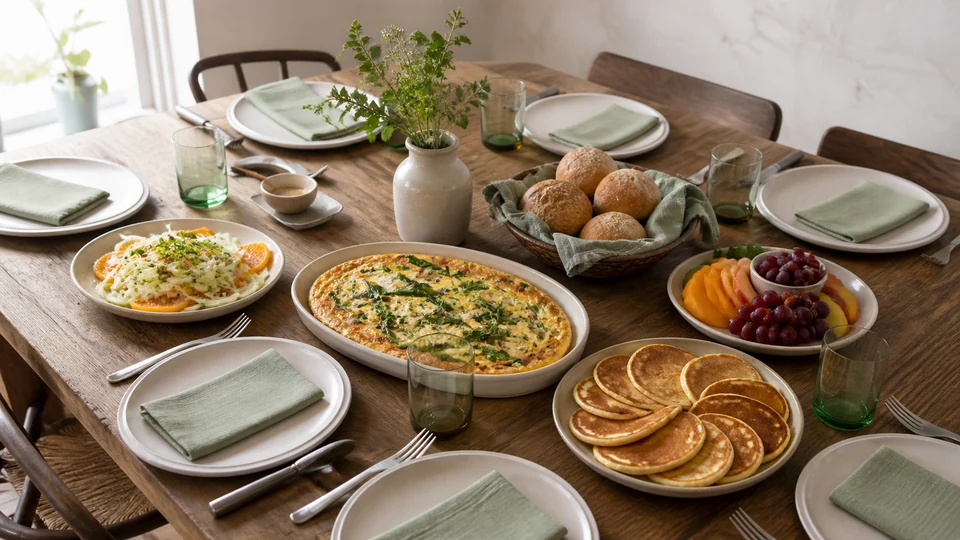
This is a recipe-selection workflow, not a tested menu or copied formula. Pancake World opens the wider brunch collection.
| Guide sections |
|---|
| Convert the event into requirements |
| Assign recipe roles |
| Scale without changing depth blindly |
| Build a backward schedule |
For broader context, continue with American Breakfast: Pancakes, Diner Plates and Brunch.
Convert the event into requirements
Write confirmed guests, arrival pattern, seated or buffet service, final-hour helpers, oven and burner capacity, refrigerator space and dietary needs. Decide whether brunch is the full meal or part of a longer gathering. These facts determine which recipes qualify.
Explore related Pancakes World guidance on American Pancakes, Maple Syrup, and Maple Syrup Pancakes.
Sources and editorial references
A candidate should name ingredient forms and quantities, pan or vessel, yield, method, timing and doneness cues. Advance-preparation, storage and reheating boundaries should be explicit where relevant. Reject fragments, social captions and summaries that lost the original pan or yield.
Use each source recipe as a complete unit. Combining a filling from one page with a base and bake time from another creates an untested formula.
Assign recipe roles
An anchor may be a documented casserole, griddle dish or substantial cold assembly. The complementary dish should use different final-hour equipment. A fresh component adds contrast, while drinks need their own preparation and serving space.
Do not choose five attractive recipes before checking whether four need the oven simultaneously. A shorter coordinated menu is stronger than a crowded list with no production logic.
Scale without changing depth blindly
Begin with source yield and the recipe's role in this menu. Follow explicit scaling instructions. Otherwise, repeat the normal batch in the stated vessel instead of doubling depth in one pan. Extra depth changes heat movement and can leave the centre behind the edges.
For pancakes or other sequential food, calculate batches from the documented yield and realistic pan capacity. Include the gap between first and last portions in the service decision.
Build a backward schedule
Start at first service. Place final cooking, rest and transfer steps on the timeline. Add assembly and preparation only where the recipe permits. Move cold dishes and table setup away from the hot-food path.
Mark every oven rack, burner, griddle and refrigerator use. If two tasks conflict, change the menu rather than improvising temperature, cook time or holding.
Verify guest coverage
Map every declared dietary need to a substantial plate, not a garnish. Check complete labels and preparation surfaces. Vegan, gluten-free and allergen-safe are separate determinations. Keep dedicated utensils with labelled dishes and do not transfer nutrition claims after substitutions.
Prepare for service and leftovers
Use vessels matched to the format: casseroles need stable serving tools; pancakes need replenishment; cold food needs appropriate holding. Track perishable exposure and protect reserve food.
Before guests arrive, clear refrigerator space and prepare clean shallow containers where needed. An uncertain buffet history is a reason to discard, not to save food by guesswork.
Keep a production margin
Leave deliberate gaps in the final-hour schedule for thermometer checks, transferring hot vessels and ordinary delays. Do not fill every minute with another recipe. A menu with visible slack is easier to execute safely than one that works only if every source timing is exact in an unfamiliar kitchen.
Frequently asked questions
What recipe is easiest for a group?
The one with a complete method that fits your equipment, schedule, batch count and service style. “Easy” is event-specific.
Can I double every recipe?
No. Use documented scaling or repeated normal batches.
How do I include pancakes?
Treat the griddle as a staffed station, use a validated holding method or choose a format designed for advance service.
- USDA FoodData Central, ingredient definitions and composition records:
https://fdc.nal.usda.gov/ - FoodSafety.gov, food-safety charts:
https://www.foodsafety.gov/food-safety-charts - U.S. Food and Drug Administration, food labeling and nutrition information:
https://www.fda.gov/food/nutrition-food-labeling-and-critical-foods