Best brunch menus for a crowd
At Pancakes World, the best brunch menu for a crowd has one clear hot anchor, enough substantial food, at least one low-conflict cold component and a service plan that does not make every dish finish at once. Choose complete recipes with documented yields, then size the menu from those yields and the role each dish plays. A long list is not a plan.
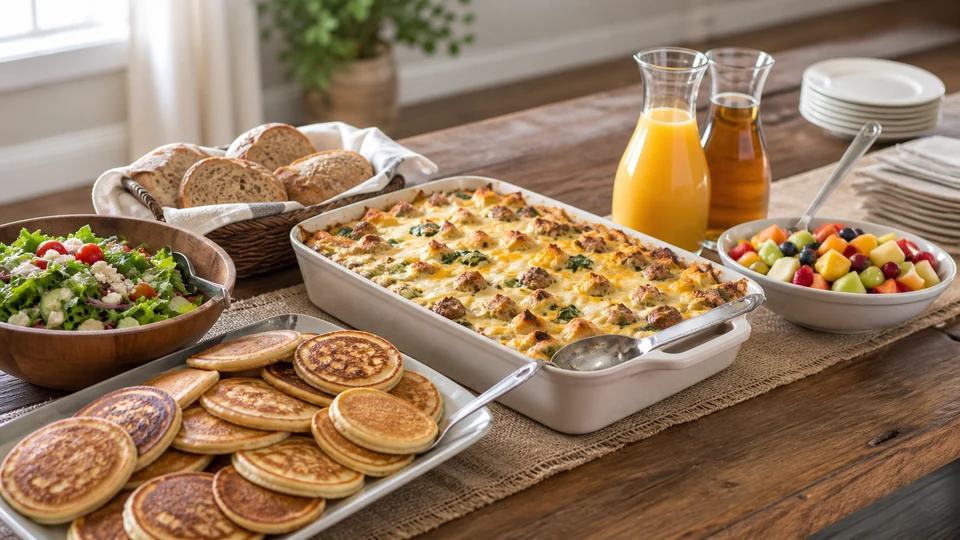
This is an event-planning framework, not a tested menu or universal serving formula. Pancake World opens the wider brunch collection.
| Guide sections |
|---|
| Start with the service format |
| Give every dish a job |
| Size from documented yields |
| Remove equipment collisions |
For broader context, continue with American Breakfast: Pancakes, Diner Plates and Brunch.
Start with the service format
Decide seated, buffet or open-house service before choosing dishes. A seated meal can support one timed hot plate; a buffet needs food that portions cleanly and can be replenished; an open house benefits from smaller waves rather than one exposed batch.
Write guest count, arrival window, available seats, serving surfaces, oven racks, burners, refrigeration and helpers. These limits shape the menu more reliably than a themed photograph.
Give every dish a job
Use functional categories: hot anchor, secondary substantial item, fresh or acidic counterpoint, bread or griddle item, beverage and optional sweet finish. Two dishes should not compete for the same equipment in the final minutes.
A casserole might own the oven while fruit and salad remain cold. Pancakes can be the visible hot anchor only when staffing and griddle capacity support continuous batches. These are planning patterns, not tested combinations.
Size from documented yields
Take yield and pan size from each complete source. Decide whether the item is a main portion, side portion or tasting portion within this menu. Do not apply an invented “pieces per person” rule to foods of different size and importance.
If scaling is undocumented, prepare repeated standard batches rather than deepening one pan. Record a modest reserve for expected variation, but do not treat more food as a substitute for a serving plan.
Remove equipment collisions
Draw a final-hour grid with rows for oven, stovetop, griddle, counter, refrigerator and serving area. Place each recipe's verified steps. Any two tasks occupying the same resource at the same time create a collision.
Resolve collisions by choosing a cold dish, moving a formula-approved preparation earlier, changing the menu or adding equipment that can be used safely. Do not invent overnight holding for a recipe that does not authorize it.
Plan guest fit visibly
Collect dietary needs before finalizing. Verify current packages and complete formulas; do not infer vegan, gluten-free or allergen-safe status from a dish name. Label the intentional major ingredients and provide separate utensils. Cross-contact controls must match the actual people and kitchen.
Offering several dishes does not guarantee everyone has a substantial option. Map each guest requirement to a full meal path rather than a garnish or fruit alone.
Control buffet exposure
Cook foods to the applicable safe endpoint, then serve promptly or use equipment capable of controlled holding. Put out smaller replenishable quantities when that suits the format. Track when perishables leave temperature control and keep reserve dishes under appropriate conditions.
Plan leftovers before service: clean containers, refrigerator space and a decision time. Food with an uncertain holding history is not rescued by later refrigeration.
A three-menu decision test
Draft three versions: oven-led, griddle-led and mostly make-ahead/cold. Score each for equipment fit, documented yields, guest coverage, final-hour labour, holding and cleanup. The winning menu is the one that fits this event with the fewest unsupported assumptions.
Frequently asked questions
How many dishes does a crowd brunch need?
There is no universal count. Cover the required meal roles without duplicating equipment and labour.
Can every casserole be assembled overnight?
No. Use advance assembly only when the exact recipe documents it.
Should pancakes be cooked ahead?
Only under a complete method that preserves acceptable quality and safe handling. Otherwise make them the staffed hot anchor or select another format.
Explore related Pancakes World guidance on American Pancakes, Maple Syrup, and Maple Syrup Pancakes.
Sources and editorial references
- USDA FoodData Central, ingredient definitions and composition records:
https://fdc.nal.usda.gov/ - FoodSafety.gov, food-safety charts:
https://www.foodsafety.gov/food-safety-charts - U.S. Food and Drug Administration, food labeling and nutrition information:
https://www.fda.gov/food/nutrition-food-labeling-and-critical-foods