Best brunch egg casserole
At Pancakes World, the best brunch egg casserole is the complete tested recipe that fits your service plan, not the one with the loudest superlative. Choose a bread-based strata when overnight soaking and soft layered texture suit the meal; a potato or vegetable casserole for a substantial slice; a crustless frittata when you want a shallower, faster-cooking form; or individual egg portions when clean serving matters most. Verify the documented yield, pan size, make-ahead limits and reheating method before buying ingredients. Favor one oven task, use a thermometer rather than color alone, check every meat, dairy and packaged ingredient for the guests’ restrictions, and plan safe holding before the casserole enters the oven.
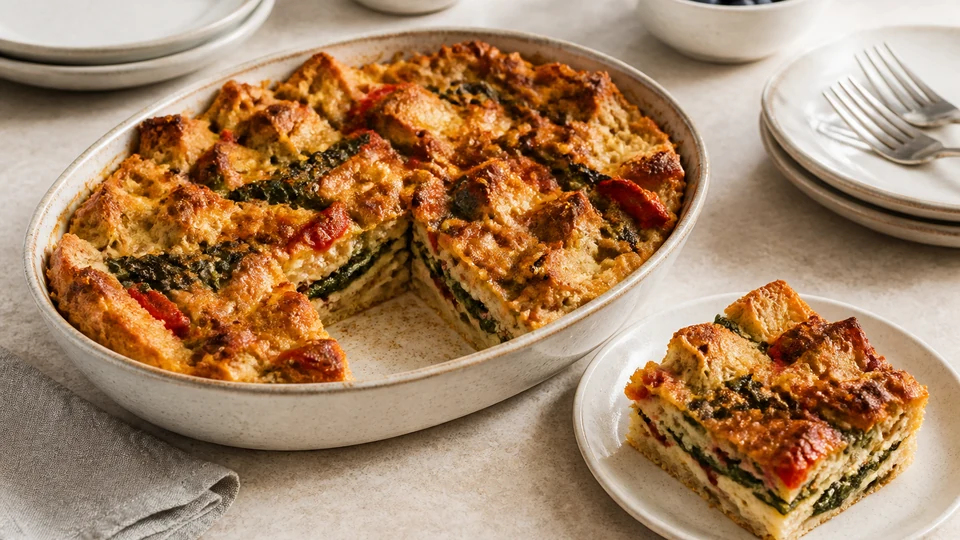
This is a source-selection and service guide, not a tested Pancake World egg-casserole recipe. The pancake science hub covers how ingredients and heat shape breakfast batters, while Pancake World opens the full collection.
For broader context, continue with American Breakfast: Pancakes, Diner Plates and Brunch.
What “best” should mean
An egg casserole can be excellent in one setting and wrong in another. A bread-heavy overnight strata may solve a morning schedule but exclude a guest who avoids gluten. A vegetable frittata may give crisp edges and a short ingredient list, yet it may not offer the deep, scoopable texture someone expects from a casserole. A sausage-and-potato bake can feel substantial but creates more ingredient, allergen and cooking-temperature checks.
Replace a vague ranking with seven fit tests:
- Form: strata, deep casserole, crustless frittata or portioned egg bake.
- Yield evidence: the complete source states the pan and servings.
- Schedule: same-day, formula-approved overnight assembly or reheating.
- Kitchen fit: the dish fits the available pan, oven rack and serving window.
- Guest fit: ingredients and cross-contact controls match the actual group.
- Doneness evidence: the center can be checked with a food thermometer.
- Service behavior: it slices, scoops or portions in the way the host needs.
A recipe that passes all seven is a defensible choice. This page does not name a universal winner because the decision changes with the meal.
Distinguish the main casserole families
Recipes that appear together in search results can behave very differently. Identify the family before comparing ratings, photographs or ingredient lists.
Bread-based strata
A strata uses bread to absorb an egg mixture and create a layered interior. The American Egg Board’s complete Simple Breakfast Strata documents a covered refrigerated rest and a subsequent bake. That makes it a useful reference for the family and for a make-ahead workflow. It does not prove that every bread-and-egg mixture can safely or successfully sit overnight.
Choose this form when soft, custardy bread layers and advance assembly fit the brief. Check bread type, dairy, meat and cheese against guest restrictions. Confirm that the exact source supplies a pan size, rest range, bake instructions and yield. Do not transfer those values to a differently proportioned formula.
Deep potato, bread or mixed casserole
A deep casserole may combine eggs with potatoes, bread, vegetables, cheese and a cooked or uncooked protein. USDA MyPlate hosts a complete layered leftover-turkey casserole with an overnight refrigeration instruction. It demonstrates one documented architecture, not a blank template for arbitrary leftovers.
Deep dishes can be convenient for a group, but depth slows heat movement toward the center. The pan dimensions and ingredient starting temperatures matter. Adding frozen vegetables, changing the protein or doubling the batch can invalidate the original timing. Use the source recipe as written unless a real development test supports the change.
Crustless frittata
Iowa State University Extension’s vegetable frittata is cooked in an oven-safe skillet and finished under a broiler. It is shallower and structurally different from a refrigerated strata. It suits a host who wants a vegetable-forward, sliceable egg dish without a bread layer, but it owns both a burner and the broiler near service.
Do not call a frittata “make ahead” simply because another casserole is. Follow the exact source’s workflow. Check that the cookware is broiler-safe and that the handle can be managed safely.
Individual egg portions
Penn State Extension’s spinach, mushroom and cheese egg bites provide a complete example of a portioned format. Individual cups or bites can reduce cutting and serving mess and can make equal portions easier to see. They also multiply pan cavities, release points and doneness checks.
Choose this form when grab-and-go service matters more than a dramatic central dish. It is not automatically faster; filling many wells and cleaning the pan may take longer than pouring one casserole.
Use a comparison card for every candidate
Do not compare recipes from memory. Create a short card for each serious candidate:
- source organization and exact recipe title;
- casserole family;
- documented pan or vessel;
- documented yield;
- preparation stages;
- allowed advance preparation;
- oven temperature and cooking instructions;
- safe final-temperature requirement for the actual ingredients;
- cooling, storage and reheating instructions;
- intentional major allergens;
- equipment used during the final hour;
- slicing or serving method;
- changes you would need to make.
The last line is often decisive. A candidate that needs four substitutions is no longer the tested recipe you evaluated. Another that works without alteration carries stronger evidence even if its photograph is less striking.
Explore related Pancakes World guidance on American Pancakes, Maple Syrup, and Maple Syrup Pancakes.
Sources and editorial references
A useful recipe source provides a full ingredient list, quantities, pan size, method, time, temperature and yield. It distinguishes optional suggestions from required steps. It also tells you whether refrigeration, freezing or reheating was part of the method.
Reject a candidate for this decision if it offers only:
- a social caption with no complete method;
- a photograph and approximate ingredient list;
- a copied summary missing the original pan and yield;
- an unverified overnight instruction;
- a “bake until done” direction with no useful doneness evidence;
- nutrition values that do not match the displayed formula;
- anonymous substitutions without a test record.
Commercial investigation does not mean buying a product. Here it means investigating the available recipe evidence before committing ingredients and oven time.
Match the recipe to the guest count
Start with the source’s documented yield. Then decide how the casserole functions within the meal: only hot main, one of several mains, or small portion beside other food. Do not invent a universal “eggs per guest” rule because portion size, pan depth, other dishes and appetite vary.
If the documented yield is too small, look for explicit scaling instructions. Otherwise make separate normal batches in the specified pans. Doubling ingredients in one deeper vessel changes heat transfer and can leave the center behind the edges.
If the recipe yield is too large, choose a smaller documented formula rather than halving eggs, leavener or pan area by intuition. A second, cold support dish can also increase menu flexibility without changing the casserole.
Write the serving plan:
- intended number of casserole portions;
- other substantial dishes;
- first serving time;
- likely late arrivals;
- whether the dish will be sliced or spooned;
- the holding method;
- the leftover decision.
The plan makes “best for eight people at one table” visibly different from “best for an open-house buffet.”
Evaluate the pan and depth
Pan area and fill depth influence how quickly the center heats. Match the recipe’s vessel as closely as possible. A smaller pan makes a deeper casserole; a larger pan makes it shallower and can change texture and cooking time.
Before cooking, verify:
- internal dimensions, not only the manufacturer’s volume label;
- oven-safe material and temperature rating;
- whether glass, ceramic or metal is specified;
- whether the dish moves directly from refrigeration to a hot oven;
- headspace for expansion;
- a thermometer access point near the center;
- handles or a stable sheet pan for moving the hot vessel.
Do not assume every glass dish tolerates sudden temperature change. Follow its manufacturer instructions. Do not place a cold vessel under a broiler unless it is explicitly approved for that use.
Choose a texture on purpose
Photographs can hide whether the interior is soft, bread-forward, potato-heavy, dense, airy or wet. Read the formula and method.
For a clean slice, look for a source designed to set in its stated pan and to rest before cutting. For a spoonable casserole, a softer interior may be intentional. For browned edges, a shallow format gives more perimeter relative to the center. For custardy strata, bread hydration and the documented soak matter.
Avoid treating visible browning as proof that the center is safe. Cheese and exposed edges can color before the center reaches the applicable temperature. Conversely, a pale surface does not prove the interior is undercooked. Use the source’s cues plus a clean food thermometer.
Compare ingredient architecture
Classify ingredients by job rather than by how appealing the list sounds.
| Role | Examples in published formulas | Decision question |
|---|---|---|
| Egg base | shell eggs or pasteurized egg product | Does the source specify the form and amount? |
| Liquid | milk or another named liquid | Is it essential to hydration and set? |
| Structure | bread, potatoes or no starch | What texture and guest restriction does it create? |
| Bulk | vegetables, meat or other filling | Is it cooked, drained, thawed or added raw? |
| Fat and richness | cheese, dairy or cooking fat | Can it be changed without losing the tested formula? |
| Flavor | herbs, spices, salsa or aromatics | Does it add liquid, salt or allergens? |
| Surface | cheese, crumbs or garnish | Does it affect final bake stages? |
The table is a reading tool, not a build-your-own recipe. Arbitrary combinations change water release, salt, density and heat movement.
Vegetables with high water content may need a documented pre-cook or drain step. Frozen potatoes or vegetables may lower the mixture’s starting temperature. Raw sausage or poultry introduces a higher safety requirement and must be handled exactly as the recipe directs. Leftover meat is usable only when its prior handling is known and the complete recipe supports it.
Treat substitutions as recipe development
Swapping one cheese for another may alter melt, salt and moisture. Replacing dairy milk with a plant beverage can change solids, sugar and flavor. Removing bread changes the structural category. Adding more vegetables changes water and pan depth.
If a guest needs a modification, first seek a complete tested recipe already designed for it. This is often safer and more predictable than converting a five-star conventional recipe.
When a change is unavoidable:
- State the function of the removed ingredient.
- Choose one evidence-based replacement.
- Keep all other variables stable.
- Record exact product, amount, pan, time and center temperature.
- Judge the result after the full cooling or resting stage.
- Do not publish the source’s yield, timing or nutrition as though unchanged.
This page has no project test record, so it supplies no substitution ratios or new casserole formula.
Decide whether make-ahead is truly supported
“Breakfast casserole” is often associated with overnight assembly, but the label is not enough. Overnight storage must appear in the exact recipe or in a validated food-safety method for that formula.
Check:
- whether the source refrigerates the assembled dish covered;
- the allowed minimum and maximum rest;
- whether ingredients are cooled before assembly;
- whether the pan can move safely from refrigerator to oven;
- whether the bake begins cold or after a stated stand;
- whether toppings are added before or after refrigeration;
- whether bake time assumes the chilled starting temperature.
The American Egg Board strata and USDA MyPlate casserole each document a refrigerated stage in their own methods. That evidence remains attached to those recipes. It does not authorize leaving another egg mixture overnight.
If no make-ahead instruction exists, choose a different formula or prepare only clearly permitted components. Do not mix raw eggs with fillings and hold them based on guesswork.
Verify egg and ingredient safety
FoodSafety.gov advises buying refrigerated eggs, keeping them cold, discarding cracked eggs and cleaning hands and items that contact raw egg. University of Minnesota Extension likewise emphasizes refrigeration, sanitation and thorough cooking.
Set up a raw-egg zone away from fruit, bread and other ready-to-eat foods. Crack eggs into a separate bowl so a shell problem does not contaminate the full mixture. Wash hands with soap and water after handling shell eggs. Clean bowls, whisks, counters and handles that received splashes.
If a component such as a sauce will remain raw or lightly cooked, FoodSafety.gov recommends pasteurized eggs or egg products. An egg casserole itself should be fully cooked; a raw-egg hollandaise or dressing on the side creates a separate risk.
Keep meat preparation separate. Use different boards and utensils, or clean and sanitize between tasks. Do not use a spoon that touched raw egg to serve the finished casserole.
Use the applicable safe temperature
FoodSafety.gov’s current chart lists 160°F (71°C) for egg dishes such as frittata and quiche. It lists 165°F (74°C) for meat and meatless casseroles, casseroles containing meat or poultry, and leftovers. Because recipe labels can overlap, identify the food and ingredients conservatively and follow the complete source plus the applicable federal category. When in doubt about classification, 165°F for a casserole is the clear federal casserole value.
Insert a clean food thermometer into the center or thickest part without touching the pan. Check more than one location in a large or uneven dish. Visual firmness, a clean knife or browned cheese may be useful quality cues in a recipe, but they do not replace the thermometer for safety.
If a recipe contains poultry, ground meat or sausage, follow the stricter applicable requirements for those ingredients and the whole casserole. Do not partially cook meat, pause and finish later unless an authoritative method explicitly controls the process.
Build a backward production plan
Anchor the schedule to the chosen recipe, not a generic timeline.
At service
The center has reached the applicable safe temperature. The recipe’s rest has been observed. A clean serving utensil is in place. The first portion is served promptly or the dish enters controlled hot holding.
Before service
The casserole bakes on its reserved oven rack. A food thermometer, heat-safe landing place and timer are ready. Cold side dishes remain refrigerated.
Before baking
Complete only the source-approved assembly steps. If the dish was refrigerated, follow its instruction for uncovering, standing or baking from cold. Do not use a fixed time borrowed from another pan.
Earlier preparation
Cook, drain and cool fillings exactly as the recipe requires. Prepare vegetables with clean equipment. Retain packages for allergen review. Label the assembled dish with recipe name and planned bake time.
Shopping stage
Confirm pan, yield, egg quantity, product sizes and every dietary restriction. Avoid buying a substitute before confirming that the recipe supports it.
One written page is enough. The value is removing decisions from the final hour.
Plan the rest of the brunch around the oven
An egg casserole usually owns the oven. Choose sides that do not need the same rack or final temperature.
Useful low-conflict pairings include fruit, a chilled salad, bread that can be served without last-minute toasting, or pancakes cooked on a griddle after the casserole is resting if staffing allows. These are editorial menu ideas, not tested combinations.
Avoid pairing the casserole with another large bake that must finish simultaneously. If roasted potatoes are essential, choose a casserole formula that incorporates potatoes or prepare a cold side instead. Move coffee and beverage service away from the oven path.
For a mixed menu, label meats, dairy, gluten and other major allergens. Give each dish its own utensil. A vegetarian casserole can receive meat residue from a shared spoon; a gluten-free recipe can receive bread crumbs at the buffet.
Score the finalists
After factual screening, score the remaining recipes from zero to two for your event:
- schedule fit;
- equipment fit;
- guest fit;
- documented yield fit;
- serving fit;
- substitution burden;
- holding and leftover fit.
Zero means poor fit or missing evidence, one means workable, and two means strong fit. Disqualify any candidate that lacks essential safety, pan or method evidence instead of allowing a high aesthetic score to compensate.
Keep the scoring local to your event. Do not publish it as a universal recipe ranking. A high score means “best supported for this brunch,” not “best egg casserole on the internet.”
Interpret ratings and comments cautiously
Reader ratings can reveal recurring questions, but they do not replace the published formula or a test in your kitchen. A high average may combine reviews of different recipe versions. Comments may describe undocumented substitutions, different pans or ovens, and a successful change for one reader does not establish a dependable method for everyone.
When comments are available, use them to identify issues to investigate:
- repeated confusion about pan dimensions;
- uncertainty about whether the filling starts cooked;
- reports of a wet center after an ingredient change;
- questions about baking from refrigerated temperature;
- requests for dairy-free, gluten-free or meatless variants;
- trouble releasing individual portions;
- inconsistent statements about freezing or reheating.
Then return to the authoritative recipe and resolve each point there. If the source does not answer an important production question, choose another recipe or run a controlled test before serving it to a group. Do not average commenters’ suggested times into a new direction.
The publication date also needs context. Egg safety guidance and package formulations can change, while a sound culinary method may remain useful. Recheck safety claims against current federal guidance and ingredients against current packages. Preserve the recipe source date in your planning notes so a future review can distinguish the method you evaluated from a later revision.
Finally, separate preference from failure. One reviewer may want more cheese and another less bread; that does not show the formula is defective. Reports of an unsafe center, unclear raw-meat handling or a missing pan size are evidence gaps and deserve greater weight than flavor preference.
Serve and hold safely
Serve cooked egg casserole promptly. If it must wait, use equipment capable of maintaining safe hot holding and verify with a thermometer. University of Minnesota Extension gives 135°F as a minimum hot-holding point in its home egg guidance; commercial requirements may be governed by local code. USDA FSIS consumer guidance commonly uses 140°F for hot buffet food. Choose the applicable rule for the setting and do not rely on a warm oven dial without measurement.
For a buffet, place out a modest first quantity if the format permits and keep reserve portions safely hot. Use a clean utensil and replace the serving vessel rather than mixing a new batch into food that has been sitting.
Do not leave perishable casserole at room temperature for an open-ended brunch. Track when it leaves temperature control and refrigerate or discard it under current guidance.
Cool, store and reheat leftovers
FoodSafety.gov’s cold-storage chart gives baked egg casseroles a refrigerator range of three to four days and a freezer quality range of two to three months when continuously frozen. Those values assume safe prior handling. A dish that sat out too long is not rescued by refrigeration.
USDA FSIS advises dividing large amounts into shallow containers for rapid cooling, covering leftovers and refrigerating promptly. Do not put one very deep, tightly covered hot casserole into an overcrowded refrigerator and assume the center cools quickly. Portion it with clean tools if needed.
Reheat leftovers to 165°F (74°C), checking more than one location. Covering can support even heating, while microwave portions should be rotated or stirred when the form allows. Do not repeatedly reheat the full casserole if only one portion is needed.
Freezing is partly a quality decision. Egg, bread, potatoes, vegetables and dairy can change texture differently. Use the selected recipe’s freezing instructions when available; otherwise do not promise that it “freezes beautifully.”
Common selection mistakes
Choosing by photograph alone
A browned top does not reveal pan depth, center set, yield or make-ahead evidence. Read the full method.
Treating all casseroles as interchangeable
Strata, frittata, deep potato bake and egg bites have different production and service needs. Compare within the desired family first.
Doubling in one pan
More filling in the same footprint changes depth and cooking. Use documented scaling or separate pans.
Assuming overnight is always better
Only use an overnight step when the exact tested recipe supports it. Some formulas release water, lose leavening or create avoidable safety uncertainty.
Adding raw vegetables without checking the method
Vegetables can release moisture and change density. Follow documented pre-cooking or draining.
Using color as the safety test
Check the center with a thermometer under the applicable temperature category.
Ignoring the buffet after baking
Safe cooking is only one stage. Plan holding, room-temperature exposure and leftovers.
Carrying over nutrition after changes
A substituted cheese, milk, meat or vegetable changes the calculation. This page provides no nutrition totals.
Frequently asked questions
What type of egg casserole is best for brunch?
Choose strata for documented overnight bread layering, a deep casserole for a substantial scoop or slice, frittata for a shallow crustless format, or egg bites for individual portions. The service plan determines the best fit.
Can every egg casserole be made the night before?
No. Use overnight assembly only when the complete recipe explicitly includes it and specifies refrigerated handling.
How do I know the center is done?
Use the recipe’s quality cues and a food thermometer. FoodSafety.gov lists 160°F for egg dishes such as frittata and quiche and 165°F for casseroles; ingredients can impose the stricter category.
Can I double a casserole?
Only follow documented scaling. Making two standard pans is more evidence-aligned than doubling the depth in one vessel.
Can I substitute plant milk?
Not with guaranteed results. Milk can affect moisture, solids, flavor and set. Select a tested dairy-free recipe or test and document the change.
Is a vegetable casserole vegetarian?
Only if every ingredient, including stock, cheese, cooking fat, seasoning and topping, meets the stated standard. Verify current packages.
Is egg casserole gluten-free?
Not automatically. Strata contains bread, and processed fillings or toppings may contain wheat. Use a complete suitable recipe and manage cross-contact.
How long can leftovers stay refrigerated?
FoodSafety.gov lists three to four days for baked egg casseroles under safe refrigeration. Discard food with an unsafe or uncertain holding history sooner.
Which recipe wins this comparison?
There is no universal winner. Fill out the comparison card and choose the formula with complete evidence and the strongest fit for your pan, schedule, guests and service.
Final decision checklist
The selected recipe belongs to the intended casserole family, comes from a complete authoritative source, fits the available pan and oven, states a useful yield, and requires no unsupported substitutions. Its make-ahead step is explicit, its center can be measured, and its serving and leftover plan is safe. That is a better definition of “best” than a copied rating or an unverified promise.
- American Egg Board, “Simple Breakfast Strata”:
https://www.incredibleegg.org/recipe/simple-breakfast-strata/ - USDA MyPlate, “Leftover Turkey Casserole”:
https://www.myplate.gov/es/recipes/cazuela-de-sobras-de-pavo - Iowa State University Extension, “Vegetable Frittata”:
https://spendsmart.extension.iastate.edu/recipe/vegetable-frittata/ - Penn State Extension, “Spinach, Mushroom, and Cheddar Cheese Egg Bites Recipe”:
https://extension.psu.edu/spinach-mushroom-and-cheddar-cheese-egg-bites-recipe/ - FoodSafety.gov, “Cook to a Safe Minimum Internal Temperature”:
https://www.foodsafety.gov/food-safety-charts/safe-minimum-internal-temperatures - FoodSafety.gov, “Salmonella and Eggs”:
https://www.foodsafety.gov/blog/salmonella-and-eggs - FoodSafety.gov, “Cold Food Storage Chart”:
https://www.foodsafety.gov/food-safety-charts/cold-food-storage-charts - University of Minnesota Extension, “Purchase, store, and prepare: Eggs”:
https://extension.umn.edu/preserve-your-own-food/eggs - USDA Food Safety and Inspection Service, “Leftovers and Food Safety”:
https://www.fsis.usda.gov/food-safety/safe-food-handling-and-preparation/food-safety-basics/leftovers-and-food-safety