Best brunch at home
At Pancakes World, the best brunch at home is a meal the host can finish and enjoy: one substantial make-ahead dish, one fresh or cold dish, one bread or sweet item, and drinks that do not compete for last-minute attention. Choose a baked egg dish for a seated group, a taco or toast bar for flexible preferences, pancakes only for a small crowd that can eat immediately, or a cold spread when the kitchen is limited. Confirm guest needs before planning, use tested recipes with stated yields, schedule backward from serving time, and keep hot foods above 140°F, cold foods below 40°F, or apply the two-hour limit.
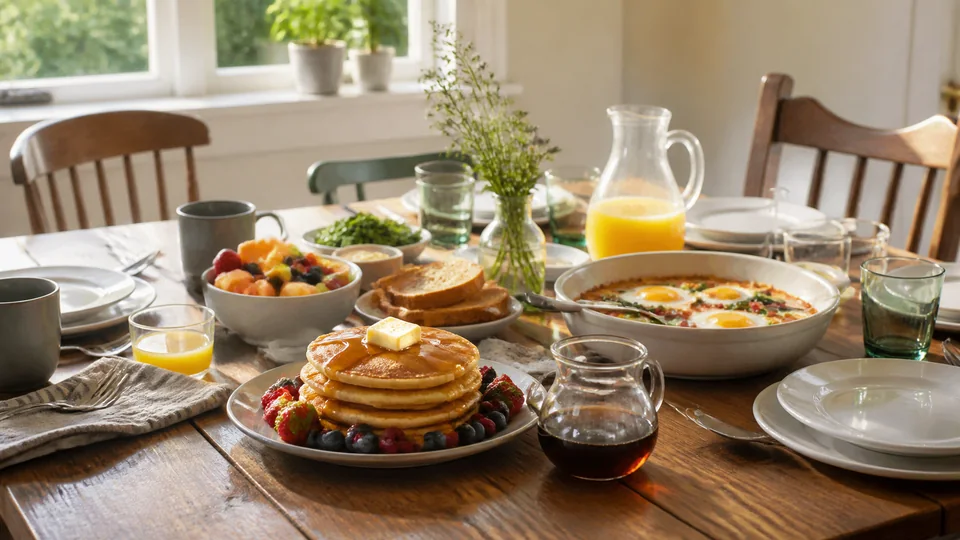
“Best” is not one famous dish. It is the brunch design that fits the guest count, table, appliances, dietary needs and amount of cooking you want to do while people are present. This guide is a planning and comparison tool rather than an invented menu test. Explore the brunch hub for more formats, or visit Pancake World for the full collection.
For broader context, continue with American Breakfast: Pancakes, Diner Plates and Brunch.
Start with five decisions
Before selecting recipes, write down five answers.
- How many people are actually coming?
- Will everyone sit and eat together, or arrive across a window?
- What is the kitchen bottleneck: oven, burners, refrigerator, counter space or cook attention?
- Which allergies, dietary patterns and strong dislikes must the menu accommodate?
- How much work can be completed before guests arrive?
These questions prevent a menu from becoming a collection of attractive but incompatible dishes. Pancakes, omelets, waffles and poached eggs all demand immediate attention. A menu containing all four asks the cook to operate a short-order restaurant. A baked casserole, prepared fruit and purchased bread distribute the work across time.
University of Illinois Extension’s event-planning curriculum recommends deciding the menu, listing what each recipe requires, reading preparation and cooking times, and determining which dishes can be made in advance. That simple sequence is the backbone of a manageable home brunch.
Choose the service style first
Seated, one-time brunch
Everyone eats within a narrow period. This format favors a hot centerpiece that portions cleanly: an egg bake, strata, frittata, breakfast casserole or baked French toast from a complete recipe. Add fruit or salad, bread and drinks that are ready before the hot dish leaves the oven.
The advantage is temperature and presentation. The disadvantage is timing. Late guests can disrupt a dish that should be served promptly, so communicate the eating time rather than only the arrival time.
Open-house or drop-in brunch
Guests arrive over an hour or more. Avoid foods that peak for five minutes. Use smaller pans, cold components and batches that can be replaced safely. A toast board, chilled yogurt station, baked goods, fruit, and one replenished hot item can work better than a single large platter.
Do not let “casual” become uncontrolled holding. Track when each perishable item leaves refrigeration or hot holding. FoodSafety.gov recommends smaller portions for cold service because less food sits on ice or runs against the room-temperature clock.
Buffet brunch
A buffet reduces table serving but creates temperature, traffic and utensil questions. Arrange plates first, food next, condiments after their related dish, and drinks on a separate surface. Provide one utensil per item and labels before the line begins.
If food will remain out beyond two hours, it needs safe holding: hot food above 140°F or cold food below 40°F. A decorative tray is not temperature control. Use working equipment, monitor it and replenish in manageable batches.
Cook-together brunch
The cooking is part of the gathering. Pick one participatory task, such as shaping biscuits, filling tortillas or finishing toppings. Complete the sanitation-sensitive and slow work in advance. Guests should not have to chop raw chicken beside a ready-to-eat fruit platter.
Choose a recipe with clear roles. Ambiguous group cooking causes missing ingredients, uneven portions and delayed eating. Print or display the full method, assign work surfaces and keep one person responsible for the final food-safety check.
Small brunch for two to four
This is the right scale for pancakes, waffles, crêpes, omelets or toast cooked to order. The cook can make a few portions without a long queue. Prepare fruit, drinks, toppings and table settings first so only one hot task remains.
Scaling a twelve-serving casserole down is not always straightforward because pan depth and bake time change. Use a recipe developed for the needed yield or plan leftovers safely.
Pick one anchor, not three
The anchor is the dish that supplies the meal’s structure and consumes the main appliance or block of attention.
Baked egg or breakfast casserole
Choose this for a group eating together. It provides defined yield, can combine vegetables and other components, and uses the oven instead of continuous stovetop labor. Its weaknesses are oven occupancy, cooling time and dietary inflexibility once all ingredients are combined.
Illinois Extension’s breakfast casserole illustrates a complete source recipe: it specifies 12 servings, stages sausage and vegetables before assembly, uses a 13-by-9-inch dish, and gives a thermometer endpoint of 165°F for that particular mixture. Those details demonstrate what a usable group recipe looks like. They should not be copied onto a different casserole without checking its ingredients and directions.
Pancakes or waffles
Choose these for a small group, a cook who enjoys live service, or a kitchen with help. Their strength is customization. Their weakness is throughput: one pan or iron produces only a few portions at a time.
Calculate the cooking cycle before committing. If an appliance makes two waffles every six minutes, a large party will wait unless multiple appliances operate safely. Holding can soften texture, so a bake-ahead anchor may be more hospitable for a crowd.
Frittata, omelet or skillet eggs
A frittata serves several people with less last-minute handling than individual omelets. Omelets suit a small seated brunch. Scrambled eggs can scale, but a deep pan can cook unevenly and prolonged holding reduces quality.
Use a food thermometer and the correct category. FoodSafety.gov lists 160°F for egg dishes. A casserole containing meat or poultry may have a 165°F endpoint. Follow the tested recipe and the safe-temperature table for the actual food.
Breakfast tacos, toast or grain-bowl station
Choose a station when guests have varied preferences and the components can be safely held. Separate toppings make exclusions visible, but they also multiply bowls, labels and cross-contact paths.
Limit the station to a coherent base, two main fillings, three or four finishes and one sauce. Twenty toppings look generous but slow the line and create leftovers. Keep cold ingredients cold and hot fillings hot, and use separate utensils.
Cold brunch spread
A cold menu solves burner and oven pressure. Yogurt, fruit, chilled cooked grains, smoked fish, cheeses, breads and prepared salads can be assembled thoughtfully. It does not solve refrigeration. Measure available shelf space and keep foods below 40°F until service.
Cold food still needs sequence: wash produce, prepare it on a clean surface, cover it, and return it to refrigeration. Bring out smaller platters rather than the whole quantity.
Use a four-role menu
A practical home brunch has four roles rather than a fixed number of recipes.
Role 1: substantial anchor
Examples include a casserole, frittata, savory strata, pancakes, a breakfast-taco filling or a chilled grain-and-protein dish. Use one complete recipe with a stated yield.
Role 2: fresh contrast
Fruit, a green salad, sliced vegetables or a bright vegetable side prevents the table from feeling uniformly rich or soft. Prepare only as early as the ingredient tolerates. Cut melon and other perishable prepared produce must remain chilled.
Role 3: bread or sweet element
Muffins, scones, toast, coffee cake or a simple loaf add comfort and can absorb late arrivals. Purchased bread is a legitimate workload decision. If the anchor is already bread-heavy, such as baked French toast, choose a small sweet or omit this role.
Role 4: drinks
Water should be visible and easy to refill. Coffee and tea need cups, milk or alternatives, sweeteners and waste handling. Juice or a batch drink adds refrigerator demand. A cocktail adds glassware, ice, alcohol planning and a nonalcoholic equivalent.
Do not treat drinks as an afterthought. Moving the beverage station away from the food line reduces congestion and keeps guests from reaching over serving dishes.
Compare four dependable menu models
Model A: make-ahead oven brunch
- baked egg, vegetable or breakfast casserole;
- prepared fruit;
- muffins, toast or quick bread;
- coffee, tea and water.
Best for: six or more guests eating together.
Main constraint: the oven and the anchor’s verified assembly schedule.
Preparation logic: assemble only if the recipe authorizes advance refrigeration. Prepare fruit and serving pieces before reheating or baking. Time the casserole to rest only as the recipe directs.
Why it works: most labor occurs before arrival, and the host handles one major hot item.
Model B: small pancake table
- pancakes from a tested batter formula;
- fruit prepared before cooking;
- one egg, yogurt or other savory/protein partner;
- a limited set of toppings.
Best for: two to four people who eat at once.
Main constraint: pan capacity and cook attention.
Preparation logic: set the table, portion toppings and warm plates if desired before mixing or cooking. Keep raw batter handling separate from ready-to-eat fruit.
Why it works: diners receive the pancakes in their best service window rather than after a long hold.
Model C: flexible toast or taco bar
- bread, tortillas or another defined base;
- one hot egg, bean or meat filling;
- one cold filling;
- a few vegetables and finishes;
- fruit and drinks.
Best for: varied preferences or staggered arrivals.
Main constraint: safe holding and many small dishes.
Preparation logic: label allergens, use individual utensils, stage cold items over ice when necessary, and refill rather than overloading the display.
Why it works: guests compose their own plates without requiring the cook to prepare custom omelets.
Model D: no-cook or mostly purchased brunch
- bakery bread or pastries;
- yogurt, cheese or another chilled partner;
- fruit or vegetables;
- a prepared spread or dip;
- drinks.
Best for: a limited kitchen, travel, or a host prioritizing conversation.
Main constraint: refrigeration, packaging and presentation.
Preparation logic: choose items with clear storage and allergen information, decant only close to service, and preserve labels for reference.
Why it works: buying the labor does not remove hospitality. Thoughtful quantities, proper temperature and a coherent arrangement matter more than cooking everything yourself.
Plan quantities without guessing
Start with the yield on each complete recipe. Do not equate pan size with guest count. A 13-by-9-inch dish can produce different numbers of portions depending on depth and the author’s definition.
Create a simple worksheet:
| Item | Recipe yield | Planned portion | Guests served | Make-ahead status | Serving vessel |
|---|---|---|---|---|---|
| hot anchor | use source | full or small | calculate | source-approved only | preheated or insulated |
| fresh dish | measured bowl | scoop or piece | calculate | short advance | chilled tray |
| bread/sweet | count or slices | one unit | calculate | usually possible | basket or board |
| drinks | cup-based plan | cup/glass | calculate | stage supplies | separate station |
Then ask whether guests will take every item. If the menu contains several substantial foods, full recipe portions of each will create excess. Use smaller service portions while keeping the recipe’s total yield honest.
Add a modest buffer for uncertain attendance, not a second complete meal. Keep unopened packaged items in reserve when possible. They preserve better than food already exposed on a buffet.
For a potluck, assign categories and quantities rather than saying “bring anything.” Otherwise four guests may bring pastries and no one brings fruit or a savory dish. Ask contributors to provide ingredient and allergen information and to explain storage needs.
Work backward from the meal
Suppose brunch is served at 11:00 a.m. Build the schedule in reverse.
At serving time
The hot anchor is at its safe temperature and intended rest point. Cold dishes are placed in small batches. Coffee is brewed, water is available and serving utensils are present.
Thirty minutes before
Finish only tasks that genuinely improve at the end: baking the anchor, cooking pancakes for a small group, dressing a salad, slicing delicate fruit or setting a hot garnish. Do not begin washing a sink full of produce now.
One hour before
Clear the sink, empty the dishwasher, set out labels, place trash and recycling access, check the thermometer and prepare safe holding equipment. Chill cold serving dishes if that supports the plan.
The previous evening
Complete source-authorized assembly, bake foods meant to hold overnight, wash and dry durable produce, set the table and group recipe ingredients. Do not refrigerate an assembled dish overnight unless its tested method says to do so.
Two or more days before
Confirm attendance and dietary needs, choose recipes, shop for shelf-stable items and check equipment. A brunch plan should not discover on the morning that the casserole dish is too large for the refrigerator.
This reverse schedule exposes collisions. If three dishes require the oven at different temperatures at 10:30, change the menu rather than relying on optimism.
Protect the kitchen bottleneck
Oven
Choose one primary oven dish. If bread needs warming, do it before or after the anchor only when safe and texturally appropriate. Check pan dimensions, rack position and preheating time.
Stovetop
Reserve one burner for a late correction or drink water. Avoid planning a sauce, eggs, potatoes and pancakes simultaneously unless several competent cooks have assigned stations.
Refrigerator
Measure shelves before shopping. Large casserole dishes, fruit trays, beverage pitchers and dairy can occupy more room than ingredients in packages. Use shallow covered containers where appropriate and leave room for safe air circulation.
Counter
Separate raw preparation from ready-to-eat assembly. Penn State Extension’s recipe-safety guidance begins with clean counters and equipment, handwashing for 20 seconds, and rinsing fresh produce under cold running water. Build those controls into the schedule.
Host attention
This is the bottleneck most plans ignore. A dish that needs constant flipping, a custom coffee order and a garnish station all draw from the same person. Spend attention on one visible element and simplify the rest.
Handle dietary needs with structure
Ask guests directly rather than guessing. Separate allergy from preference and clarify what the person can safely eat. A vegetarian menu may contain eggs or dairy; a vegan menu does not. “Gluten-free ingredients” do not guarantee protection from cross-contact.
Use one of three strategies:
One inclusive anchor
Select a tested recipe designed for the relevant needs and let most guests eat the same main dish. This reduces utensils and confusion.
Two clearly separated anchors
Prepare a standard dish and a distinct alternative using separate tools and controlled surfaces. Label both. This can work when cross-contact risk is understood and managed.
Modular assembly
Serve a base with separated toppings. This helps preferences but is not automatically allergy-safe; shared spoons migrate, crumbs spread and hands touch multiple containers.
Do not perform structural recipe substitutions on event morning. University of Minnesota Extension notes that eggs serve moisture, binding and leavening roles in baking, so no single replacement works identically in every product. Choose a formula already built for the change.
Eggs, sauces and safe doneness
Eggs appear in casseroles, quiches, French toast, pancakes, hollandaise-style sauces, dressings and baked goods. Their role and safety control differ by preparation.
FoodSafety.gov lists 160°F for egg dishes. It lists 165°F for poultry and for leftovers being reheated. A mixed casserole may need the higher category-specific temperature, as the Illinois Extension breakfast casserole demonstrates.
For sauces or dressings that would otherwise use raw or undercooked egg, University of Minnesota Extension recommends pasteurized eggs or a validated heating method. Do not serve an improvised raw-egg sauce to a group. Keep prepared egg-based sauces cold when the source requires it.
Check temperature in the appropriate location with a food thermometer. Surface browning, bubbling edges or a clean knife can be quality cues in a source recipe, but appearance alone does not replace a required safety endpoint.
Run the buffet safely
Keep hot food hot
Use an appliance or holding system designed for the task and keep food above 140°F. Preheat holding equipment according to its instructions; a cold slow cooker is not an instant warmer. Stir foods when appropriate to distribute heat, and verify rather than assume.
Keep cold food cold
Maintain cold foods below 40°F. Place serving dishes over ice and replenish ice as it melts, or bring out a small bowl and keep the refill refrigerated. This is especially useful for yogurt, cut fruit, cheese, egg salad and milk.
Apply the time limit when not holding
FoodSafety.gov’s general limit for perishable food at room temperature is two hours, reduced to one hour above 90°F. Start the clock when food leaves safe temperature control, not when the first guest takes a plate.
Avoid topping-up an old tray
Replace the tray or bowl rather than pouring a fresh batch over food that has been sitting out. This makes time tracking clearer and gives you a clean vessel.
Label and separate
Show dish names and major allergens. Give every item its own utensil. Keep raw food away from ready-to-eat food during preparation, and keep handles from falling into the food.
Leftovers are part of the menu plan
Decide before brunch which containers will hold leftovers and whether refrigerator space exists. Large deep dishes cool slowly, so divide food into smaller shallow containers when appropriate.
Perishable foods left uncontrolled beyond the safe time limit should be discarded, not saved because they still look or smell normal. Foods held hot above 140°F or cold below 40°F can enter the storage plan, provided their specific guidance allows it.
FoodSafety.gov advises using most cooked leftovers within four days and reheating leftovers to 165°F. The cold-storage chart gives category-specific limits: an egg casserole is not assigned a life by analogy with bread. Label containers with the dish and date.
Send food home only if it can remain safely cold or hot during travel. A guest making several stops cannot reliably protect a perishable casserole without suitable equipment.
What to buy and what to make
Make the item where homemade effort is visible to you and your guests. Buy tasks that are repetitive, equipment-heavy or outside your confidence.
Good candidates to make:
- the main casserole or frittata when you have a trusted recipe;
- a signature pancake or bread when serving a small group;
- fruit or vegetable dishes that benefit from fresh preparation;
- one sauce whose safe method is clear.
Good candidates to buy:
- bread, pastries or bagels when oven capacity is scarce;
- cutlery, ice or beverages that remove logistics;
- a labeled alternative for a dietary need you cannot safely reproduce;
- coffee when the home equipment cannot serve the group.
Buying does not eliminate verification. Read labels, preserve storage directions, protect packaging during transport and ask the producer about perishable fillings. Avoid unsupported “best bakery” or product claims; availability, price and quality change by location and date.
Common brunch plans that fail
Too many live-cooked dishes
Failure: guests wait while the host flips, poaches and toasts.
Correction: retain one live component and convert the rest to make-ahead, cold or purchased formats.
Every dish uses the oven
Failure: temperatures and finish times conflict.
Correction: one oven anchor, one cold side, one room-temperature bread and pre-staged drinks.
The menu ignores arrival pattern
Failure: waffles soften before late guests appear.
Correction: serve a punctual seated meal or choose a format that tolerates replenishment.
Dietary needs are handled by removal
Failure: taking cheese off a finished dish does not make it dairy-free, and picking nuts from a topping does not control cross-contact.
Correction: use a distinct verified option and separate tools.
Buffet time is not tracked
Failure: no one knows whether the quiche has been out for 30 minutes or three hours.
Correction: label deployment time, use smaller batches and maintain safe temperatures.
Recipe yields are assumed
Failure: a pan thought to serve twelve produces eight host-sized portions.
Correction: use the source yield and decide the planned service portion before cooking.
Beverages block the food line
Failure: guests wait for coffee while hot plates cool.
Correction: use a separate drink station with water immediately available.
Sample planning blueprints
These are editorial assembly patterns, not tested composite recipes.
Six-person relaxed brunch
- one six- to eight-serving baked egg dish from a complete source;
- one chilled fruit platter;
- one purchased loaf or six small pastries;
- coffee, tea and water;
- one vegetarian alternative only if the anchor does not already fit.
Schedule: prepare the table and cold components first, bake the anchor last, and sit down together.
Twelve-person family buffet
- one source recipe explicitly yielding twelve portions;
- one large fresh side deployed as two smaller trays;
- twelve to eighteen small bread or sweet portions depending on the rest of the menu;
- hot and cold holding equipment;
- separate beverage station.
Schedule: stage the first half of cold food, record deployment time, keep the refill chilled and transfer leftovers promptly.
Four-person pancake morning
- one tested pancake formula with stated yield;
- one fruit dish completed before batter mixing;
- one simple egg, yogurt or other savory/protein item;
- two or three toppings rather than a full bar.
Schedule: set everything except the pancakes before guests sit. Cook and serve in a short sequence.
Eight-person low-kitchen brunch
- bakery bread or pastries with retained ingredient information;
- chilled yogurt or cheese and a suitable alternative;
- fruit and raw vegetables prepared on clean surfaces;
- one purchased savory item handled by its label;
- cold drinks and delivered coffee if needed.
Schedule: reserve refrigerator shelves, plate in small batches and avoid pretending that no-cook means no food-safety work.
Frequently asked questions
What is the easiest brunch to make at home?
A tested baked centerpiece, cold fruit, purchased bread and pre-staged drinks create a low-attention plan for a seated group. For two to four people, pancakes or eggs cooked to order can be equally manageable.
How many dishes should brunch include?
Four roles are enough: one substantial anchor, one fresh item, one bread or sweet item and drinks. Add another main only for a large group or a dietary need the first cannot meet.
What can be prepared the night before?
Only prepare and refrigerate an assembled dish overnight when its recipe explicitly allows it. Tables, labels, dry ingredients, serving tools and some baked goods can often be staged earlier. Treat cut produce and perishable fillings according to their guidance.
Are pancakes practical for a crowd?
Usually only with enough griddle capacity and help. Calculate portions per cooking cycle. A casserole, sheet-pan format or bread-based centerpiece can serve a larger group with less live labor.
What temperature should an egg casserole reach?
FoodSafety.gov lists 160°F for egg dishes, but casseroles containing meat or poultry may require 165°F. Follow the complete recipe and the category-specific safe-temperature table. The Illinois Extension breakfast casserole cited here specifies 165°F for its mixture.
How long can brunch food stay on the table?
Perishable food can remain at room temperature for up to two hours, or one hour when the temperature is above 90°F. For longer service, keep hot food above 140°F and cold food below 40°F.
How do I keep fruit and yogurt cold?
Serve smaller quantities in dishes set over ice, monitor and replace the ice, and keep refills refrigerated. Replace rather than top up an old bowl.
Should I offer both sweet and savory dishes?
That is a useful way to create contrast, but it need not mean two elaborate mains. A savory casserole with a small pastry, or pancakes with eggs and fruit, can provide both directions.
Is a brunch bar good for allergies?
It can clarify ingredients, but shared utensils and crumbs create cross-contact. A separately prepared and served option is safer when strict avoidance is necessary. Discuss needs with the guest.
How do I make brunch enjoyable for the host?
Protect one hour before serving from unnecessary cooking. Clear the kitchen, choose one last-minute dish, buy one labor-intensive item and assign a trusted guest a non-cooking task such as drinks.
Final host checklist
- confirmed head count and eating time;
- dietary needs clarified directly;
- one service style selected;
- one main kitchen bottleneck identified;
- complete recipes with stated yields chosen;
- make-ahead instructions verified rather than assumed;
- refrigerator, oven and serving vessels checked;
- food thermometer and safe holding equipment ready;
- cold items below 40°F and hot items above 140°F for extended holding;
- room-temperature clock assigned where holding is absent;
- beverage station separated from the buffet;
- leftover containers and refrigerator space prepared.
The best brunch at home is not the one with the most dishes. It is the one in which food reaches the table at the intended temperature, guests can understand their choices, the kitchen has no impossible collision and the host sits down. Choose the service model first, build four useful roles around one anchor, and let reliable recipes supply the quantities and timings.
Explore related Pancakes World guidance on American Pancakes, Maple Syrup, and Maple Syrup Pancakes.
Sources and editorial references
- University of Illinois Extension, “4-H Cooking 301”:
https://extension.illinois.edu/sites/default/files/4h_cooking_301_book.pdf - University of Illinois Extension, “Breakfast Casserole”:
https://extension.illinois.edu/food/recipes/breakfast-casserole - University of Illinois Extension, “Breakfast Recipes”:
https://eat-move-save.extension.illinois.edu/eat/recipes/breakfast - USDA MyPlate, “A Harvest of Recipes with USDA Foods”:
https://www.myplate.gov/sites/default/files/cookbooks/HarvestofRecipes.pdf - FoodSafety.gov, “Food Safety Tips for Catered and DIY Wedding Food”:
https://www.foodsafety.gov/blog/food-safety-tips-catered-and-diy-wedding-food - FoodSafety.gov, “Keeping Hot Foods Hot and Cold Foods Cold”:
https://www.foodsafety.gov/blog/your-holiday-how-keeping-hot-foods-hot-and-cold-foods-cold - FoodSafety.gov, “Cook to a Safe Minimum Internal Temperature”:
https://www.foodsafety.gov/food-safety-charts/safe-minimum-internal-temperatures - FoodSafety.gov, “Cold Food Storage Chart”:
https://www.foodsafety.gov/food-safety-charts/cold-food-storage-charts - University of Minnesota Extension, “Purchase, Store, and Prepare: Eggs”:
https://extension.umn.edu/preserve-your-own-food/eggs - Penn State Extension, “Key Food Safety Instructions for Recipes”:
https://extension.psu.edu/key-food-safety-instructions-for-recipes