Best breakfast meals
At Pancakes World, the best breakfast meals are complete combinations built around a clear purpose: quick food before leaving, a portable travel meal, a warm seated plate, a make-ahead family breakfast, or a flexible guest spread. Choose one anchor, one contrasting side, and one drink before adding extras. Porridge with fruit and yogurt behaves differently from a breakfast sandwich with fruit or a vegetable-and-egg skillet with toast. Judge the meal by preparation order, portion flexibility, temperature control, cleanup, and whether every component earns its place—not by how many dishes appear on the table.
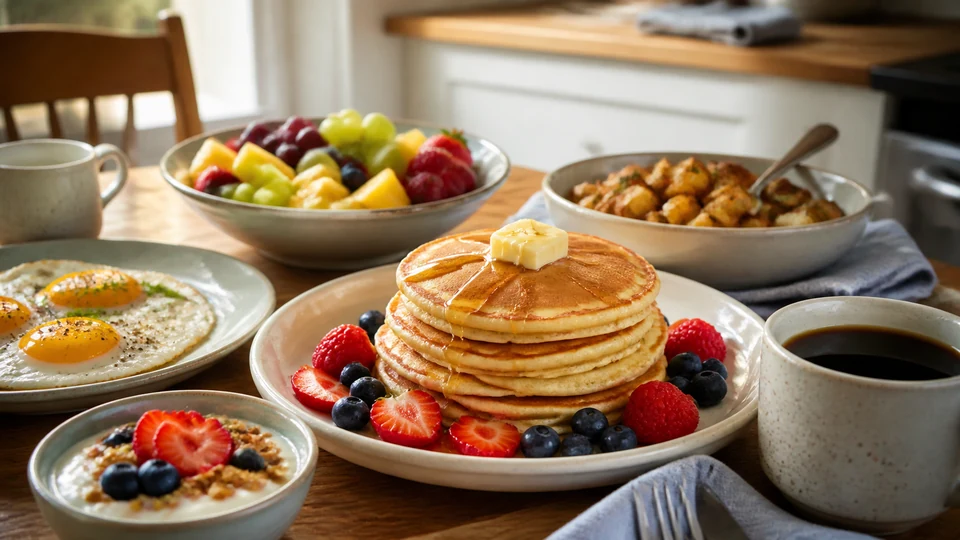
Unlike a list of individual foods, this guide plans combinations and the work needed to serve them. Its examples are editorial assemblies, not tested recipes or nutrition prescriptions. The breakfast hub covers the wider morning-food topic, while Pancake World opens the full editorial collection.
| Guide sections |
|---|
| What makes breakfast a complete meal |
| Start with the morning, not a ranking |
| Choose the anchor by format |
| Add contrast with a purpose |
For broader context, continue with American Breakfast: Pancakes, Diner Plates and Brunch.
What makes breakfast a complete meal
A breakfast becomes a useful meal plan when every component has a job and the jobs fit together. The anchor supplies the main eating experience: it might be porridge, a sandwich, a bowl, pancakes, a skillet, or a tested baked dish. A contrast changes texture, temperature, or food role. The drink belongs in the plan because it affects carrying, table space, and cleanup even when it needs no cooking. Extras should solve a real need, such as letting two people finish the same base differently, rather than simply increasing the dish count.
This definition is intentionally practical. It does not declare one ingredient essential for everyone, assign a universal portion, or promise a health outcome. Culture, appetite, access, allergies, professional advice, and the rest of the day can all change what a person calls complete. The decision that matters here is whether the selected parts form one executable breakfast instead of several unrelated ideas.
Write the purpose in one sentence before selecting food. “A warm meal for two people who have twenty seated minutes” leads to a different combination from “a breakfast that can be carried on a train without assembly.” If the purpose is vague, attractive additions accumulate while the central meal remains unresolved.
Start with the morning, not a ranking
There is no honest universal ranking of breakfast meals because the constraints change. Begin with the fixed facts of the morning. Note where the meal will be eaten, how much active preparation fits, which equipment is actually available, whether anyone must leave at a fixed time, and whether individual needs require labelled alternatives. These facts eliminate unsuitable formats faster than debating favourite dishes.
A rushed weekday usually rewards a meal with few handoffs. One container, one cold pack where required, and no assembly at the destination may be more valuable than a menu with greater variety. A quiet weekend can support separate hot and cold elements because there is time to finish the fragile component last. A family meal needs portion flexibility and a serving order that does not leave one person continually cooking. A guest breakfast also needs visible labels and a plan for replenishment.
Treat these as design conditions, not quality judgments. A bowl is not automatically better than a sandwich, and a cooked plate is not inherently more complete than a cold assembly. The best fit is the combination whose preparation, service, and storage consequences agree with the actual morning.
Choose the anchor by format
The anchor determines most of the workflow, so choose its format before its flavour. A spoonable bowl is easy to vary at the table but awkward in transit unless the vessel seals securely. A handheld sandwich is portable, but wet fillings and crisp bread may need to stay separate until close to eating. A composed plate makes contrasts obvious, yet it requires a seated surface and often creates more dishes. A skillet can combine ingredients efficiently, although it ties service to one hot pan. A baked breakfast may shift work earlier, but only a complete tested recipe can supply its quantities, timing, yield, and doneness instructions.
Ask four questions about the candidate anchor. Can it be made with the equipment available? Can it reach the eater in the intended condition? Can portions expand or contract without rebuilding the whole menu? Does its remainder have a clear plan? If one answer is no, change the format before adding sides.
Names alone do not settle these questions. “Porridge,” “pancakes,” and “breakfast bowl” describe broad families, not one controlled formula. Attach cooking details to the recipe or package actually being used. This page can help choose the meal architecture, but it cannot replace evidence that belongs to a specific preparation.
Add contrast with a purpose
Contrast prevents the meal from feeling like the same food repeated in different shapes. It may be crisp beside soft, cool beside warm, fresh beside cooked, or chewable beside spoonable. The contrast should also fit the schedule. A delicate crisp side adds little value if it must sit in a closed container beside steam. A cold item is useful only when its temperature can remain controlled. A topping bar helps a group only when labels and traffic around it are manageable.
Consider a porridge meal. Fruit, a labelled cultured product, or a seed or nut topping could each provide a different eating experience, but they are not interchangeable for allergies, storage, or personal needs. The practical selection depends on current labels and the intended eater. Keep any crisp topping apart until service. If the meal must travel, prefer a contrast that survives the journey rather than one chosen for a photograph.
For an egg-and-toast plate, vegetables or fruit can add contrast without demanding another elaborate recipe. For a sandwich, a whole fruit or separately packed vegetable side may work better than a moist layer inside the bread. For pancakes, a cool side can change the rhythm of the meal, but every packaged product still needs its own ingredient and allergen review. These are planning examples, not performance claims.
Give the drink a real place
Drinks are often added after the food plan, even though they can create the most troublesome part of a portable setup. Decide whether water, a hot drink, milk, a plant-based beverage, juice, or no separate drink fits the person and setting. Use the current package for ingredient, allergen, and storage decisions. Do not infer suitability from a category name alone.
At home, check whether the drink competes with food preparation for time, kettle space, counter room, or attention. In transit, use a vessel suited to the liquid and carry it separately from papers or electronics. For a shared table, put drinks where refills do not cross the route between hot food and seats. A drink should complete the service plan, not become an unexamined extra task.
Five breakfast situations and how to plan them
A quick meal before leaving
Select an anchor that is already ready or requires one short finishing step. Pair it with a side that needs no knife work at the last minute and choose the drink before packing. A yogurt-and-grain assembly, a sandwich with fruit, or leftovers used within their applicable storage and reheating guidance could each fit, depending on the actual ingredients. Keep wet and dry parts separate when early assembly would damage texture.
The critical test is the departure time. Work backward: eating or packing comes last, hot preparation immediately before that, and retrieval of cold items as late as practical. Remove any garnish whose only contribution is extra handling. If the plan routinely delays departure, it is not the best weekday meal for that household even if every component is appealing.
A portable travel breakfast
Portability changes the selection criteria. The meal must survive movement, be opened without a full table, and leave a manageable remainder. Avoid a container that must stay upright when the journey cannot guarantee it. Keep utensils, napkin, and any separate topping with the food instead of assuming they will be available later.
Choose firm, compact components over an elaborate plated idea. A sandwich-and-fruit combination, a cold grain bowl in a secure vessel, or a savoury muffin paired with an appropriate side can be evaluated for the journey. The exact recipe or product controls preparation and storage. Pack cold foods with the controls appropriate to them, and do not let a portable label substitute for an actual time-and-temperature plan.
A warm seated breakfast
A seated meal can use a hot anchor and a separately prepared contrast, but timing still matters. Pick one fragile item to finish last. Toast, pancakes, eggs, and some vegetables can lose the condition intended for service when they wait, so avoid promising that several last-minute elements will all arrive simultaneously unless enough cooks and equipment exist.
Map burners, oven space, and serving dishes before beginning. Prepare cold components and set the table first. Complete longer stable work next. Finish the item that most needs immediate service, then sit down rather than adding one more optional component. A coherent warm plate with two or three purposeful parts is usually more executable than a miniature buffet.
A make-ahead family meal
Make-ahead planning should move suitable work earlier without inventing storage permission. A tested baked breakfast may allow advance assembly; another recipe may not. A grain base might be prepared separately from toppings. Washed whole fruit and labelled packaged sides may have their own directions. Keep each component attached to the source that governs it.
Build flexibility into service. Put the common anchor in one vessel and keep optional additions separate when that supports labels, appetite, and texture. Serve useful initial portions rather than dividing everything equally before anyone sees it. Store safe remainders by component, because an assembled plate often keeps less well than its parts. The goal is to reduce morning pressure while retaining clear control, not to make every possible step the night before.
A flexible breakfast for guests
For guests, choice matters, but unmanaged variety creates risk and work. Start with one substantial anchor and one genuine alternative, not several competing mains. Add a cold contrast, a simple drink station, and clearly labelled optional finishes. Ask about needs early enough to read complete labels and choose a workable plan; do not present a broad category such as “plant-based” or “gluten-free” as an allergy guarantee.
Keep drinks away from the food queue. Release small amounts when holding conditions require control, while reserves remain stored appropriately. Put serving utensils with their dishes and avoid sharing them across labelled alternatives. The best guest breakfast is one the host can explain and maintain, not the table with the greatest number of bowls.
Build three-part combinations
A three-part structure—anchor, contrast, drink—is a useful starting constraint. It is not a nutrition formula. Its value is operational: each part is easy to identify, prepare, serve, and remove if it does not earn its place. Add a fourth component only when it solves a named problem.
For a porridge meal, the anchor is the prepared porridge, the contrast might be fruit or a separately held topping, and the drink is chosen for the setting. The source recipe controls the porridge quantities and cooking. The package controls any labelled addition. The meal plan controls when the parts meet.
For a sandwich meal, the sandwich is the anchor, whole fruit or prepared vegetables can be the contrast, and a securely carried drink completes the travel setup. If the filling makes the bread wet during a long journey, change the assembly time or choose a firmer format. Do not add a second starch merely because it is a familiar breakfast item.
For a pancake meal, a tested pancake recipe must control batter and cooking claims. The meal planner decides whether a cool side, fruit, or another suitable component provides contrast, and whether the griddle workload fits the service time. If one cook must make individual pancakes while everyone else eats, smaller batches, a different anchor, or a different occasion may be the more practical decision.
For a rice, egg, and greens bowl, the exact preparations remain separate evidence questions. The planning task is to make sure their cooking sequences fit and the bowl can be served promptly. If all three need the same pan at the same minute, revise the method or choose a simpler contrast.
For soup with bread and fruit, the meal can work as breakfast when it suits the eater and context; morning food does not need to follow a sweet template. The soup recipe and leftover history control its safe use. The bread adds a different format, while fruit may add a cool or fresh contrast. This is a combination example, not a claim that the meal is universally appropriate.
Use leftovers deliberately
Leftovers can become a breakfast anchor, a supporting component, or a reason to choose another meal. First establish identity and history: what is the food, when and how was it stored, and what guidance applies? If that history is uncertain, the editorial desire to avoid waste does not resolve the safety question.
Next consider format. A stored grain may become the base of a bowl when its safe handling is established. Cooked vegetables might support a skillet or plate. A remaining tested casserole may be portioned and reheated according to its source and applicable guidance. None of these possibilities authorizes improvising with uncertain food.
Keep the breakfast coherent. One useful leftover anchor plus a fresh contrast can make more sense than assembling several small remainders that require different reheating methods. Avoid repeatedly heating a large batch merely to remove one portion. Record what remains and its next intended use so the plan does not depend on memory.
Plan equipment before ingredients move
List the equipment each component needs, including small items such as a blender cup, strainer, toaster slot, or travel vessel. Then place those needs on a timeline. Two recipes that each look easy may conflict because both need the same pan or because one occupies the oven through the service window.
Resolve conflicts on paper. One component can become cold, another can be made from a tested make-ahead recipe, or an unnecessary extra can be removed. Do not try to solve an overloaded plan by raising heat, shortening a recipe’s stated time, or crowding the appliance. Those changes move beyond meal planning into an untested preparation.
Cleanup belongs in the same equipment review. A blender, griddle, skillet, and topping station may be feasible but unreasonable for a ten-minute weekday meal. Count surfaces and vessels, then ask which component creates the least value for its cleanup cost. Removing it often improves the breakfast more than finding another shortcut.
Sequence cold, stable, and fragile work
Divide the plan into cold preparation, stable work, and fragile finishing. Cold preparation includes tasks that can be completed while perishable ingredients remain controlled and returned promptly. Stable work includes table setting, packing dry utensils, and preparing components that the governing source permits to wait. Fragile finishing covers food whose intended condition declines quickly.
Complete setup first. Arrange vessels, read labels, confirm the recipe, and clear the work surface. Prepare cold sides and return them to controlled storage until they are needed. Start the longest source-governed cooking step. Finish the fragile component last, bring the selected parts together, and serve.
This order is more useful than a generic instruction to multitask. It identifies which tasks can overlap without making the cook guess. If the plan has three fragile finishes, simplify the menu. A breakfast that depends on perfect simultaneous timing is a poor match for a morning with interruptions.
Make portions flexible without inventing numbers
Portion flexibility means the meal can respond to different appetites without forcing the cook to guess recipe yield or divide every food identically. Serve modular components when appropriate. A common anchor can be offered in useful portions, while sides and toppings remain optional. The tested recipe or current package supplies any quantity or yield claim; this guide does not.
Avoid using one person’s portion as a universal template. Let diners add a labelled optional component when it suits them. For packed meals, choose the container after the intended portion is known rather than filling the largest available vessel. For guests, begin with modest service quantities and replenish from safely held reserves.
When a recipe yields more than the morning needs, decide before cooking whether safe leftovers have a named use. If not, choose a smaller validated recipe or a different anchor. “We can probably save it” is not a complete remainder plan.
Read labels at the meal level
Label review should cover every packaged ingredient in the combination, including toppings, bread, beverages, sauces, and convenience components. Front-of-pack language is not enough. Use the current ingredient list, allergen declaration, Nutrition Facts panel when a comparison requires it, and preparation or storage directions that belong to that exact product.
Do not let the anchor’s identity stand in for the whole meal. A meal described as dairy-free, egg-free, vegan, or suitable for a named allergen can be undermined by a side, topping, spread, drink, or shared utensil. If individual safety depends on cross-contact information that the label does not resolve, contact the responsible manufacturer or choose a clearer alternative. Pancake World does not certify a personal diet from a menu description.
Comparisons also need a common basis. When looking at regulated label information, confirm the serving basis and units before drawing a conclusion. Do not translate a nutrient number into a promised health result. The label supports a documented product comparison; it does not choose the best breakfast for every person.
Keep hot and cold lanes visible
Every perishable component needs a path from storage through preparation, service, and leftovers. Mark whether it stays cold, is cooked and served promptly, follows an applicable hot-holding plan, or is discarded when its history cannot be established. Use FoodSafety.gov for relevant storage, cooking, holding, and leftover guidance and retain the specific recipe or package directions.
Do not use room temperature as an informal waiting lane while another dish finishes. Retrieve cold items near service. If a hot component must wait, confirm that the chosen method is actually permitted rather than assuming a warm appliance can correct incomplete cooking. Cool and store safe leftovers promptly in an appropriate form. A later reheating step cannot reconstruct an unknown earlier history.
Texture decisions should sit beside safety decisions, not replace them. Separating crisp and wet components may improve the meal, but it does not change their temperature requirements. Conversely, a safe storage method may soften an item; that is a reason to choose a different format, not to ignore the control.
Common meal-planning mistakes
Selecting several anchors
Porridge, pancakes, sandwiches, and a casserole can each anchor breakfast. Serving all of them together without a large-event purpose creates equipment conflict and leftovers. Choose one main structure and let the other components contrast with it.
Adding sides that duplicate the anchor
A side should change the meal in a useful way. Another soft, sweet, spoonable item may add volume without improving a soft, sweet, spoonable anchor. Look for a different texture, temperature, or service role.
Ignoring the eating location
A beautiful plate is not a travel meal. A tall stack, loose toppings, runny filling, and open cup require a stable surface. Redesign the format for the actual location instead of hoping the eater can recreate a dining table elsewhere.
Treating make-ahead as automatically easier
Advance work can reduce morning pressure, but it also creates cooling, storage, labelling, and reheating decisions. Use it only when the source supports the preparation and the stored form genuinely improves the schedule.
Leaving every choice until service
A modular breakfast can respect preference, but unlimited choice transfers planning work to a busy moment. Decide the anchor, the available contrast, and the drink lane in advance. Keep only the few optional finishes that have clear labels and serving tools.
Confusing a meal idea with a recipe
“Pancake-and-fruit breakfast” is an assembly concept, not evidence for batter quantities, pan temperature, yield, or timing. Use a completed tested recipe for those details. Mark editorial variations as untested until a project record supports them.
A repeatable planning worksheet
Write the morning purpose, eating location, service time, and number of eaters at the top. Record any dietary or label questions that must be resolved. Choose one anchor and identify the exact recipe, package, or leftover record that governs it. Name one contrast and one drink, then explain each role in a short phrase.
Under the menu, list equipment and assign each component to cold, hot, immediate-service, or shelf-stable handling as applicable. Put the tasks in order, with setup first and the most fragile finish last. Note what can be prepared in advance only when its source permits that step. Identify a fallback if the anchor cannot be used.
Finally, plan service and remainder handling. Decide which parts stay separate, how portions can flex, what must be returned to storage, and which leftovers have a named next use. Read the sheet once as if another person had to execute it. Any instruction that still requires guessing needs a source, a narrower decision, or removal.
Frequently asked questions
How many components make a breakfast meal?
Three purposeful parts can be enough: an anchor, a contrast, and a drink. The count is a planning aid, not a nutrition rule. Add another component only when it serves the eater or solves a practical need.
Can leftovers become breakfast?
Yes, when their identity and storage history are known and their reheating or service follows the applicable guidance. Choose one coherent leftover anchor rather than combining uncertain remnants.
Is a breakfast bowl more complete than toast or a sandwich?
No format is automatically more complete. Compare how the components work together, how they fit the morning, and whether their preparation and storage can be controlled.
Does breakfast have to include a hot food?
No. A cold meal can be practical when it suits the eater and the ingredients remain properly stored. A hot meal can be welcome when the schedule and equipment support it.
Can pancakes be the anchor?
Yes. Use a genuine tested pancake recipe for formula and cooking details, then select contrasts and service timing that keep the overall meal manageable. Do not imply the assembly itself has been tested.
How can one breakfast work for different appetites?
Keep suitable components modular, serve useful initial portions, and allow optional additions with clear labels. Do not invent a universal serving size or force every plate to contain the same amount.
Explore related Pancakes World guidance on American Pancakes, Maple Syrup, and Maple Syrup Pancakes.
Sources and editorial references
- USDA FoodData Central —
https://fdc.nal.usda.gov/ - FoodSafety.gov food safety charts —
https://www.foodsafety.gov/food-safety-charts - FDA Food Labeling & Nutrition —
https://www.fda.gov/food/nutrition-food-labeling-and-critical-foods