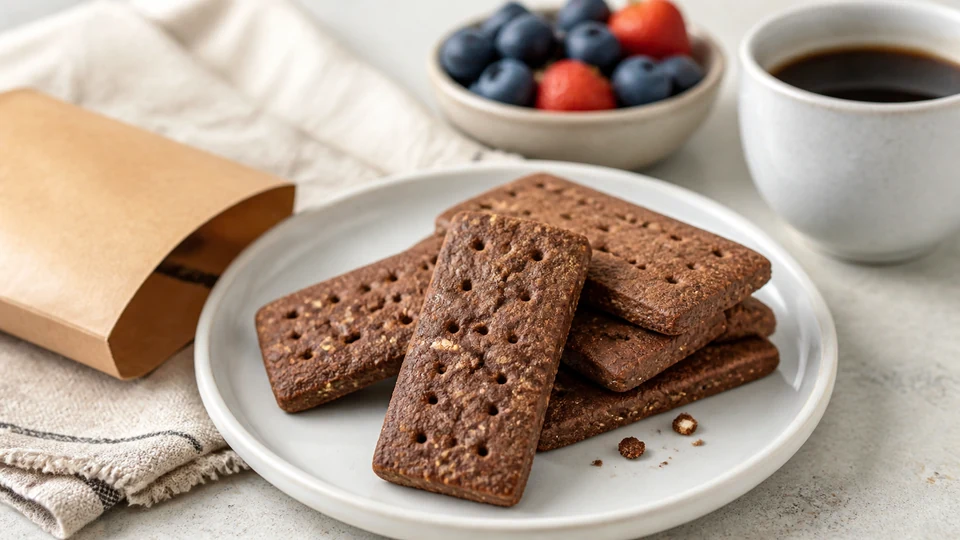
Belvita chocolate breakfast biscuits
At Pancakes World, belvita chocolate breakfast biscuits are a packaged crunchy biscuit product, not a homemade recipe or a name for every chocolate item in the brand family. The official US SmartLabel record identifies UPC 00044000031947 and an 8.8-ounce container with about five servings; one serving is one 50-gram pack containing four biscuits. That online record lists 220 calories, 8 grams total fat, 170 milligrams sodium, 36 grams carbohydrate, 4 grams fiber, 11 grams total sugars and 4 grams protein per pack, and it directs shoppers to the physical package for the most accurate ingredients, nutrition and allergens. The recorded allergens are wheat and soy, so check every pack before serving. This guide helps identify the exact product, read one pack correctly and decide how it fits a particular breakfast without rating, endorsing or promising a health result. It does not recreate the biscuit or transfer its label to soft-baked, filled, sandwich or protein products. Browse the American Breakfast: Pancakes, Diner Plates, and Brunch Context for other morning formats, or use the editorial platform for the broader editorial library.
For adjacent decisions around Belvita chocolate breakfast biscuits, compare breakfast from pantry staples, hot-weather breakfasts without the oven, and a budget breakfast batch plan.
For broader context, continue with American Breakfast: Pancakes, Diner Plates and Brunch.
Identify the crunchy chocolate product first
The words “Belvita chocolate breakfast biscuits” can point to several visually related products. The brand index includes crunchy breakfast biscuits, soft-baked bars, filled biscuits, sandwich biscuits, bite-size products and protein lines. Chocolate may appear as the main flavor, a chip, a filling or part of a multi-flavor description.
For the product covered here, match all of these fields:
- brand: belVita;
- product form: crunchy Breakfast Biscuits;
- flavor: Chocolate;
- US SmartLabel UPC: 00044000031947;
- online container reference: 8.8 ounces;
- inner unit: one 50-gram pack containing four biscuits;
- online container count: about five servings.
Do not use color alone. A dark package or a visible cocoa-colored biscuit does not prove the UPC, serving, allergen set or nutrition values. “Dark chocolate creme,” “cocoa creme,” “oats, honey and chocolate,” and plain “Chocolate” are separate product identities.
If any field differs, stop using the numbers on this page. Read that product’s own Nutrition Facts and ingredient statement. The article is a label-reading guide for one identity, not a database for the whole brand.
Explore related Pancakes World guidance on American Pancakes, Maple Syrup, and Maple Syrup Pancakes.
Sources and editorial references
The SmartLabel page states that its information was updated on May 24, 2022 and explicitly tells users to refer to the product label for the most accurate nutrition, ingredient and allergen information. That warning matters because formulas, serving presentations and labels can change.
University of Minnesota Extension likewise advises reading the label every time a food is purchased because manufacturers may change ingredients. When a dietary or allergy decision is important, keep the actual wrapper or box until the food has been served.
Use this order of authority at home:
- Read the physical package in hand.
- Match the UPC and exact product wording.
- Confirm serving size and servings per container.
- Read the complete ingredient list and “Contains” statement.
- Use the official online record as a cross-check, noting its update date.
- If the physical and online information conflict, follow the physical label and contact the manufacturer when clarification is needed.
Do not average two conflicting sodium figures or choose the lower calorie number from a retailer. A label disagreement is a signal to verify identity and version, not an invitation to construct a hybrid record.
Read the serving before reading the calories
FDA tells consumers to start with serving size and servings per container. On the cited SmartLabel record, the serving is not one biscuit. It is one pack: 50 grams and four biscuits.
That distinction changes every calculation:
- one full pack equals one labelled serving;
- two packs equal two labelled servings;
- two biscuits equal one-half of the labelled four-biscuit serving only if all biscuits in the pack are equivalent and the package does not state otherwise;
- one biscuit is one-quarter of the labelled serving under the same condition.
For a full pack, the online reference values are:
- 220 calories;
- 8 grams total fat;
- 1.5 grams saturated fat;
- 0 grams trans fat;
- 0 milligrams cholesterol;
- 170 milligrams sodium;
- 36 grams total carbohydrate;
- 4 grams dietary fiber;
- 11 grams total sugars;
- 4 grams protein.
The record also displays percent Daily Values for several nutrients. FDA explains that Daily Values are reference amounts used on the label, not a personalized prescription. A person’s individual needs can differ.
Do not call the 8.8-ounce outer box “one serving.” It contains about five. Conversely, do not call one biscuit a full serving merely because it is one physical piece.
Work through portion arithmetic transparently
If the physical label matches the online serving exactly, simple multiplication can help interpret how much was eaten.
One pack
Use the full per-serving panel: four biscuits and the listed values. No multiplication is needed.
Two packs
Multiply each per-pack number by two. On the online reference, that would mean eight biscuits and 440 calories, with every other listed amount doubled as well. This arithmetic is not a judgment about whether two packs are appropriate; it only reads the label correctly.
Half a pack
If two of four equivalent biscuits are eaten, one-half of each per-pack amount is the reasonable arithmetic estimate. Keep the wrapper because broken pieces can make visual fractions unreliable.
A mixed plate
Do not merge the biscuit values with yogurt, milk, fruit, nut butter, coffee additions or another food without counting those items separately. The pack’s Nutrition Facts describe the pack, not the complete plate.
This is why “220-calorie breakfast” would be inaccurate when the biscuits are accompanied by anything else. It would also be incomplete as a description of a person’s nutritional needs.
Read ingredients by order, not by marketing emphasis
Ingredient lists place components in descending order by weight. The label record for this crunchy chocolate product begins with whole-grain wheat flour and enriched wheat flour, followed by sugar, canola oil and whole-grain rolled oats. It also includes semisweet chocolate chips with their own sub-ingredients, whole-grain rye flour, cocoa, leavening and other formulation ingredients.
That order supports several practical conclusions:
- wheat is central to the product identity;
- “chocolate” does not mean the item consists mainly of chocolate;
- oats and rye are part of the grain system;
- chocolate chips have a nested ingredient list;
- soy lecithin appears in the formulation and within the chocolate-chip sub-ingredients in label records;
- a shopper must read the complete list rather than infer contents from the front panel.
Do not convert ingredient order into exact percentages unless the package provides them. Being listed first means greatest by weight before processing under US labelling conventions; it does not reveal the precise amount.
Do not infer that the product is vegan, dairy-free, gluten-free or suitable for a specific religious or medical diet from a partial ingredient summary. Use the full current physical label and relevant certification marks.
Manage wheat and soy allergens explicitly
The official online record identifies wheat and soy. FDA lists both among the nine major food allergens. Wheat appears in whole-grain and enriched flours; soy appears through soy lecithin in the label record.
For an allergy-relevant service decision:
- Keep the individual wrapper and outer box.
- Read both the ingredient list and “Contains” statement.
- Check for “May contain” or shared-facility wording on the current package.
- Avoid placing unwrapped biscuits on a shared board with foods containing other allergens.
- Use clean hands or utensils.
- Do not move biscuits into an unlabeled container when the original identity is needed.
- Let the person with the allergy or their responsible caregiver review the label.
Do not call the product gluten-free. The identified product contains wheat and rye ingredients in available label records. Do not call it soy-free because soy lecithin appears in the ingredient and allergen information.
A missing allergen from an old web snippet is not proof of absence. The physical package is the deciding source.
Separate product facts from marketing claims
Brand materials describe belVita products using language about morning energy. This article does not translate that language into a promise that a pack will keep every person full, alert or energized for a fixed number of hours.
FTC health-product guidance explains that health-related claims need competent and reliable scientific evidence appropriate to the claim. A product label or advertising phrase is not a licence for an editorial page to expand into medical, weight, glucose, cognitive or performance outcomes.
Therefore, the evidence-safe statements are narrow:
- the item is labelled as a breakfast biscuit;
- it is packaged in four-biscuit servings in the cited record;
- its label provides quantified nutrient information;
- it can be carried and eaten without recipe preparation when the wrapper is intact;
- its fit within a meal depends on the eater’s preferences and needs.
Avoid “complete breakfast,” “healthy for everyone,” “keeps you full,” “slow energy,” “diet-friendly,” or “better than cereal” unless a separate, appropriately designed evidence assessment supports the exact statement. None is needed to help a reader understand the product.
Decide whether one pack is the whole breakfast or one component
USDA MyPlate presents meals as combinations of food groups rather than declaring one branded item universally complete. Use that framework as a planning prompt, not a prescription.
Start with the actual situation:
Time and setting: Will the food be eaten at a table, while travelling or between activities?
Appetite: Is one four-biscuit pack the intended amount, or is it one component?
Available foods: Are fruit, dairy or fortified alternatives, protein foods or beverages available?
Allergens and preferences: Which options are safe and acceptable?
Label target: Does the eater need to monitor a specific nutrient under professional advice?
Then assemble the plate without making the biscuits carry claims they do not support. Examples of neutral meal structures include:
- one labelled pack plus a piece of fruit and an appropriate beverage;
- part of a pack alongside plain yogurt or an alternative whose label has been checked;
- one pack used as a portable component, with another food eaten separately;
- biscuits served as a snack rather than forcing the “breakfast” label to define the occasion.
These are editorial arrangement ideas, not tested combinations or individualized nutrition prescriptions. Count every added food separately.
Compare the exact product with adjacent belVita formats
The brand family contains formats that differ in piece count, texture, filling and label. Use a field comparison rather than assuming shared values.
| Field | Crunchy Chocolate record covered here | What must be checked on another format |
|---|---|---|
| Form | Crunchy biscuit | Soft-baked, filled, sandwich, bites or protein format |
| Serving unit | One 50 g pack, four biscuits | Pack weight and pieces per serving |
| Container | Online reference 8.8 oz, about five servings | Exact net weight and serving count |
| Calories | 220 per cited serving | Own Nutrition Facts |
| Allergens | Wheat and soy in cited record | Own ingredient and Contains statements |
| Product code | UPC 00044000031947 | Own UPC |
| Evidence date | SmartLabel updated May 24, 2022 | Current package and page date |
This table does not rank the products. It shows which fields must be re-read. A one-biscuit soft-baked pack is not “less” or “more” than a four-piece crunchy pack until serving weights and labels are compared.
Do not transfer the 220-calorie value to a sandwich or filled biscuit. Do not transfer the wheat-and-soy allergen line to a protein product that may declare additional allergens.
Use the package for a controlled serving decision
The individual pack is the cleanest unit for identity and portion tracking. Keep it sealed until service. Check for damage, an unreadable code, moisture exposure or an abnormal seal. Do not eat from a package whose integrity is questionable.
When only part of the pack is used:
- count the biscuits removed;
- fold or place the remainder in a clean closed container;
- keep the original wrapper with the remainder;
- note when it was opened;
- protect it from moisture and cross-contact;
- follow package storage instructions.
The cited SmartLabel record does not supply a route-specific open-pack storage duration. Do not invent one. Product quality after opening depends on packaging, environment and time. If the biscuits lose crispness, that is a quality observation, not automatically a safety determination.
Do not heat the wrapper in a microwave or oven. The product is ready to eat; any serving variation that warms or crushes it is an untested editorial use and must follow appliance and packaging safety directions.
Neutral serving ideas that preserve label clarity
The most defensible ideas change presentation rather than claiming to improve the product.
Pack intact for travel
Carry the sealed 50-gram pack. This preserves the ingredient and allergen label and makes the four-biscuit serving visible. Protect it from crushing and extreme conditions.
Divide the pack intentionally
Place two biscuits on a clean plate and retain two in the labelled wrapper. Treat the eaten portion as half the labelled serving only when the current package confirms four equivalent biscuits per serving.
Use as a separate crunchy component
Serve the biscuits beside another labelled food rather than crumbling them invisibly into a bowl. Separate presentation keeps portions and allergens easier to identify.
Crumble with a written record
If a biscuit is crumbled over yogurt or fruit, count the biscuits before crushing and retain the wrapper. Do not estimate from crumbs. Update the combined allergen record for every component.
Offer a choice, not a hidden substitution
When serving a group, display the original pack and an alternative food with its own label. Do not tell guests the product is equivalent to toast, cereal or a homemade cookie; let them compare relevant fields.
None of these serving ideas changes the product’s Nutrition Facts. Added foods, however, must be counted separately.
Reconcile a label mismatch without guessing
A mismatch can appear even when two pages show the same product name. One record may use a different sodium value, serving presentation or package size; another may describe an adjacent format. Resolve the conflict field by field.
First compare UPCs. If they differ, treat the items as different products. If the UPC matches, compare net weight, pack count, serving size and the printed revision context. Then transcribe the physical Nutrition Facts into a short record rather than relying on memory:
UPC: exact digits
Net weight: exact package value
Servings per container: printed value
Serving size: grams, packs and biscuit count
Calories and sodium: current physical values
Contains statement: exact current text
Date checked: current date
Use that record only for the package examined. Do not “correct” the physical label with an older webpage. SmartLabel itself says the package is the more accurate source.
If an outer box and inner wrapper appear inconsistent, preserve both and ask the manufacturer to identify the controlling information. Do not serve the product to someone with an allergy while the allergen record remains unresolved. For ordinary portion arithmetic, postpone the calculation until the serving unit is clear.
This reconciliation process also protects against a common product-family error: using the four-biscuit crunchy serving for a one-piece soft-baked pack or a two-piece sandwich pack. The brand name may be shared, but the serving denominator is not. Accurate comparison always begins with grams and pieces, then moves to the nutrient lines.
Use a simple breakfast-context record
When the product is part of a planned breakfast, write down the actual components rather than using the word “balanced” as a substitute for evidence. A useful record is:
- biscuit portion: number of biscuits and fraction of the labelled pack;
- accompanying food: exact item and amount;
- beverage: plain or with recorded additions;
- total labels used: one for each packaged component;
- allergens across the entire plate;
- uneaten remainder and how it was kept identified.
The record is not a diet plan. It simply prevents the biscuit panel from being mistaken for the nutrition of everything consumed. It also makes repeated breakfast choices comparable on the same factual fields without declaring one choice universally better.
Questions about Belvita chocolate breakfast biscuits
How many biscuits are in one serving?
The cited US SmartLabel record says one 50-gram pack containing four biscuits. Check the physical package because other formats and future labels may differ.
How many calories are in one pack?
The online record lists 220 calories per 50-gram four-biscuit pack. Use the current physical label as the final authority.
What allergens are listed?
Wheat and soy are identified in the cited record. Read the current ingredient, Contains and precautionary statements every time.
Is one biscuit 220 calories?
No. The cited 220-calorie value belongs to four biscuits in one pack. If the four pieces are equivalent, one biscuit is one-quarter of that labelled serving, but the wrapper remains the authority.
Is the product gluten-free?
No. The identified label includes wheat and rye ingredients. Do not serve it as gluten-free.
Is it a complete breakfast?
The label name does not establish nutritional completeness for every person. Decide whether the pack is the whole eating occasion or one component, and count other foods separately.
Is this page a product review?
No. It reports identity and label data and offers a decision framework. It makes no taste rating, price comparison, availability claim or endorsement.
Can the biscuits be used in a recipe?
They can be arranged or crumbled as an editorial serving idea, but this page has no tested recipe using them. It therefore uses Article schema and makes no baking or storage guarantee.
Final label-reading checklist
Before relying on this guide, verify:
- The package says crunchy Chocolate Breakfast Biscuits.
- UPC 00044000031947 matches when present.
- Serving size is one 50-gram pack with four biscuits.
- The outer container and serving count match the physical label.
- Nutrition values are read from the current package, not copied from another format.
- Wheat and soy plus every current precautionary statement are reviewed.
- The pack count is multiplied correctly when more than one is eaten.
- Added foods are counted separately.
- No health, fullness, energy or performance promise is inferred.
- The original wrapper stays with any remainder or group serving.
That checklist answers the useful question behind the branded search: exactly what product is this, what does one labelled pack contain, and what must be decided before treating it as part of breakfast?
- Mondelēz SmartLabel Chocolate Breakfast Biscuits —
https://smartlabel.mondelez.info/00044000031947-0001-en-US/index.html - Snackworks belVita Brand Product Index —
https://www.snackworks.com/brands/belvita/products/ - FDA How to Understand and Use the Nutrition Facts Label —
https://www.fda.gov/food/nutrition-facts-label/how-understand-and-use-nutrition-facts-label - FDA Food Allergies —
https://www.fda.gov/food/nutrition-food-labeling-and-critical-foods/food-allergies - University of Minnesota Extension Celiac Disease Label Guidance —
https://extension.umn.edu/food-service-industry/celiac-disease-what-you-need-know - USDA MyPlate What Is MyPlate —
https://www.myplate.gov/eat-healthy/what-is-myplate - FTC Health Products Compliance Guidance —
https://www.ftc.gov/business-guidance/resources/health-products-compliance-guidance