Banana flaxseed pancakes, vegan and source-led
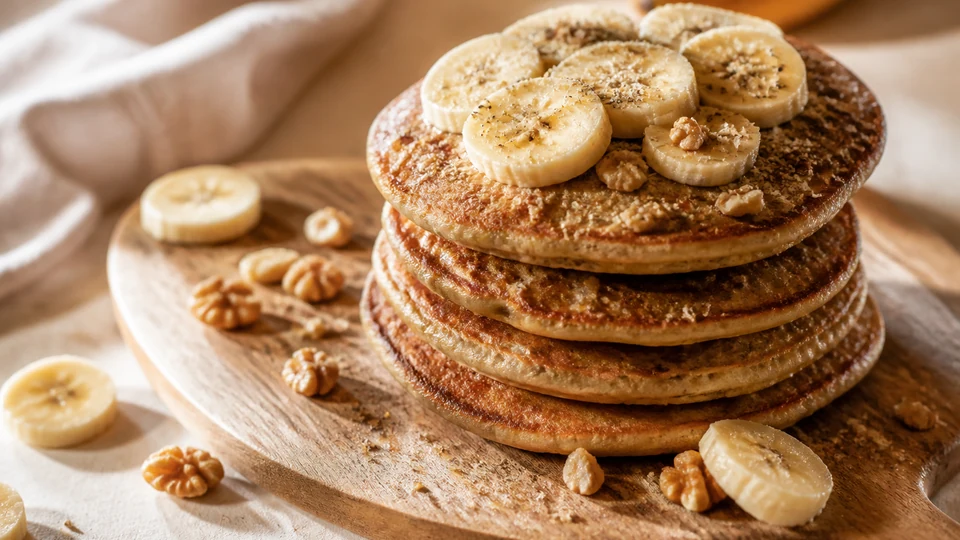
At Pancakes World, a concise institutional formula uses 1 ripe banana, a vegan binder made from 2 tablespoons ground flaxseed plus 6 tablespoons water, 1/4 cup oats, 1 tablespoon nut butter, salt and cinnamon. The University of California recipe booklet hydrates the flax for 5 minutes, blends the ingredients smooth, then cooks small 3-inch pancakes over medium-low heat for about 2 minutes on the first side and 30 seconds to 1 minute after turning. Use plant-derived pan fat and serving additions for a fully vegan plate. This is a source formula verified by the editorial platform , not a Pancake World kitchen test.
For broader context, continue with Healthy Pancake Guides.
Direct answer for banana flaxseed pancakes vegan
The formula is deliberately different from a conventional flour pancake. Banana supplies most of the wet bulk, oats contribute the cereal structure, and hydrated flax is an explicit vegan alternative to the booklet's two-egg option. Keep those quantities together for the first attempt instead of adding flax to an unrelated banana batter.
Primary formula and evidence boundary
The University of California Office of the President Basic Needs recipe booklet presents “simple pancakes” with a choice between two eggs or a vegan option of ground flaxseed soaked in water. For the vegan route, use:
- 1 ripe banana
- 2 tablespoons ground flaxseed
- 6 tablespoons water for the flax
- 1/4 cup oats
- a pinch of salt
- a pinch of cinnamon
- 1 tablespoon nut butter
- optional vegan chocolate chips
- plant-derived oil or verified vegan butter for the pan
- maple syrup or another verified vegan topping, if desired
The source does not publish a pancake count. It describes 3-inch pancakes but gives no scoop volume. Do not infer a yield from the egg version or from the number that fits in one pan.
Equipment
- small bowl for hydrating flax
- fork or small whisk
- dry measuring spoons and cup
- blender for the unambiguous vegan method
- flexible spatula for scraping the blender safely after blades stop
- nonstick skillet or griddle
- thin, wide turner
- plate for the cooked test pancake
The booklet offers a blender method and a hand-mixing method, but the hand method's text specifically says to mix banana with eggs. Because that wording does not explicitly substitute the hydrated flax in the hand sequence, this article uses the blender option for the vegan baseline. That preserves the published vegan ingredient alternative without pretending the ambiguous branch says more than it does.
Step-by-step method
- Choose the vegan branch. Set aside eggs; they do not belong in this version. Confirm that the nut butter, pan fat, chocolate and toppings meet the eater's vegan and allergen requirements.
- Hydrate the flax. Mix 2 tablespoons ground flaxseed with 6 tablespoons water. Let it stand for 5 minutes, as the source instructs.
- Prepare the banana. Peel one ripe banana and break it into pieces suitable for the blender. The source does not state a weight, so record the peeled weight privately if repeatability matters without converting it into an official quantity.
- Measure the oats and nut butter. Use 1/4 cup oats and 1 tablespoon nut butter. Add only a pinch each of salt and cinnamon for the baseline.
- Load the blender safely. Add the banana, hydrated flax mixture, oats, salt, cinnamon and nut butter. The booklet permits optional chocolate chips, but keep the first batch plain so the base remains interpretable.
- Blend smooth. Secure the lid and blend until the mixture is combined and smooth. Follow the appliance's order, capacity and duty-cycle instructions.
- Preheat gently. Warm a lightly greased skillet over medium-low heat. High heat is not the source baseline.
- Make a small test pancake. Pour or spoon a roughly 3-inch round. Do not turn the whole batter into one large pancake.
- Cook the first side. Use the source's 2-minute mark as a checking point. Wait for the underside to release and the edge to look more set; the timer alone is not proof.
- Turn with support. Slide a wide turner under most of the round and flip once. Cook for about 30 seconds to 1 minute on the second side.
- Check the center. Open the test pancake before repeating. The exterior color does not prove the banana-oat center is set.
- Repeat consistently. Keep the diameter, heat and pan-fat film stable. Reduce heat if browning outruns the center.
This method paraphrases the institutional recipe and adds only conservative decision cues. It does not introduce a project-owned yield, exact scoop, banana weight, internal temperature, taste statement or guaranteed timing.
What the reader needs to know
Flax is an ingredient system here, not a garnish
The vegan branch uses 2 tablespoons ground flaxseed plus 6 tablespoons water. That is twice the familiar one-tablespoon “flax egg” ratio used in many recipes because the booklet offers it as an alternative to two eggs. Use the full hydrated mixture.
Do not sprinkle whole flax seeds on top and call the binder complete. The source specifies ground flax. Whole seed has a different physical form and will not distribute through the batter in the same way.
Banana and flax both influence structure
The formula contains no large wheat-flour phase. Banana supplies moisture and mashed fruit solids, while oats and ground flax thicken the blended mixture. Removing either banana or flax creates a different recipe.
This is why the article does not endorse a universal claim that one banana equals a certain number of eggs. Recipe architecture matters. Food Network Kitchen's separate vegan banana pancake uses banana without flax but includes 1 1/2 cups all-purpose flour, almond milk, vegan butter and a tablespoon of baking powder. Its ratios belong to a conventional-flour system.
The source's hand method is ambiguous for the vegan branch
The booklet says the blender option combines all ingredients except pan fat. Its hand option tells the cook to mash banana, mix in eggs, then add oats and remaining ingredients. It does not explicitly rewrite that sentence for hydrated flax.
Rather than silently editing the institution's method, this article chooses the blender branch for the vegan option. A cook who wants hand mixing should use a separately published vegan formula whose hand sequence expressly adds the flax mixture.
The batter is naturally small-batch, but yield is unknown
One banana and 1/4 cup oats are modest quantities, yet the source gives no count. Three-inch diameter also leaves portion depth undefined. Actual count depends on the pour and residue in the blender.
Record the first batch. A stated personal yield can help the same cook next time, but it is not evidence for an editorial yield.
Nut butter changes allergy status
The institutional formula includes 1 tablespoon nut butter without naming one type. Peanut and tree nuts fall within major-allergen categories under U.S. FDA labeling rules, and their identities matter. Sunflower-seed or another seed butter might appear to solve a nut concern, but the source does not explicitly test that substitution.
Read the exact jar label and follow the eater's safety plan. Vegan does not mean nut-free, peanut-free or free from cross-contact.
Oat sourcing controls gluten-free claims
The booklet simply says oats. It does not label the formula gluten-free. Oats, chocolate, nut butter, spices and shared equipment all require suitable verification when gluten avoidance matters.
Do not add a gluten-free label solely because the ingredient list lacks wheat. Choose labeled oats and control the preparation environment according to the person's needs.
Raw batter is not ready to taste
The FDA advises against eating raw flour, dough and batter. Although this formula uses oats rather than conventional flour, it remains an uncooked grain batter. Use the cooked test pancake to assess flavor and texture, then clean the blender, worktop and utensils.
Article-only status prevents overclaiming
The approved brief allows Recipe schema only after a genuine Pancake World test with a complete owned formula. This article preserves an institutional recipe and its limitations. Editorial verification cannot establish project yield, performance, nutrition or repeatability, so the page remains Article-only.
Independent recipe comparisons
A conventional whole-grain flax-and-banana formula
Love & Lemons publishes a distinct vegan banana pancake using 1 tablespoon ground flax with 3 tablespoons water, 1/2 cup mashed banana, olive oil, almond milk, 1 1/2 cups whole-wheat pastry flour, 1/2 cup oat flour, baking powder, baking soda, spices and salt. It hydrates banana, flax and water together for 5 minutes, then uses 1/3-cup portions.
That recipe supports the broader practice of hydrating ground flax and using ripe banana, but it cannot be merged with the UC small-batch ratio. Its larger flour system, more liquid and chemical leaveners explain why it behaves differently.
A high-flax non-vegan diagnostic reference
Mayo Clinic Press publishes banana flax pancakes with 1 cup ground flaxseed, 1 cup all-purpose flour, milk and two eggs. It warns that the high flax content may take longer to cook through and advises lowering heat if necessary. This is useful as an independent diagnostic: a dark exterior may precede a firm center in a flax-heavy pancake.
It is not vegan and is not a conversion target. Replacing its eggs and milk without rebalancing the whole formula would create an untested recipe.
A vegan banana formula without flax
Food Network Kitchen uses a very ripe banana with all-purpose flour, almond milk, vegan butter, sugar and baking powder. It cooks 1/4-cup portions over medium heat and lowers the heat when browning is too fast.
That page shows that banana can participate in a vegan pancake without flax when the remaining architecture supplies structure. It does not make flax optional in the UC vegan branch.
Practical options and examples
Option 1: follow the UC vegan blender formula unchanged
Use one ripe banana, the full two-flax binder, oats and nut butter. Keep the pancakes near 3 inches and start at medium-low heat. This is the lowest-uncertainty route for the exact banana-flax intent because every structural ingredient comes from one institutional source.
The goal of the first batch is not to prove it superior. It is to establish a readable baseline. Record the banana, oats, nut butter, pan and actual result before making substitutions.
Option 2: use the Love & Lemons flour-based formula as a complete unit
Choose this when a conventional stack with whole-wheat pastry flour and oat flour better matches the goal. Use its one-flax binder, stated milk, leaveners, spices and 1/3-cup portions together.
Do not take the 2-tablespoon flax binder from the UC recipe and add it to the larger formula. More binder is not automatically more stable, and this article has no test supporting that hybrid.
Option 3: use the Food Network banana pancake when flax is unavailable
Food Network Kitchen's developed recipe is vegan and banana-based but flax-free. It suits a reader whose core need is vegan banana pancakes rather than banana-plus-flax. Follow its complete all-purpose-flour system.
Changing to that formula is not a substitution inside the UC recipe. It is selecting a different recipe whose structure has already been published.
Option 4: choose a flour-specific route
For a wheat-led formula, vegan whole-wheat banana pancakes keep the grain decision central. For a gluten-free rice-flour direction, use vegan brown-rice-flour pancakes rather than replacing the 1/4 cup oats without a complete formula.
Option 5: choose a savoury breakfast instead
Banana makes this formula fruit-forward. If a savoury plate is the real intent, savory vegan buckwheat pancakes are a more coherent starting point than removing banana and adding salt to this batter.
Choosing the right approach
| Priority | Source-led route | Boundary |
|---|---|---|
| Banana and flax with minimal cereal | UC vegan blender formula | Yield not published |
| Flour-based whole-grain stack | Love & Lemons formula | Different binder and liquid system |
| Vegan banana but no flax | Food Network Kitchen formula | Does not answer flax intent |
| Very high flax with eggs and dairy | Mayo diagnostic reference only | Not vegan and not a conversion template |
| Nut-free preparation | Choose a developed nut-free formula | Source nut-butter swap is untested |
| Gluten-free requirement | Verify every ingredient and kitchen control | Oats alone do not certify the batch |
Common mistakes
Using whole flaxseed
The recipe calls for ground flaxseed. Whole seeds do not create the same distributed binder in the short hydration period.
Skipping the five-minute hydration
The vegan option explicitly soaks 2 tablespoons ground flax in 6 tablespoons water for 5 minutes. Use that pause before blending.
Adding eggs to the vegan branch
The booklet offers eggs or hydrated flax as alternatives. Adding both changes the formula and removes vegan status.
Following the ambiguous hand instruction literally
The hand branch says to mix banana with eggs. For a clearly vegan baseline, use the source's all-in blender option rather than guessing where the flax belongs.
Using an unripe banana
The ingredient list says ripe banana. A firm green fruit is harder to blend and materially different in texture and sweetness.
Making one large pancake
The source says 3-inch pancakes. Small rounds shorten the distance heat must travel and make a tender batter easier to turn.
Starting on high heat
Medium-low is the institutional instruction. Banana and flax can darken while the center remains soft. More heat is not a substitute for time.
Turning at exactly two minutes regardless of appearance
Use 2 minutes as the source checkpoint. Wait for release and a more set edge if the pan runs cool; reduce heat if the surface darkens quickly.
Tasting the uncooked batter
Judge a cooked test pancake. Vegan batter is not synonymous with ready-to-eat batter.
Hiding nut butter or chocolate in the ingredient count
Nut butter is part of the source formula and optional chips remain an ingredient. Both affect allergens and the finished meal.
Calling the pancakes high-protein, low-calorie or keto
No such conclusion follows from banana or flax alone. Exact products, yield, pan fat and toppings would be needed for a nutrition calculation. This article publishes none.
Step-by-step checklist
Before blending
- Confirm the vegan flax branch, not the two-egg branch.
- Measure 2 tablespoons ground flax and 6 tablespoons water.
- Allow the full 5-minute hydration.
- Choose one ripe banana.
- Measure 1/4 cup oats and 1 tablespoon nut butter.
- Read nut butter, chocolate, oil and topping labels.
- Prepare a clean nonstick pan and wide turner.
While blending
- Follow the appliance's loading guidance.
- Secure the lid.
- Blend only until smooth and combined.
- Switch the machine off before scraping.
- Keep fingers and tools away from moving blades.
- Do not taste the raw mixture.
While cooking
- Preheat over medium-low heat.
- Apply a thin vegan fat film.
- Make one 3-inch test pancake.
- Check the first side near 2 minutes.
- Turn only when it releases as one piece.
- Cook the second side 30 seconds to 1 minute as the source range.
- Open the test pancake and inspect the center.
- Keep the later rounds the same size.
After cooking
- Record actual pancake count.
- Note first- and second-side times.
- Record the banana weight and oat type if repeatability matters.
- Cool leftovers promptly.
- Refrigerate in a covered shallow container.
- Reheat leftovers thoroughly.
USDA Food Safety and Inspection Service guidance says perishable leftovers should be refrigerated within two hours and reheated to 165°F. These safety limits do not guarantee a banana-flax pancake's texture after storage.
Troubleshooting by observable symptom
Batter is too loose to hold a small round
Verify that the flax was ground, used at the full quantity and hydrated for 5 minutes. Check whether 6 tablespoons water was accidentally doubled or the banana was unusually large. Do not add several new dry ingredients at once.
Because the source gives no correction amount, cook a very small test and record the result. For the next batch, weigh the banana or select a complete flour-based formula when more structure is needed.
Batter is too thick for the blender
Stop the machine before scraping and confirm its minimum-liquid requirements. Do not force a stalled appliance. The source does not publish extra liquid, so a large pour would be an unsupported reformulation.
If the appliance cannot process the batch safely, use a published vegan hand-mixed recipe rather than the ambiguous hand branch in this booklet.
Pancake breaks during the turn
The first side may be under-set, the diameter too wide or the turner too narrow. Make the next round closer to 3 inches, give it more first-side time at medium-low heat and support the full center.
Outside is dark but center is wet
Lower the heat and keep the pancake small. Mayo Clinic Press independently warns that a high-flax pancake can need more time to cook through. That diagnostic supports patience, not importing its eggs-and-milk formula.
Pancake sticks
Confirm a clean suitable surface, adequate preheating and a light film of compatible fat. Let the underside set before moving it.
Texture is gummy
Possible observable contributors include a thick portion, very large banana, short cook or excess water. Pancake World has not tested the formula, so this article does not assign one universal cause. Change one variable in the next small test.
Finished pancakes taste bitter or overly salty
The source uses only pinches of salt and cinnamon. Review measuring and nut-butter ingredients. Do not use a full teaspoon where a pinch was intended.
Later pancakes brown faster
The pan can retain heat across batches. Lower the setting as needed, mirroring the heat-management advice in the independent published formulas.
Variations or substitutions when relevant
Peanut versus almond butter
The source says nut butter without naming a type. Select one that fits the eater's allergy plan and vegan standard. Different products vary in salt, sugar and fluidity, so record the jar.
Seed butter
A seed butter might answer a nut-free need, but the institutional source does not explicitly test it. Use a separately developed formula or treat a small trial as personal experimentation, not a verified substitution.
Chocolate chips
The booklet lists them as optional. Verify vegan status and allergens. Add only after establishing the plain baseline, and keep pieces small enough not to interfere with turning.
Blueberries
Love & Lemons offers blueberries in its flour-based formula, not the UC small-batch recipe. Do not transfer a large amount automatically. Wet fruit can change release and center setting.
Different oats
The source says oats but does not distinguish rolled, quick or steel-cut. Use a product that can blend into the stated smooth batter; do not assume coarse steel-cut oats behave the same. Record the choice.
Banana-free
Banana is a structural ingredient and the primary flavor. A banana-free goal requires another complete recipe.
Flax-free
Choose the Food Network vegan banana formula or another developed recipe. Simply omitting hydrated flax from the UC branch removes a major part of its structure.
Frequently asked questions
Is the UC formula definitely vegan?
It provides an explicit vegan option of 2 tablespoons ground flax soaked in 6 tablespoons water instead of two eggs. The remaining pan fat, nut butter, chocolate and toppings still require label checks.
Why use the blender method?
The booklet's blender branch combines all ingredients and accommodates the listed vegan alternative. Its hand branch explicitly mentions eggs and does not restate where flax enters, so the blender route is less ambiguous.
How many pancakes does it make?
The source gives no yield. It specifies 3-inch pancakes. Record the actual count rather than publishing an invented one.
Can I use flour instead of oats?
That would change the formula. Choose a flour-based vegan banana-flax recipe with its own liquid and leavener quantities.
Are the pancakes gluten-free?
Not automatically. Verify the oats, nut butter, chocolate, toppings and kitchen controls according to the eater's needs.
Can I make them without nut butter?
The source includes 1 tablespoon nut butter. Omitting it is unverified here. Select a developed nut-free formula when that constraint is essential.
Why is there no Recipe schema?
The complete method is attributed to an institutional booklet and has not undergone a genuine Pancake World test. Article-only status prevents borrowed evidence from looking like original recipe development.
First-batch record and next-batch prevention
Write down the banana peeled weight, flax and water measurements, flax rest, oat product, nut butter product, blender model, blend duration, pan material, heat setting, approximate diameter, first-side time, second-side time and actual yield.
For the test pancake, record three separate moments: when the edge looked set, when the underside released and when the center stopped looking wet. If browning happened first, lower the heat. If the round released but folded over the turner, reduce its diameter or extend the first side.
Keep the remaining batter unchanged while diagnosing pan behavior. Do not add oats after one dark pancake if excessive heat is the obvious issue. Conversely, do not lower the heat repeatedly if the batter spreads like a drink because water or banana size is out of range.
For the next full batch, change one recorded factor. A slightly smaller banana, another oat product or a different nut butter should each be evaluated separately. Personal notes help one kitchen repeat an outcome; they do not upgrade this source-led article to a project test.
Practical verdict
For the exact banana-flaxseed vegan intent, the UC blender formula is a concise evidence-led baseline: one ripe banana, 2 tablespoons ground flax hydrated with 6 tablespoons water, 1/4 cup oats, 1 tablespoon nut butter, salt and cinnamon. Rest the flax for 5 minutes, blend smooth and cook small 3-inch rounds gently.
Use Love & Lemons when a larger whole-grain flour formula is preferred, or Food Network when vegan banana pancakes without flax are the goal. Do not splice their ratios together. Preserve the vegan branch, label allergens and treat time cues as observation windows rather than guarantees.
For more griddle formats, visit vegan breakfast pancakes and vegan hotcakes, then return to the vegan pancakes hub for the parent collection.
Explore related Pancakes World guidance on American Pancakes, American Breakfast: Pancakes, Diner Plates and Brunch, and Maple Syrup.
Sources and editorial references
These institutional, culinary and food-safety references were checked on August 16, 2026. URLs appear once as plain, non-clickable text.
- University of California Office of the President Basic Needs, “UC Recipe Booklet — Simple Pancakes”:
https://basicneeds.ucop.edu/resources/uc-recipe-booklet.pdf - Love & Lemons, “Vegan Banana Pancakes”:
https://www.loveandlemons.com/vegan-banana-pancakes/ - Mayo Clinic Press, “Banana Flax Pancakes”:
https://mcpress.mayoclinic.org/nutrition-fitness/banana-flax-pancakes/ - Food Network Kitchen, “Vegan Banana Pancakes”:
https://www.foodnetwork.com/recipes/food-network-kitchen/vegan-banana-pancakes-11603394 - U.S. Food and Drug Administration, “Food Allergies”:
https://www.fda.gov/food/nutrition-food-labeling-and-critical-foods/food-allergies - U.S. Food and Drug Administration, “Handling Flour Safely: What You Need to Know”:
https://www.fda.gov/food/buy-store-serve-safe-food/handling-flour-safely-what-you-need-know - USDA Food Safety and Inspection Service, “Leftovers and Food Safety”:
https://www.fsis.usda.gov/food-safety/safe-food-handling-and-preparation/food-safety-basics/leftovers-and-food-safety