Apple breakfast bake
At Pancakes World, choose the kind of apple breakfast bake before choosing ingredients. For a spoonable, make-ahead breakfast, follow a complete baked-oatmeal formula. For a richer shared casserole, use a tested apple French-toast bake with bread and egg custard. For individual portions, bake whole apples and serve them with oatmeal or yoghurt as the source directs. These three systems need different liquid ratios, pan depths and doneness checks, so do not combine them. Cut apples evenly, keep overnight egg mixtures at 40°F or below, and use 160°F for egg dishes. Reheat cooked leftovers to 165°F and follow the selected recipe’s own pan, timing and storage directions.
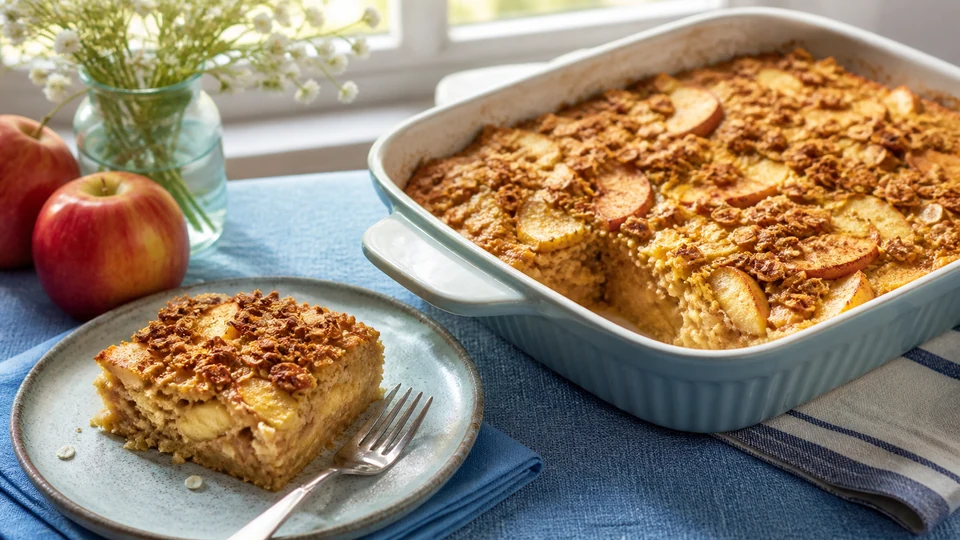
This is a selection and troubleshooting guide, not a recipe claimed as tested by Pancake World. The breakfast hub covers other morning formats, while Pancake World connects the wider collection.
For broader context, continue with American Breakfast: Pancakes, Diner Plates and Brunch.
Direct answer: pick one of three bake families
| Bake family | What forms the structure | Best when | Main risk to control |
|---|---|---|---|
| Apple baked oatmeal | Rolled or steel-cut oats absorbing measured liquid | You want a scoopable make-ahead breakfast | Changing oat type or liquid without using a complete formula |
| Apple French-toast bake | Bread soaking in an egg-and-dairy custard | You want a richer casserole cut into portions | Wet centre mistaken for desirable softness |
| Whole baked apples | The apple itself holds a filling or accompanies oatmeal | You want individual fruit-led portions | Uneven apple size and incomplete tenderness |
King Arthur Baking publishes a complete apple cinnamon baked oatmeal and a separate apple French toast bake; Food Network publishes baked apples with oatmeal and yoghurt. Select one whole formula. Do not lift the soaking liquid from the oatmeal, the bread quantity from the French-toast bake and the apple timing from the whole-fruit recipe.
Path 1: apple cinnamon baked oatmeal
Baked oatmeal is the clearest choice when oats should be the main structure. The King Arthur formula uses both rolled and steel-cut oats, apple pieces, applesauce, milk and other ingredients in a 9-inch square dish. It rests overnight and bakes the next morning.
That published method demonstrates several route-specific decisions:
- two oat forms are balanced against a defined amount of liquid;
- apple cubes go inside while apple wedges form a top layer;
- the dish size fixes depth;
- overnight soaking happens under refrigeration;
- the centre can appear slightly wet at the source’s specified endpoint;
- a short cooling period is part of the method.
Do not transfer the source’s “slightly wet” centre cue to an egg custard casserole. Baked oatmeal can retain moisture after oats have hydrated; a French-toast bake containing eggs must meet its own formula and food-safety endpoint.
Choose this path if you want:
- a breakfast that can be portioned with a spoon;
- most assembly completed the night before;
- oats rather than bread as the main starch;
- fruit distributed through the dish;
- individual portions reheated later according to the source.
Avoid casual substitutions between quick oats, rolled oats and steel-cut oats. They absorb liquid and soften at different rates. Use the exact combination in the chosen recipe or a tested variation supplied by its author.
Path 2: apple French-toast bake
An apple French-toast bake is a bread-and-custard casserole. Bread absorbs an egg-and-dairy mixture, and the finished structure depends on bread quantity, dryness, cube or slice size, pan depth and the custard formula.
King Arthur’s source uses a 9-by-13-inch pan. That dimension is not decorative: it spreads the mixture to a planned depth. Putting the same amount into a smaller, deeper dish changes the route heat must travel to the centre.
Choose this path if:
- a rich shared casserole fits the meal;
- egg, dairy and wheat suit the guests;
- refrigerator space can hold the covered pan;
- the oven is available for the full source time;
- a thermometer can reach the centre without touching the pan.
Because this family includes eggs, FoodSafety.gov’s safe minimum temperature chart lists 160°F for egg dishes. Check the centre and any visibly softer area. A browned top and crisp edge do not prove that the middle is ready.
Do not add raw breakfast sausage between the bread and apples unless a complete tested recipe includes it and supplies safe cooking directions. Extra raw meat changes moisture, fat, thickness and the temperature endpoint.
Path 3: whole baked apples with oatmeal
Whole baked apples are a different format: the fruit provides the portion boundary. Food Network’s source pairs baked apples with oatmeal and yoghurt. It is useful when diners should receive one apple rather than a square or scoop from a casserole.
Choose apples of similar size so they soften at similar rates. A large apple and a small apple in the same pan are unlikely to reach matching tenderness at the same moment. Core and prepare them according to the selected formula without cutting through the base if the recipe requires a cavity that holds filling.
Use this path when:
- presentation as individual fruit matters;
- a guest prefers oatmeal beside or inside the apple rather than a mixed casserole;
- the oven can hold a single fruit layer;
- portions need to be counted before service.
Do not use an oatmeal casserole’s baking time for whole apples. The intact fruit has a different thickness and moisture path. Test tenderness only as the whole-apple recipe directs.
Decide by texture, not by a vague name
“Apple breakfast bake” can mean a creamy oat dish, a custardy bread casserole, a cake-like quick bake or a whole stuffed apple. Before shopping, ask what the serving utensil should do.
- If it should scoop, choose baked oatmeal.
- If it should cut into soft squares, choose French-toast bake.
- If it should lift one portion, choose whole baked apples.
- If it should slice like cake, find a complete apple breakfast cake or quick-bread formula rather than forcing one of these systems.
This decision prevents ingredient drift. Adding more flour to make oatmeal sliceable or more milk to make a quick bread creamy creates a new, untested formula.
Apple cut controls the bake
The size and placement of apple pieces affect moisture and tenderness.
Small even cubes distribute through oatmeal or bread more predictably than irregular chunks. Thin wedges on top soften and brown differently from submerged cubes. Grated apple releases juice and integrates into batter; it cannot replace cubes without changing the system.
Prepare one representative apple first and measure the cut. Then repeat it. Use a stable board and sharp knife, and keep fingers clear. Discard the core and any damaged or spoiled portion.
Do not cut apples hours in advance merely for convenience unless the formula supplies a holding method. Browning is often a quality issue, while unsafe handling or prolonged room-temperature exposure becomes a safety concern when cut fruit is combined with egg or dairy.
If a recipe uses lemon, cider or another acidic ingredient, keep its amount. Do not add a large unmeasured splash solely to prevent browning; extra liquid and acidity can change oat hydration or custard texture.
Apple variety: use the formula’s description
There is no defensible universal “best apple” for every breakfast bake. Some recipes want slices that hold their shape; others want cubes that soften into oatmeal. Local availability and ripeness vary.
Follow the source’s named variety or functional description, such as a firm baking apple or tart apple. If substituting, choose one with similar behavior and accept that sweetness and firmness may differ. Do not mix several unknown varieties on the first attempt if repeatability matters.
Inspect each apple. A very soft, mealy or damaged fruit may not deliver the texture assumed by a recipe written for firm apples. That is a quality judgment, not an unsupported nutrition claim.
Pan size and depth
A 9-inch square dish and a 9-by-13-inch pan have different surface area. Even when volume seems similar, the depth changes heat penetration, evaporation and the ratio of edge to centre.
Use the pan specified by the complete formula. If a different material or size is unavoidable, choose a recipe that provides an approved alternative. Glass, ceramic and metal can respond differently; follow the source and manufacturer guidance.
Do not double a recipe in one deeper dish. Make two source-sized pans if oven capacity and airflow allow, or choose a formula designed for a larger group. A deeper custard casserole can brown on top while remaining below 160°F inside.
Place the pan where the recipe directs. Leave room around it for oven airflow. Do not crowd it with several unrelated bakes that alter recovery time and block circulation.
Overnight assembly
Overnight preparation is only valid when the selected recipe calls for it. The King Arthur apple baked oatmeal explicitly rests covered in the refrigerator. A French-toast formula may also include advance assembly, but its directions control the interval.
Use this sequence:
- Confirm that the recipe permits overnight assembly.
- Check that the covered pan fits level in the refrigerator.
- Prepare apples, bread or oats exactly as directed.
- Combine the mixture and cover it promptly.
- Refrigerate at 40°F or below.
- Record when it entered the refrigerator.
- The next morning, follow the recipe’s cold-pan, room-temperature or preheating instruction.
Do not leave an egg-and-milk casserole on the counter while the oven preheats unless the complete method explicitly includes that step within safe handling. Do not put a refrigerated glass dish into a hot oven if its manufacturer warns against thermal shock.
Morning-only workflow
If overnight storage is unavailable, select a recipe designed for same-morning preparation. Do not shorten an overnight soak and assume oats or bread will hydrate identically.
Set out ingredients, weigh dry components and prepare the pan before cutting apples. Preheat at the recipe’s stated moment. Mix wet and dry components in separate bowls when instructed, then combine without unnecessary delay.
For a whole-apple bake, start the apples first if the companion oatmeal is cooked separately. For a French-toast bake, allow the recipe’s stated soak. For baked oatmeal, do not invent a shorter rest if the formula relies on overnight hydration.
Doneness: use the correct system
Baked oatmeal
Use the source’s combination of time, edge behavior, centre appearance and apple tenderness. The King Arthur formula says the centre still appears slightly wet at its endpoint. That cue belongs only to that formula.
Egg-and-bread casserole
Use the recipe’s visual cues plus 160°F for the egg dish. Insert the thermometer into the centre and another soft-looking area without touching the pan bottom.
Whole baked apples
Use the source’s tenderness check. The apple should reach the intended texture while retaining the structure described. The oatmeal or yoghurt accompaniment follows its own method and storage requirements.
Leftovers
Reheat to 165°F. Check the centre of a thick portion, not only the hot edge. Add a small amount of liquid only if the source recommends it; do not turn a dry leftover into an unmeasured new formula.
What 160°F and 165°F apply to
FoodSafety.gov lists 160°F for egg dishes and 165°F for leftovers. It also lists 165°F for casseroles containing meat and poultry. These numbers do not mean every oat-only bake must be cooked to the same sensory result as an egg casserole.
Identify the food category:
- an egg custard bake: 160°F;
- a casserole containing poultry: 165°F;
- a reheated leftover portion: 165°F;
- an oat bake without egg: follow its complete recipe’s endpoint;
- a whole apple: follow the source tenderness method, while separately handling any dairy accompaniment.
Use a clean calibrated food thermometer where temperature applies. Clean it between checks.
Add-ins: keep the system coherent
Nuts, dried fruit, seeds, sausage and extra fresh fruit all change the dish.
Add only ingredients included in the formula or a tested variation. Nuts add mass and an allergen. Dried fruit absorbs some moisture. Fresh berries or extra apple release juice. Raw sausage adds a separate safety endpoint and fat.
If the source permits walnuts but a guest avoids them, use the source’s nut-free variation or omit them only when the author says the structure remains sound. Replacing nuts with an equal volume of seeds is not automatically equivalent for allergies, flavor or absorption.
Serve optional yoghurt, syrup or nuts separately. This gives guests control without changing the baked structure.
Dairy-free, egg-free and gluten-free decisions
Do not make three simultaneous substitutions in a custard bake and describe the result as the same recipe.
For dairy-free baked oatmeal, choose a complete formula tested with a suitable plant beverage. Check soy, nut and other allergen labels. For egg-free breakfast bake, start with an oat formula that does not depend on egg or use a tested egg-free recipe. For gluten-free service, verify oats if required and every packaged ingredient; ordinary bread is not suitable.
A plant-based drink may differ in sugar, protein, fat and stabilizers. A gluten-free bread may absorb custard differently. A flax mixture can alter structure. These are reasons to select a complete tested variation, not to guess a one-for-one replacement.
Scaling for a group
Use the recipe yield and pan count.
The King Arthur baked oatmeal yields one 9-inch square dish with about 9 to 12 servings as defined by its source. The breakfast context, other foods and guest appetites still affect how much is eaten. Do not convert that into a universal portion claim.
If more food is needed:
- make two complete source-sized batches;
- keep pan depth unchanged;
- confirm the oven can circulate air around both;
- rotate pans only if the recipe or oven guidance supports it;
- check each centre independently;
- label allergen variants clearly.
If fewer guests are expected, choose a smaller published formula or plan leftovers safely. Halving eggs and changing pan size can introduce measurement and depth errors.
Serving the bake
Allow the source’s resting time. Cutting a custard bake immediately can release liquid before the structure settles; waiting far beyond safe service is not the solution.
Use a clean spoon or turner. Serve yoghurt, cream, syrup, nuts and fruit in separate labelled containers. Keep chilled toppings at 40°F or below until service.
A fresh side can be simple: whole fruit, citrus or berries. The bake already contains starch and apple, so a second sweet pastry is optional rather than required.
Storage and reheating
The FDA’s egg safety guidance says egg dishes held for later should be refrigerated and reheated to 165°F. FoodSafety.gov’s cold storage chart provides category-specific storage guidance.
Cool suitable leftovers promptly, divide a large quantity into shallower covered containers when appropriate, label the date and refrigerate within two hours. Use the exact federal category that matches the bake; do not invent a longer life because apples or oats seem durable.
Reheat only the portion needed. Check the centre at 165°F. Do not repeatedly warm and cool the entire dish. Discard food whose time or temperature history is unknown.
Troubleshooting by symptom
Watery oatmeal bake
Check whether the correct oat types and amounts were used, whether extra fruit or liquid was added, whether the overnight rest occurred and whether the full bake and rest were completed. Do not add dry oats to the hot finished dish as a repair.
Dry oatmeal bake
Confirm flour or extra oats were not packed into the measure, the pan was not larger than specified and the bake was not extended until every trace of surface moisture disappeared. Follow the source’s reheat suggestion for leftovers.
French-toast bake is wet in the centre
Measure the centre. If below 160°F, continue cooking safely. Check pan size, bread amount, apple moisture and any unapproved extra liquid. Do not serve raw custard as “creamy.”
Top burns before centre is ready
Confirm oven temperature with reliable equipment, pan placement and depth. Use any source-approved covering step. Do not lower the safe endpoint.
Apples stay hard
Check cut size, variety behavior and whether pieces were substantially larger than the formula specified. Whole apples must be similar in size. Extend only within the recipe’s method, monitoring the rest of the dish.
Apples disappear into mush
The pieces may be too small, too ripe or from a softer variety. Use the source’s cut and functional apple description on the next batch. This is a texture problem, not a safety failure by itself.
Bake will not release cleanly
Use the specified pan preparation and resting time. A scoopable oatmeal is not supposed to cut like cake. Confirm that the expected serving format matches the chosen family.
Final bake checklist
- The bake is clearly oat-based, bread-and-custard, or whole-apple.
- One complete recipe controls ingredients, pan, time and endpoint.
- Apple pieces are even and match the source cut.
- Oat types have not been interchanged casually.
- Pan size and depth match the formula.
- Overnight egg or dairy mixtures stay at 40°F or below.
- Egg dishes reach 160°F.
- Leftovers are chilled within two hours and reheated to 165°F.
- Allergens in oats, bread, milk, egg, nuts and substitutes are identified.
- No wet-centre cue has been transferred from oatmeal to custard.
The dependable apple breakfast bake begins with the correct family. Once the structure is chosen, the source formula—not a generic casserole instinct—should control the apples, liquid, pan and doneness.
Explore related Pancakes World guidance on American Pancakes, Maple Syrup, and Maple Syrup Pancakes.
Sources and editorial references
- King Arthur Baking, “Apple Cinnamon Baked Oatmeal.”
https://www.kingarthurbaking.com/recipes/apple-cinnamon-baked-oatmeal-recipe - King Arthur Baking, “Apple French Toast Bake.”
https://www.kingarthurbaking.com/recipes/apple-french-toast-bake-recipe - Food Network, “Baked Apples with Oatmeal and Yoghurt.”
https://www.foodnetwork.com/recipes/bobby-flay/baked-apples-with-oatmeal-and-yogurt-2111954 - FoodSafety.gov, “Safe Minimum Internal Temperatures.”
https://www.foodsafety.gov/food-safety-charts/safe-minimum-internal-temperatures - FDA, “What You Need to Know About Egg Safety.”
https://www.fda.gov/media/82227/download - FoodSafety.gov, “Cold Food Storage Charts.”
https://www.foodsafety.gov/food-safety-charts/cold-food-storage-charts