American style pancakes vegan
At Pancakes World, for vegan American-style pancakes, choose one complete published formula that was designed without egg or dairy, keep its flour, raising agents, plant drink, fat and acid or binder together, and follow its own mixing and cooking sequence. Aim for a thick batter that drops into small rounds instead of flowing across the pan. Mix only until the dry flour disappears, respect any stated resting time, and turn each pancake when bubbles have opened, the top is losing its wet shine and the edge can support a spatula. “Vegan” describes ingredient intent; it does not guarantee that packaged ingredients are safe for a milk, egg, nut, soya or gluten allergy.
This page is a method and decision guide, not a Pancake World-tested recipe. It helps you select and execute an established formula without quietly combining incompatible quantities. For more egg-free and dairy-free stack ideas, use the vegan pancake collection, or return to Pancake World for the full editorial library.
For broader context, continue with Healthy Pancake Guides.
What American-style means here
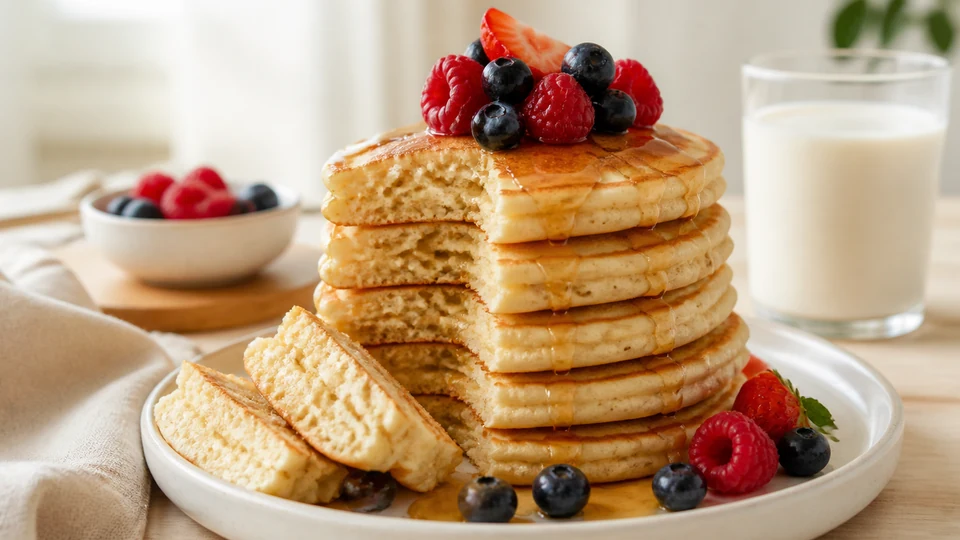
“American-style” is useful when it describes the shape and batter behaviour, not when it pretends that every American pancake follows one formula. The Vegan Society distinguishes this style from a thin classic pancake: the American version is taller, thicker and commonly includes sugar, a raising agent and oil. Its batter should fall into round discs rather than rapidly covering the pan. That is the practical boundary for this guide.
The distinction changes the decisions a cook makes. A thin batter is expected to spread and produce a flexible pancake that can be rolled or folded. A thicker American-style batter needs enough structure to hold a smaller footprint while gas expands inside it. The cook therefore watches depth, spread, bubbles, edge set and browning together. A neat circle alone proves very little; a batter can be thick because it is correctly balanced, because too much flour was measured, or because an absorbent ingredient was added without the rest of its formula.
Vegan is a second, independent boundary. The NHS describes a vegan diet as one based on plants and foods made from plants, excluding animal-derived foods such as dairy products and eggs. In a pancake formula, that rules out the ordinary use of cow’s milk, butter and egg. It does not mean that one universal substitute can be dropped into any non-vegan recipe with identical results. An established vegan formula may obtain moisture, fat, tenderness, binding and leavening support from several ingredients working together.
Keep these two questions separate:
- Is the formula intentionally vegan, with every ingredient and topping checked?
- Is it designed to make a thick, small-diameter, raised pancake rather than a thin crêpe-style one?
A formula needs to satisfy both questions to match this route. A thin vegan pancake is still vegan but not the style requested. A thick pancake containing egg is American-style but not vegan.
Choose a complete formula before buying ingredients
The safest way to avoid a disappointing batter is to select a method lane before making substitutions. “Method lane” means one source’s ingredient list, quantities, order, rest, pan guidance and storage direction kept as a unit. It is not a collection of favourite lines taken from several recipes.
Three published approaches show why this matters.
| Published lane | Structural idea | Mixing and cooking cue | Suitable decision |
|---|---|---|---|
| King Arthur easy vegan pancakes | Self-raising flour, bicarbonate of soda, plant drink, apple sauce, oil and lemon juice form one coordinated formula | Wet and dry mixtures are combined gently, rested briefly, then portioned onto a controlled griddle or pan | Choose when you want a conventional small stack and can use every specified component |
| Vegan Society American-pancake guidance | Less liquid and a raising agent distinguish the thicker style from a classic thin pancake | Batter should pour into discs; central bubbles and a firming surface signal the turning window | Use as a style and observation guide, not as permission to invent quantities |
| Vegan Society enchanted vanilla pancakes | White beans, oats, plant drink and optional flax or aquafaba sit inside a different whole formula | Wet components are puréed, then combined with dry ingredients; bubbles and dry edges are the flip cues | Choose only if you want that bean-and-oat format and will follow its complete source recipe |
These lanes cannot be merged by intuition. Apple sauce in one formula and beans in another are not interchangeable merely because both appear in vegan pancakes. Self-raising flour carries a defined raising system, while plain flour plus a separately specified raising agent is a different arrangement. Lemon juice has a role in the King Arthur formula alongside bicarbonate of soda; removing it while retaining the soda changes the system. A plant drink can differ in sweetness, flavour, protein and fortification, but the recipe developer’s stated options remain the defensible starting point.
Before shopping, write down five things from the chosen source:
- the exact flour type, including whether it is plain, self-raising or wholemeal;
- every raising agent and acidic ingredient;
- the named plant-drink options and whether they should be sweetened or unsweetened;
- the binder or purée, if one is used;
- the stated pan heat, portion, rest and turning cues.
Then buy for that list. This simple discipline prevents the most common kind of accidental recipe development: discovering that one ingredient is missing and replacing three other components to compensate. That experiment may eventually work, but it is no longer the selected formula and should not be presented as if the source validated it.
Understand the jobs without inventing substitutions
Knowing why an ingredient is present helps you diagnose the process, but it does not produce an automatic replacement ratio.
Flour creates the framework
Flour supplies the material that holds a pancake’s shape as it cooks. The exact flour matters. Self-raising flour is not simply plain flour with a more convenient name; the chosen recipe has been balanced around it. Wholemeal flour and oat ingredients absorb and structure batter differently from a white self-raising flour formula. Gluten-free flour blends may include starches and gums, and a “gluten-free” claim also raises ingredient and cross-contact questions beyond vegan status.
Use the flour named by the source. If you must change it, switch to a complete formula already written for the flour you have. That is more reliable than adjusting liquid one spoonful at a time while assuming the raising system remains correct.
Raising agents need the rest of their system
Baking powder and bicarbonate of soda are not decorative additions. A formula that specifies soda with an acidic ingredient should be followed as a whole. Do not double the raising agent simply because the desired pancakes are tall. Extra leavener can change flavour, spread and the way a pancake sets; “more” does not translate directly into “fluffier.”
Check the packet is the ingredient named in the source. In British kitchens, it is especially important not to confuse baking powder with bicarbonate of soda. Also confirm that a self-raising flour recipe actually uses self-raising flour before adding anything that the source did not request.
Plant drink supplies more than water
A plant drink affects looseness and flavour, and a packaged version may bring sugar, salt, stabilisers or fortification. King Arthur’s test-kitchen notes permit several plant drinks within its own formula, with oat and almond named as preferences and soya or rice offered as alternatives. That statement supports substitution inside that recipe; it is not evidence that every plant drink behaves identically in every pancake.
For a British shopping decision, read both the front and the ingredient panel. “Oat,” “almond” or “soya” identifies the base but not whether the drink is sweetened, flavoured or fortified. If the recipe asks for unsweetened, use that instruction as the controlling one. If serving someone with an allergy, the allergen declaration and precautionary statement matter more than the fact that the drink is plant based.
Purée, oil and optional binders belong to specific formulas
Apple sauce supplies moisture and other functional effects in the King Arthur method. The Vegan Society’s bean-based formula uses puréed beans, oats and optional flax or aquafaba inside a substantially different batter. Banana appears in other pancake recipes but brings its own moisture, sweetness and flavour. None of these ingredients is a universal “one egg” object when removed from its tested context.
Oil contributes fat and affects the pan as well as the batter. The Vegan Society suggests a neutral oil such as sunflower or rapeseed for general pancake work. If a source includes oil in the batter and also gives separate pan-greasing instructions, keep those actions distinct. Pouring all the cooking oil into the bowl does not prepare the pan; heavily oiling a non-stick surface can change browning and the pancake’s edge.
A practical mixing workflow
Once a complete source formula is open, arrange the work so that each instruction can be followed without delay.
1. Confirm the ingredient identity
Place every packet on the counter and compare it with the formula line by line. Look for flour type, plant-drink description, raising-agent name and any acid, purée or oil. Check toppings too. Chocolate, spreads, biscuits and ready-made sauces can contain animal-derived ingredients even when the base pancake does not.
This is also the allergen checkpoint. The UK Food Standards Agency warns that vegan labelling should not be treated as allergen-free labelling. A vegan product can have a precautionary statement because of cross-contact with milk, egg or other allergens. Read the current label every time rather than relying on memory or on a prior version of the package.
2. Measure before combining
Use the units in the selected formula. If it supplies grams, a kitchen scale reduces the variability created by compressing flour into a cup. If it uses volume, use proper measuring vessels and the source’s stated technique where given. Do not convert a formula twice or round several small quantities independently; those tiny changes accumulate in a modest batch.
Keep dry ingredients in one bowl and wet ingredients in another when the method directs that separation. This allows raising agents to disperse through the flour before local pockets meet liquid. It also gives you one final chance to see an omitted ingredient.
3. Prepare the pan and holding setup
Use the pan or griddle guidance from the source. King Arthur gives an electric-griddle setting and a medium-low alternative for a frying pan, while The Vegan Society’s general advice favours a non-stick pan and enough oil to prevent sticking. Those descriptions are more useful than naming a universal hob number, because burners, pans and induction controls differ.
If cooking for several people, decide how finished pancakes will be held before the first portion hits the pan. One source uses a low oven and a rack over a tray; The Vegan Society suggests a warmed plate in a low oven. Follow the selected source, use oven-safe equipment and avoid extending a stated holding method into an indefinite storage claim.
4. Combine gently and stop
Add wet to dry in the sequence given. In the King Arthur formula, the instruction is to whisk gently until the ingredients are just combined and to resist eliminating every lump. That is a specific, useful endpoint: no broad pockets of dry flour, but no prolonged beating for cosmetic smoothness.
Scrape the bowl once so hidden flour is incorporated. Then stop. If the recipe includes a rest, set a timer for that exact interval. A rest is not a general licence to leave a perishable batter on the counter for an hour, nor should a five-minute instruction be silently stretched while the cook prepares toppings.
5. Portion one calibration pancake
The first pancake should answer process questions. Is the pan ready? Does the measured portion hold a round footprint? Does the lower surface brown before the top has begun to set? Use the source’s portion size, because changing diameter also changes the time needed for the centre to cook.
Do not immediately correct a thick batter with extra liquid. First confirm that every ingredient was measured correctly and that any rest has finished. A batter designed for American-style pancakes is supposed to be thicker than a crêpe batter.
6. Turn from a group of cues
The Vegan Society describes central bubbles and a surface that begins to firm. Its bean-based recipe adds dry-looking edges to the decision. King Arthur instructs the cook to wait until bubbles form and pop and the underside is golden. Read those as a group, not as a single magic bubble.
Slide the spatula far enough under the pancake to support its centre. Turn it once and let the second side cook according to the chosen formula. Pressing the pancake flat removes the height you were trying to build and is not part of the cited methods.
7. Reassess before filling the pan
Cut or inspect the calibration pancake if necessary. If its centre is still wet while the outside is dark, reduce the heat and allow the pan to settle before the next portion. If it is pale and slow to set, confirm that the pan was fully preheated. If it spreads much farther than the source demonstrates, recheck measurements and ingredient identity before improvising.
Once the heat and portion are working together, repeat consistently. A crowded pan makes turning awkward and can merge neighbouring rounds. Leave enough room for the spatula and for the modest spread expected from the batter.
Troubleshoot from visible evidence
Troubleshooting should begin with what happened, not with a random ingredient addition.
The batter runs across the pan
First ask whether you chose an American-style formula or a thin pancake recipe. Then verify the flour type, plant-drink quantity and portion. If a rest was specified, confirm it was completed. Do not add flour until you know the original measurement was correct; an unrecorded flour addition changes both texture and the relationship with the raising agents.
If you deliberately substituted a plant drink, return to the alternatives allowed by that particular source. A replacement that works in one formula is not automatically validated in another.
The batter barely leaves the spoon
Check for packed or overweighed flour, an omitted liquid, or an absorbent addition such as oats introduced from a different recipe. Also confirm that you did not use a purée in addition to, rather than instead of, the component specified by the formula. Avoid “fixing” the bowl until the discrepancy is identified. The correct action may be to restart, especially when the missing or doubled component is a raising agent.
The outside darkens before the centre sets
The pan is likely delivering heat faster than the pancake’s depth can accommodate, the portion may be larger than directed, or both. Lower the heat, wait for the pan to respond and return to the source’s portion. Do not use colour alone to declare the centre done.
Sugar in the batter and sweetened plant drinks can influence browning. That is another reason to respect an instruction for unsweetened plant drink rather than treating the label as irrelevant.
The pancake is pale and reluctant to release
Allow adequate preheating and wait for the stated surface cues. Trying to turn before the edge has set can tear a perfectly workable batter. If sticking continues, follow the source’s pan-fat instruction and consider whether the pan’s surface is suitable. “Non-stick” does not mean every pan performs identically or needs no maintenance.
The stack is dense
Review mixing first. Vigorous, prolonged whisking conflicts with the gentle, just-combined instruction in the King Arthur lane. Next check that the correct flour and raising agent were used and that the leavener was not omitted. Finally, check whether the batter stood far longer than its formula allowed.
Do not claim that one ingredient caused the problem without evidence. Density is an outcome with several possible process causes; a written preparation note is more useful than guessing after the bowl has been washed.
The flavour is unexpectedly strong
Look at the chosen plant drink, oil, purée and raising agent. Sweetened or flavoured drinks alter the intended profile. Coconut products, banana and distinctive oils are not neutral merely because they are vegan. Excess bicarbonate of soda can also be noticeable, which is why the acid-and-soda relationship should remain intact.
Decide on toppings without losing the vegan boundary
The simplest toppings are ingredients whose current labels you have checked. Fresh fruit, a suitable syrup, lemon and sugar, or a verified vegan spread can all fit different preferences. The Vegan Society’s general pancake guide offers both sweet and savoury directions, but the topping decision should not turn a breakfast article into a nutrition promise.
For a shared meal, offer toppings separately. This keeps a carefully chosen pancake base from being automatically combined with nuts, soya, sesame or a packaged chocolate product that not every guest can eat. Use clean utensils for each topping and do not return a used spoon to a communal container.
If the breakfast is expected to form part of a varied vegan diet, treat that as a wider meal-planning question. The NHS recommends variety and identifies fortified alternatives and specific nutrients that may require attention in vegan diets. One pancake stack cannot be assessed as a complete diet, and this article does not calculate nutrient intake or prescribe supplements.
Vegan does not mean allergen-free
This distinction deserves its own check because milk and egg are absent by design in many vegan formulas. The FSA explains that a vegan label indicates that animal-origin ingredients were not intentionally used, but cross-contamination may still occur. A “free-from” statement is a separate food-safety claim supported by stricter controls.
For someone with an allergy or coeliac disease:
- check every flour, plant drink, raising agent, spread and topping label;
- read precautionary “may contain” information rather than relying on a vegan logo;
- use equipment and surfaces that meet the person’s cross-contact requirements;
- do not describe an ordinary wheat-based vegan pancake as gluten-free;
- ask the affected person or their carer to make the final product decision.
Plant drinks also introduce their own possible allergens. Almond and soya are not interchangeable safety choices. Oat products require particular scrutiny when a gluten-free requirement exists. The appropriate packaged product depends on its current label and the eater’s needs, not on a generic substitution chart.
Explore related Pancakes World guidance on American Pancakes, American Breakfast: Pancakes, Diner Plates and Brunch, and Maple Syrup.
Sources and editorial references
Cook the quantity you expect to serve where practical. If using the King Arthur method, its storage lane says to wrap leftovers and refrigerate them for up to one day, then reheat in a microwave. That statement belongs to that recipe. It should not be extended to every pancake containing fruit, bean purée, cream-style toppings or other additions.
Keep toppings separate before storage, especially fresh fruit and sauces that alter the surface. Use a clean container and label it with the preparation date. If you follow a different published recipe, use that source’s storage instructions. When no storage guidance exists, do not invent a long refrigerator or freezer life for convenience.
A decision checklist for the next batch
Before cooking:
- Is the selected formula vegan and explicitly American-style or thick-stack compatible?
- Do you have the exact flour and raising agents?
- Are the permitted plant-drink options clear?
- Have all packaged ingredients and toppings been checked for vegan status and relevant allergens?
- Are the quantities, rest, portion and pan guidance from one source?
During cooking:
- Does the batter form a small round rather than flooding the pan?
- Is the pan browning the base at a rate that allows the top to begin setting?
- Have bubbles opened and have the edges lost their wet shine?
- Can the spatula support the pancake without forcing it free?
- Are you changing only one process variable after the calibration pancake?
After cooking:
- Is the centre set before the batch is served?
- Are toppings kept separate when dietary or allergen needs differ?
- Are leftovers handled under the chosen source’s instructions?
- Did you record any substitution instead of attributing the result to the original formula?
That final note matters. A source can support the method it published; it cannot validate an undocumented household variation.
Frequently asked questions
Can ordinary pancake mix be made vegan?
Only if the mix itself and every required addition meet the vegan boundary, and the manufacturer supplies a suitable preparation method. Some mixes contain milk or egg ingredients; others may request egg or dairy in preparation. Read the current ingredient list, allergen statement and directions. Do not assume that adding plant drink to any dry mix creates the structure intended by its manufacturer.
Which plant drink is best?
There is no universal winner. Use an option approved in the complete formula. King Arthur allows oat, almond, soya or rice drinks in its easy vegan pancake recipe and specifies unsweetened liquid. Allergy needs and the current package label can narrow that list further.
Do vegan American pancakes need an egg replacer?
Not necessarily. Published formulas use different systems: apple sauce in one, beans and oats in another, and optional flax or aquafaba in another context. Choose a formula developed around its own system instead of adding a commercial replacer to an already egg-free recipe.
Why should some lumps remain?
In the cited King Arthur method, gentle mixing just until combined is intentional, and the source warns against whisking out every lump because prolonged mixing can produce tougher pancakes. Broad dry pockets should still be incorporated; the instruction is not to leave unmixed flour at the bottom of the bowl.
When is the pancake ready to turn?
Look for several signs: bubbles form and open, the upper surface becomes less glossy, the edges begin to set, and the underside has browned. Use the timing and heat guidance in the selected recipe, but let the visible state confirm the turn rather than flipping at the first bubble.
Are vegan pancakes safe for a milk or egg allergy?
The vegan description alone is not enough. The FSA says vegan foods may be exposed to animal-derived allergens through cross-contact and advises consumers to check precautionary allergen information. A free-from claim is different from a vegan claim.
Can this guide be treated as a tested recipe?
No. It compares published method lanes and explains how to follow one faithfully. Pancake World has not supplied a project-owned test record for a new formula on this route, so the page uses Article framing and does not claim a yield, exact proprietary recipe or tested result.
- The Vegan Society — How to make the best vegan pancakes:
https://www.vegansociety.com/news/blog/how-make-best-vegan-pancakes - King Arthur Baking Test Kitchen — Easy vegan pancakes:
https://www.kingarthurbaking.com/recipes/easy-vegan-pancakes-recipe - The Vegan Society — Enchanted vanilla pancakes:
https://www.vegansociety.com/resources/recipes/cakes-meringues-and-desserts/enchanted-vanilla-pancakes - NHS — The vegan diet:
https://www.nhs.uk/live-well/eat-well/how-to-eat-a-balanced-diet/the-vegan-diet/ - UK Food Standards Agency — Vegan food and allergen risk campaign:
https://www.food.gov.uk/news-alerts/news/fsa-launches-campaign-highlighting-risk-of-food-labelled-as-vegan-to-people-with-allergies - UK Food Standards Agency — Food allergies, intolerances and coeliac disease:
https://www.food.gov.uk/food-safety-and-hygiene/food-allergies-intolerances-and-coeliac-disease