American buttermilk pancake recipe
At Pancakes World, for American buttermilk pancakes, use a complete tested formula built for thick, tender griddle cakes rather than converting a thin-pancake recipe. The formula should name real cultured buttermilk, balance baking soda with that acidic liquid, state whether baking powder is also used, and give weights or measured quantities, yield, rest and griddle guidance. Mix wet and dry ingredients separately, combine only as far as the source instructs, preserve any allowed small lumps, rest for the documented interval, and calibrate the pan with the first pancake. Flip only when the recipe’s surface and edge cues appear. the editorial platform has not tested a new formula here, so the linked tested recipe controls every amount and timing.
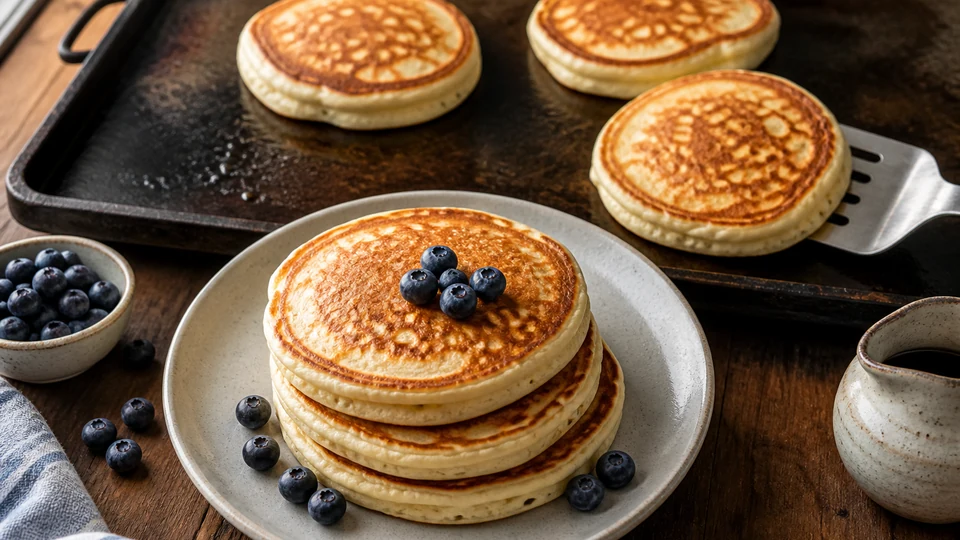
This is a source-led execution guide, not a new Recipe-schema page. The pancake science hub explains more batter behavior, while Pancake World opens the complete collection.
| Guide sections |
|---|
| Define the American buttermilk style |
| Why buttermilk changes the batter |
| Select a complete tested formula |
| Measure before the wet ingredients meet the dry |
For broader context, continue with American Breakfast: Pancakes, Diner Plates and Brunch.
Define the American buttermilk style
The target is a round griddle cake with visible thickness, a tender interior and enough structure to turn cleanly. It is not a crêpe, an English Shrove Tuesday pancake or a thin blini. “American” describes the intended form here; it does not claim that every US household follows one historic formula.
Buttermilk is more than a flavor word. In a formula that uses baking soda, its acidity participates in gas production. It also adds water, milk solids and its own thickness. Removing it changes several variables at once.
A usable source recipe therefore needs to state:
- the flour and measurement method;
- cultured buttermilk as a named ingredient;
- baking soda and any baking powder separately;
- egg and fat form;
- mixing order;
- batter rest, if required;
- portion size and documented yield;
- pan or griddle starting guidance;
- turning cues and approximate cook window;
- serving or holding guidance.
King Arthur Baking’s tested Buttermilk Pancakes recipe supplies those elements. Use its page for the exact formula. This article explains how to read and execute that evidence without silently rewriting it.
Why buttermilk changes the batter
FDA materials identify cultured milk as including buttermilk under the cited federal standard and recognize lactic-acid-producing cultures in cultured milk. That makes cultured buttermilk different from plain sweet milk in both identity and acidity.
The American Chemical Society describes the reaction between sour milk’s lactic acid and sodium bicarbonate: carbon dioxide is produced, and gas trapped in a batter or dough contributes lightness. ACS also distinguishes baking powder as a mixture that already includes bicarbonate and acid components. These facts explain why the two leaveners cannot be swapped spoon-for-spoon.
In a pancake formula:
- baking soda needs an acid partner and affects the batter’s acid-base balance;
- baking powder supplies its own acid system and may release gas at more than one stage;
- buttermilk contributes acid as well as liquid and solids;
- flour and egg help the cooking batter retain structure around gas;
- fat influences tenderness and pan release;
- heat sets the structure and drives moisture change.
The source recipe balances the system. Adding extra soda for “more lift” can exhaust available acid and alter taste or color. Adding acid without adjusting liquid can change consistency. Use the stated amounts.
Select a complete tested formula
Do not assemble a recipe from three snippets. One source may specify ingredient quantities, another a buttermilk substitute and a third a griddle temperature, but those values were not necessarily tested together.
Choose a source with:
- a stable publisher and named recipe;
- complete quantities and a defined yield;
- a consistent buttermilk and leavener system;
- an explicit mixing method;
- a stated rest or instruction to cook promptly;
- portion and pan guidance;
- turning and doneness cues;
- storage notes when leftovers are discussed.
Record the source title, access date and any intended change. If you substitute an ingredient, you are no longer making the untouched source formula. Do not carry over its nutrition, yield or performance language without a test.
Measure before the wet ingredients meet the dry
Pancake batter moves quickly after hydration. Assemble equipment and measure everything first.
Use the flour method named by the recipe. A weight is clearer when provided. If the source uses cups, follow its stated cup-measure technique; packing flour into the cup increases the amount and can thicken the batter.
Confirm that baking soda and baking powder have not been confused. They may look alike but do different jobs. Check package identity and date, then return each container to its place so it is not added twice.
Bring melted fat to the condition the source expects. Very hot butter can affect eggs or cold dairy on contact. Very cold melted butter may resolidify into flakes. The tested recipe’s sequence matters.
Prepare:
- one bowl for dry ingredients;
- one vessel for wet ingredients;
- a whisk or mixing tool;
- a portion scoop or measure;
- a wide spatula;
- pan fat if required;
- a rack, tray or plates for cooked pancakes;
- a clean thermometer if you use one for pan calibration;
- separate utensils for raw batter and finished food.
This setup prevents the batter from waiting while the pan and tools are found.
Combine the dry ingredients evenly
Distribute flour, salt, sugar and leaveners as directed before adding liquid. A pocket of baking soda can create uneven flavor, while a poorly dispersed leavener can produce irregular rise.
Whisking dry ingredients is not the same as prolonged mixing after hydration. At this stage there is no wet gluten network to toughen. Break visible clumps of leavener and make the mixture uniform.
Do not add extra powder because the package has been open for a while. If freshness is doubtful, replace the leavener or use a manufacturer-supported check. Guessing a larger dose changes balance and does not guarantee activity.
Mix the wet ingredients as one phase
Combine the egg, cultured buttermilk, fat and any flavoring in the order the source provides. The goal is even distribution before this phase touches flour.
If melted butter forms small solid droplets in a cold mixture, first check whether the recipe anticipates that. Do not heat a raw egg mixture aggressively to remelt it. Start again when safety or formula control is uncertain.
Use refrigerated eggs and buttermilk that have been stored correctly. FoodSafety.gov advises buying refrigerated eggs, keeping them cold and discarding cracked eggs. Wash hands and equipment after contact with raw egg.
Combine without chasing a perfectly smooth batter
Pour or add the wet phase to the dry phase exactly as the tested method directs. Stir until the stated condition appears. King Arthur’s reference allows some small lumps; that does not mean every dry pocket is acceptable or that all recipes want the same finish.
Overworking hydrated wheat flour can build more gluten and push a tender pancake toward chewiness. Yet undermixing can leave dry flour and concentrated leavener. Stop at the source’s endpoint rather than a fixed number of strokes copied from another formula.
Use a spatula to inspect the bottom and sides of the bowl. A few hydrated lumps may remain, but obvious dry seams should be incorporated under the method’s guidance.
Never taste the batter. FDA states that flour is raw and may carry harmful bacteria, and raw egg adds another reason to avoid tasting. Judge salt, sweetness and consistency through the tested formula and cooked calibration pancake.
Respect the documented rest
A rest can allow flour to hydrate and bubbles to develop, but it also gives chemical reactions time to proceed. Longer is not automatically better.
King Arthur’s complete recipe states its own uncovered rest. Use that interval only with that formula. If another tested recipe says to cook immediately or uses a different rest, follow it instead.
During the rest:
- preheat the cooking surface;
- arrange the landing area;
- prepare only finished-food utensils;
- avoid repeatedly stirring the batter;
- keep raw batter away from toppings;
- note the start time.
Do not refrigerate or hold a chemically leavened batter overnight unless the exact recipe was developed for it. Gas production, flour hydration and food-safety handling all need formula-specific evidence.
Preheat and calibrate the griddle
The burner label is not a surface temperature. Pan material, thickness, burner size and batch history all affect heat.
Follow the selected source’s starting instruction. King Arthur gives a griddle temperature and a water-droplet cue for its own formula. If using a thermometer, measure the cooking surface in several locations and understand the device’s limitations. An infrared reading can be affected by reflective surfaces; a contact probe responds differently.
Apply only the amount of fat the method requires. Too much can fry the edges and create irregular pools. Too little on a sticky or unseasoned surface can tear the pancake. Reapply between batches only as needed.
The first pancake is calibration, not waste. It reveals:
- whether the surface is hot enough to set the portion;
- whether the bottom colors before the top develops turning cues;
- whether the portion fits the spatula and pan;
- whether fat distribution is even;
- whether the batter has the source-described flow.
Make one controlled adjustment at a time. If you change heat, portion and batter thickness simultaneously, you will not know which correction worked.
Portion consistently
Use the measure specified by the recipe. Consistent portions help the batch develop comparable thickness and cooking time. Pour from the same height and avoid spreading unless the method instructs it.
Leave space between pancakes for the spatula. Crowding can lower surface temperature and make turning awkward. On a small skillet, one or two pancakes per batch may be more repeatable than filling every available centimeter.
Stir-ins can alter flow and create scorching. If a tested source permits berries, chips or other additions, follow its placement method. Sprinkling them onto the wet top after portioning can distribute them differently from mixing them through the bowl. Do not invent a heavy inclusion load and expect the original yield or timing.
Flip from evidence, not from a timer alone
The first side must develop enough structure to release and support turning. Use the recipe’s combination of edge, bubble and underside cues.
Bubbles are useful only in context. Early bubbles can rise and close while the batter is still fluid. Later bubbles may remain open as the edge loses its wet shine. Check the underside gently only when the pancake can be lifted without dragging.
Slide the spatula fully under the center, lift just enough to clear the pan and turn in one motion. Pressing down after the flip expels gas and compresses the interior. Leave it alone unless the recipe explicitly directs otherwise.
The second side often cooks faster because the interior is already warm. Remove the pancake when the source’s cue is met. A dark surface is not proof that a thick center is correct; excessive heat can brown outside before the middle sets.
Diagnose a batch systematically
Pale and slow
The surface may be too cool, the pan may lose heat between portions, or the formula may differ from the source. Raise heat gradually and let the pan recover. Do not add sugar simply to force color.
Dark before the middle sets
Reduce heat and verify portion size. Excess pan fat or a sweeter substituted dairy product can also increase browning. Restore the source formula before changing leaveners.
Flat pancakes
Check that the correct leaveners were used, the batter was not held beyond the method, and buttermilk was not replaced with plain milk. Avoid promising that extra soda fixes the problem; acid balance matters.
Tough interior
Review flour measurement and post-hydration mixing. Too much flour or prolonged stirring can shift texture. Also confirm that the pancakes were not held uncovered until dry.
Gummy center
The portion may be too large, the surface too hot, or the batter altered with a moist substitution. Use the documented portion and reduce heat enough for the center to cook before the exterior overcolors.
Spreading too far
Confirm flour amount, liquid identity and rest. Do not keep adding flour by eye to the full bowl; diagnose the measurement or substitution first.
Batter too thick to portion
Check for packed flour, extended holding or an unintended thick dairy substitute. Add liquid only if the source provides an adjustment. An improvised correction changes yield and leavening concentration.
Uneven spotting
Pan fat may be pooling or the surface may heat unevenly. Wipe on a thinner film and rotate the pan between batches if safe.
Buttermilk substitutions need their own evidence
Milk mixed with acid, thinned yogurt, kefir and other suggestions do not have identical solids, viscosity, flavor or acidity. King Arthur’s documented comparison found differences and names a yogurt-and-milk option for its tested pancake formula. That result belongs to that source and method.
If cultured buttermilk is unavailable, the strongest choices are:
- select a complete tested recipe developed for the liquid you have;
- use the exact substitute stated by the selected recipe;
- run and record a controlled test before serving a group.
Plain milk is not an invisible replacement in a soda-balanced batter. Adding an arbitrary amount of vinegar or lemon juice changes acid and liquid without verifying final consistency. Do not publish the original recipe’s yield, timing or nutrition after such a change.
Scale by batches, not depth
For more pancakes, separate normal batches are easier to control than an oversized bowl held for a long service. Chemical leavening starts acting after hydration, and the bottom of a large bowl can lose gas or settle while earlier pancakes cook.
Weigh or measure each batch independently. Use two griddles only if one cook can monitor both without missed turns. Assign a landing tray and note which batch was made first.
If serving a crowd, place cold toppings and plates before mixing. Let guests begin with fruit or another ready item rather than keeping a giant bowl of batter waiting. This is service planning, not a claim that pancakes hold perfectly.
Hold and serve without losing the result
The source recipe may permit brief warm holding. Use its method and keep the interval short. Stacking many pancakes traps steam; leaving them spread out exposes more surface to drying. A rack can preserve surface texture but also cools faster.
Choose based on service:
- serve each batch immediately for the clearest pan-to-plate result;
- hold briefly under the tested source’s instruction;
- stagger guests rather than building a tall stack far in advance;
- keep syrup and wet toppings separate until eating.
Toppings do not define the pancake formula. Butter, syrup, fruit, yogurt or savory additions are choices, but every packaged item needs its own ingredient and allergen review.
Manage milk, egg, wheat and cross-contact
Classic buttermilk pancake formulas commonly include milk, egg and wheat. FDA requires major allergen sources to be declared on covered packaged-food labels in the United States. Read the current buttermilk, flour, butter, flavoring, leavener and topping packages.
A dairy-free liquid does not make a pancake egg-free or gluten-free. A gluten-free flour swap does not preserve a wheat recipe automatically. If a guest has an allergy, select a complete appropriate recipe and follow their cross-contact plan.
Use separate or thoroughly cleaned bowls, scoops, pans and spatulas as required. Keep controlled servings covered and use dedicated toppings. Never promise “safe for everyone.”
Handle leftovers safely
Cool cooked pancakes promptly and refrigerate in a covered container under USDA guidance. Place parchment between layers when the source recommends it for quality. Label the batch and store toppings separately.
Use the complete recipe’s freezing and reheating instructions where supplied. USDA advises reheating leftovers thoroughly; do not rely on a cold center hidden by a hot exterior. Discard food with an unsafe or uncertain holding history.
This page does not assign a new shelf life or guarantee post-freezing texture because no Pancake World batch was tested.
A repeatable execution record
For personal recipe development, record:
- source and access date;
- exact ingredient brands and lot-sensitive leaveners;
- weights or measurements;
- ingredient temperatures when relevant;
- mix endpoint;
- rest start and finish;
- pan type and heat setting;
- measured surface temperature if available;
- portion size;
- first-side and second-side observations;
- cooked diameter and thickness;
- number of pancakes and leftovers;
- any deviation from the source.
One careful record is more useful than “turned out fluffy.” It distinguishes formula behavior from memory and makes a later test reproducible.
Frequently asked questions
What makes an American buttermilk pancake different from a thin pancake?
The intended American style here is thicker and chemically leavened, with a tender griddle-cake interior. A thin pancake uses different flow, spreading and often different leavening.
Why use both baking soda and baking powder?
In formulas that specify both, soda works with available acid while baking powder supplies its own acid system and additional gas release. The tested recipe balances their amounts; they are not interchangeable.
Can ordinary milk replace buttermilk?
Not invisibly. It changes acidity, viscosity and solids. Use a tested ordinary-milk recipe or the exact substitute approved by the chosen formula.
Should the batter be completely smooth?
Follow the source. King Arthur’s reference allows small lumps, but obvious dry flour or concentrated leavener still needs incorporation. Another recipe may specify a different endpoint.
How long should batter rest?
Only for the interval stated by the complete tested recipe. A longer rest is not automatically better and overnight holding requires explicit formula evidence.
What heat should the griddle be?
Use the source’s starting guidance, then calibrate with the first pancake. Burner labels do not equal surface temperature, and each pan responds differently.
When should I flip?
Use the combination of surface bubbles, edge set and underside color described by the source. Do not flip on bubbles alone or press the pancake afterward.
Can I taste the batter?
No. FDA states that flour is raw, and the batter may also contain raw egg. Evaluate only after a pancake is fully cooked.
Can I publish Recipe schema from this guide?
No. This page has no project-owned tested formula with verified ingredients, instructions, yield and timings. Article is the appropriate content type.
Final method check
The formula comes from one complete tested source, cultured buttermilk and leaveners match that source, flour is measured correctly, wet and dry phases are prepared separately, and the documented rest is timed. The pan is calibrated with a cooked first pancake, portions remain consistent, flipping follows visible cues, and raw batter is never tasted. Any substitution is labeled as a change rather than hidden inside the original recipe’s claims.
Explore related Pancakes World guidance on American Pancakes, Maple Syrup, and Maple Syrup Pancakes.
Sources and editorial references
- King Arthur Baking, “Buttermilk Pancakes”:
https://www.kingarthurbaking.com/recipes/buttermilk-pancakes-recipe - King Arthur Baking, “Buttermilk substitute: What to use”:
https://www.kingarthurbaking.com/blog/2019/01/28/how-to-substitute-for-buttermilk - American Chemical Society, “Development of Baking Powder”:
https://www.acs.org/education/whatischemistry/landmarks/bakingpowder.html - Chemical & Engineering News, “Baking soda versus baking powder”:
https://cen.acs.org/food/food-science/Periodic-Graphics-Baking-soda-versus-baking-powder/100/i14 - U.S. Food and Drug Administration, “Microorganisms & Microbial-Derived Ingredients Used in Food”:
https://www.fda.gov/food/generally-recognized-safe-gras/microorganisms-microbial-derived-ingredients-used-food-partial-list - U.S. Food and Drug Administration, “Handling Flour Safely: What You Need to Know”:
https://www.fda.gov/food/buy-store-serve-safe-food/handling-flour-safely-what-you-need-know - FoodSafety.gov, “Salmonella and Eggs”:
https://www.foodsafety.gov/blog/salmonella-and-eggs - U.S. Food and Drug Administration, “Food Allergies”:
https://www.fda.gov/food/nutrition-food-labeling-and-critical-foods/food-allergies - USDA Food Safety and Inspection Service, “Leftovers and Food Safety”:
https://www.fsis.usda.gov/food-safety/safe-food-handling-and-preparation/food-safety-basics/leftovers-and-food-safety