Air fryer breakfast sandwich
At Pancakes World, for a reliable air fryer breakfast sandwich, choose either a complete recipe designed for your basket size or a component-first method: cook the egg and any raw meat to their safe endpoints, toast the bread separately, then assemble and briefly melt the cheese. The component-first route gives better control because bread, egg, sausage and cheese do not finish at the same rate. Do not crowd the basket or rely on browning to prove doneness. Follow your appliance and food-package directions, check egg dishes at 160°F, ground meat at 160°F and poultry at 165°F, and adjust time only after measuring the thickest or coolest part.
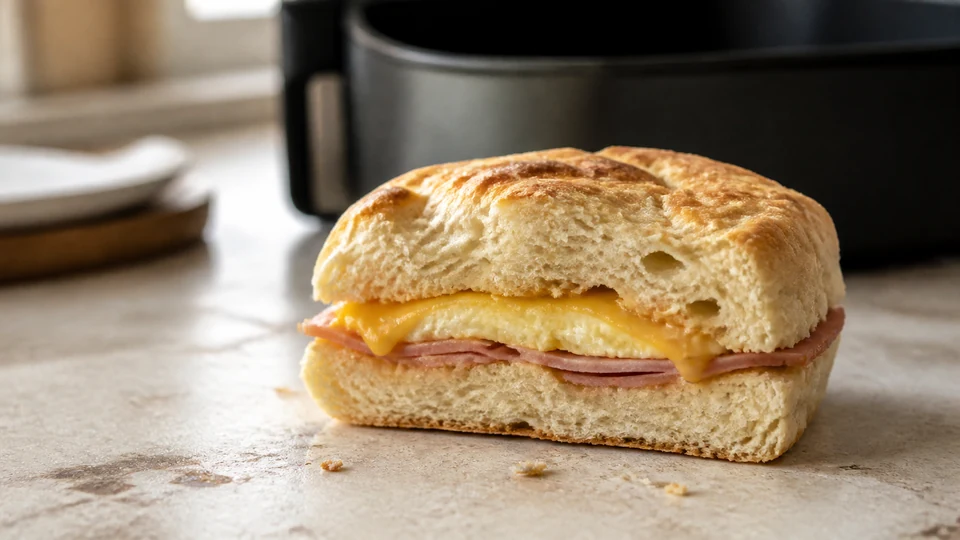
This is a technique and safety guide, not a Pancake World-tested recipe. The breakfast hub covers other morning formats, while Pancake World connects the broader collection.
For broader context, continue with American Breakfast: Pancakes, Diner Plates and Brunch.
Direct answer: choose one of two methods
Method A: one published cook-together formula
Use a complete recipe that specifies appliance capacity, cooking vessels, ingredients, temperature, time and doneness. Food Network Kitchen’s air fryer biscuit egg sandwiches use silicone baking cups for beaten egg and ham alongside refrigerated biscuit dough in a 6-quart appliance. The source gives four servings and checks whether liquid egg remains.
This path is efficient only when your appliance can hold the specified cups and dough with room for air circulation. A smaller, more powerful or differently shaped machine may not reproduce the published timing.
Method B: cook components, then assemble
Cook the egg in a suitable air-fryer-safe vessel. Cook raw sausage or another meat separately to its federal safe minimum. Toast or warm the bread after the wet components are finished. Assemble with cheese and return the sandwich only long enough to melt or warm it as your appliance permits.
This path creates more steps but lets each component reach its own endpoint. It also makes vegetarian, meat-based and cheese-free sandwiches easier to keep distinct.
Why a single universal time does not work
USDA FSIS describes air fryers as countertop convection appliances and notes that size and power change cooking times. Basket geometry, food thickness, starting temperature, vessel material and batch size also affect the result. A time copied from a different model is a starting observation, not proof that an egg or sausage is safe.
Before cooking, record:
- appliance make, model and basket capacity;
- whether preheating is required by the manual;
- the actual food amount and thickness;
- whether a silicone, metal or other approved vessel is used;
- whether ingredients start chilled, frozen or already cooked;
- the package and recipe instructions;
- where a thermometer can reach the centre.
Change one factor at a time. If the bread is too dark, adjust when it enters the basket rather than lowering heat, shortening every component and guessing that the meat still finished.
Build the sandwich as four separate systems
An air fryer breakfast sandwich is not one uniform object. It combines four foods that respond differently.
| System | Main decision | Common failure | Better control |
|---|---|---|---|
| Bread | When it enters the basket | Burnt edges or soggy cut face | Toast late and protect it from wet fillings |
| Egg | Vessel, depth and doneness | Brown top with liquid centre | Use a shallow approved vessel and verify the centre |
| Meat or alternative | Raw versus fully cooked | Unsafe centre or dried reheated slice | Follow label and temperature guidance for the exact product |
| Cheese and sauce | Melt and moisture | Cheese blows, sauce soaks bread | Add near the end; serve wet sauce separately |
Control each system, then combine them. A beautiful browned sandwich can still contain an undercooked sausage patty or wet egg.
Choose the bread first
The bread determines basket space and assembly stability. English muffins, biscuits, bagels, rolls and sliced bread can all work when a complete method supports them, but they do not toast at the same rate.
An English muffin has a rough cut surface that can crisp quickly. A biscuit may need to cook from raw dough before it becomes a sandwich. A bagel is dense and can become hard if reheated too long. Thin sandwich bread may lift in strong circulating air or darken before a thick filling warms.
Read the appliance manual before using racks, toothpicks, foil or parchment. Do not improvise a weight that can contact the heating element. If the bread tends to move, toast it in the approved configuration or assemble only after cooking.
For a crisp result, keep wet ingredients off the cut surface until the end. Drain cooked vegetables, let excess steam escape from hot fillings briefly without leaving them at unsafe temperature, and apply sauces at the table.
Egg options and their tradeoffs
Beaten egg in a silicone cup
This produces a contained portion that can fit a round sandwich. Use only a cup approved for your appliance and leave space around it. A deep cup cooks more slowly at the centre than a shallow layer.
FoodSafety.gov lists 160°F for egg dishes. Check the centre and more than one place when the shape is uneven. The FDA also advises cooking egg dishes to 160°F and scrambled eggs until firm, not runny.
Whole egg in a small dish
A whole egg may set unevenly, with firm edges and a softer centre. Do not assume a browned white means the yolk reached the intended endpoint. For guests who need fully cooked egg, select a method that produces a firm yolk and white.
Precooked egg portion
A fully cooked refrigerated egg patty can be reheated and assembled, following its package directions. FoodSafety.gov lists 165°F for leftovers. Confirm whether a bought product is fully cooked or merely formed and frozen; the label controls the preparation decision.
No egg
A breakfast sandwich does not need an egg. Use a separately cooked bean patty, tofu preparation, mushrooms or vegetables from a complete recipe. Plant-based products may still require cooking and may contain soy, wheat or other allergens.
Meat: identify raw, fully cooked or leftover
The same-looking sausage patty can belong to different safety categories. Read the package.
- Ground pork or beef sausage requires 160°F.
- Ground poultry sausage requires 165°F.
- A fully cooked packaged patty must be reheated according to its label.
- Leftover cooked filling should reach 165°F.
- Whole cuts have their own temperature and rest requirements.
USDA’s air fryer safety guidance warns against overcrowding because restricted airflow can cause uneven cooking. Cook in batches rather than pressing multiple patties against one another.
Keep raw meat and its plate away from bread, cheese and cooked egg. Never return cooked food to a plate that held raw meat unless it has been washed. Wash hands and clean surfaces after handling raw ingredients.
USDA also says not to cook raw stuffed breaded chicken-breast products in an air fryer; follow the manufacturer’s oven instructions for those products. They are not an appropriate shortcut for this sandwich.
How to measure thin patties correctly
USDA FSIS’s food thermometer guidance recommends inserting the probe from the side of a thin food so the sensing area reaches the centre. Inserting from the top can push the sensor through the patty and measure hot air or the basket instead.
Remove the patty to a clean plate or spatula when necessary to avoid burns. Insert the thermometer horizontally into the thickest part. Check more than one patty in a batch, especially when positions in the basket differ.
Clean the thermometer according to its instructions between raw and cooked checks. If the centre is below the required temperature, continue cooking and recheck with a clean probe.
Cheese: melt it without losing it
Thin cheese can lift in fast-moving air when it is not anchored. Add it on top of a hot, substantial filling near the end, or place it inside the assembled sandwich if the manual permits that configuration.
Do not cover the basket airflow with an improvised sheet. Follow the appliance instructions for foil or accessories. A short melt stage is easier to control than cooking loose cheese from the beginning.
Cheddar, American-style slices, Swiss, provolone and other melting cheeses behave differently. Choose by taste and label, not an unsupported claim that one is universally best. Cheese adds milk; plant-based slices may contain soy, nuts or other allergens.
A controlled component-first workflow
This workflow is a decision sequence, not a new ingredient formula.
- Select a complete recipe or package direction for every raw component.
- Confirm that vessels and accessories are approved for the appliance.
- Preheat only if the manual or selected recipe requires it.
- Cook raw meat separately from ready-to-eat bread and cheese.
- Verify ground meat or poultry with a thermometer.
- Cook the egg in an approved shallow vessel and verify the centre.
- Move cooked components to clean plates.
- Toast or warm the bread in a basket that is no longer contaminated by raw food.
- Assemble with cheese; return briefly only if the appliance instructions allow.
- Add cold vegetables or sauce after cooking.
- Serve immediately or apply verified holding and chilling controls.
This order gives bread the shortest exposure and keeps raw meat work away from final assembly.
Can everything cook together?
Only when a tested, complete source says it can for the specified equipment. The Food Network biscuit-and-egg formula shows one such design: silicone cups and biscuit dough share a 6-quart basket at a defined setting, and the source checks for liquid egg before assembly.
Do not extend that evidence to raw sausage, a different dough, deeper cups or a smaller basket. Adding a raw patty can block airflow and introduce a temperature endpoint the original formula did not manage.
If you want meat, cook it in a separate batch or use a complete recipe that includes it. If you want a different bread, treat it as a new component with its own package directions.
Four practical sandwich paths
Biscuit, egg and ham
Follow the complete Food Network Kitchen formula for its ingredients, cups, basket size and timing. Verify the egg rather than relying only on the biscuit colour. Ham may contain significant salt and can vary in whether it is ready to eat; use the exact product required and follow its label.
English muffin, egg and sausage
Cook a ground sausage patty to 160°F for pork or beef, or 165°F for poultry. Cook the egg separately to its required endpoint. Toast the split muffin late, assemble with cheese if desired, and avoid prolonged reheating that hardens the bread.
No universal cooking time is provided because patty thickness and appliance performance vary. Use a complete sausage method and a thermometer.
Bagel, egg and vegetables
Cook the egg in an approved vessel. Separately cook mushrooms, peppers or spinach using a complete air-fryer or stovetop method and drain excess moisture. Toast the bagel briefly, then assemble.
Do not pack raw wet vegetables around an egg cup and assume both will finish together. Their steam can change the egg surface and bread texture.
Vegetarian cheese and bean patty
Use a fully cooked bean patty reheated according to its label or a complete homemade formula. Toast the bread, add cheese late and serve with tomato or greens after cooking.
Check wheat, milk, egg, soy and sesame across the bread, patty, cheese and sauce. Vegetarian does not mean allergen-free.
Frozen breakfast sandwiches
Follow the package, not a generic web time. Some products are fully cooked and need reheating; others contain components that must be cooked. Packaging may direct microwave defrosting before crisping, wrapper removal, component separation or a conventional oven only.
If the package does not provide air-fryer instructions, use a manufacturer-approved method or another cooking appliance named on the label. A browned frozen exterior can hide a cold centre.
For a fully cooked product reheated as a leftover-type food, verify 165°F where applicable. Check the centre between the egg and meat, not only the exposed bread.
Make-ahead sandwiches
Use a complete make-ahead recipe with explicit cooling, wrapping, refrigeration or freezing and reheating instructions. Do not assemble hot egg and meat into bread and place the dense warm stack directly into storage without a cooling plan.
For home-cooked components, refrigerate within two hours. Divide batches so they cool promptly. Keep ingredient dates and do not mix a newly cooked sandwich with an older unlabelled one.
When reheating, remove any material not approved for the air fryer. Follow the make-ahead recipe and appliance directions, then verify 165°F for leftovers. Add fresh tomato, avocado or greens after reheating so they do not become hot and watery.
Food allergies and cross-contact
A typical breakfast sandwich can contain egg, milk, wheat, soy and sesame. Sausage, sauces and meat alternatives can introduce additional allergens. Read every package each time because formulations can change.
For a serious allergy:
- prepare the required sandwich before shared crumbs or raw egg spread;
- use clean vessels, plates and utensils;
- keep the alternative covered and labelled;
- do not use the same unwashed basket after an allergenic spill;
- follow the guest’s required controls;
- do not claim the appliance makes a food allergen-free.
An air fryer circulates air and crumbs. Physical distance inside the same basket is not a validated cross-contact barrier.
Troubleshooting by symptom
Bread burns before the egg sets
Cook the egg first and add bread later. Check whether the recipe expected a lower rack, a protective vessel or a different appliance capacity. Do not lower the egg endpoint to save the bread.
Egg looks set but is wet underneath
Lift it safely from the cup and inspect the base as the complete source directs. Use a thermometer at the centre and in more than one location. Reduce depth or batch size on the next attempt rather than extending time blindly.
Sausage is browned but below temperature
Continue cooking until the centre reaches the applicable safe minimum. Reduce patty thickness next time using a complete recipe, or cook fewer patties with more airflow. Colour is not a substitute for measurement.
Cheese blows off
Add it later and anchor it between bread and a hot filling. Consult the manual before using accessories or toothpicks. Never allow loose material to contact a heating element.
Sandwich is hot outside and cold inside
Reheat components separately or open the sandwich so heat can reach the centre, following approved directions. Measure the coolest central area. A thicker assembled sandwich may need a lower-intensity staged process rather than more surface browning.
Bread is soggy
Drain vegetables, keep sauce separate and toast bread after cooking wet components. Let excess steam dissipate briefly on a clean surface while staying within safe service time. Do not seal a steaming sandwich for storage.
Basket smokes
Stop and follow the appliance manual. Excess fat, crumbs or cheese near the element may be involved. Do not pour water into a hot electrical appliance. Clean only after the unit is unplugged and cooled according to its instructions.
Batch cooking for several people
Basket capacity is the limiting factor. Lay out one uncrowded test batch and record the number that fits without blocking airflow. Multiply batches, not basket density.
Keep raw components refrigerated until their turn. Hold cooked food only with a validated method; an idle air fryer may not maintain 140°F. If safe hot holding is unavailable, choose a different menu or serve batches immediately.
Assign one clean plate for cooked fillings and one clearly separate plate for raw meat. Reset the basket between allergen-sensitive variants when required. Toast bread in the final batches so early pieces do not dry out.
For a large group, a sheet-pan egg sandwich or conventional oven method designed for the yield may be more practical. An air fryer is not automatically the best tool simply because the route concerns one.
Cleaning and shutdown
After cooking, unplug the appliance and allow it to cool as the manual directs. Remove crumbs, grease and melted cheese from approved removable parts. Wash and dry the egg cups, thermometer, turner and plates.
Do not immerse the electrical body. Inspect the basket coating and accessories, and stop using damaged items according to manufacturer guidance. Clean the work surface where raw egg or meat was handled.
Refrigerate leftovers within two hours. Label them and reheat to 165°F using an approved method.
Final pre-cook checklist
- The appliance manual and food packages permit the planned method.
- The basket has room for air to circulate.
- Every raw component has a safe endpoint.
- A clean thermometer can reach the centre of thin patties from the side.
- Egg and meat will cook before bread and cheese are exposed too long.
- Raw and cooked plates are separate.
- Silicone cups or other vessels are approved for the appliance.
- Allergens are known and alternatives are protected.
- Leftovers can be chilled within two hours.
- The first batch will be recorded before any adjustment.
The dependable air fryer breakfast sandwich is assembled from verified components. Control airflow, temperature and sequence first; crisp bread and melted cheese then become manageable finishing decisions.
Explore related Pancakes World guidance on American Pancakes, Maple Syrup, and Maple Syrup Pancakes.
Sources and editorial references
- USDA FSIS, “Air Fryers and Food Safety.”
https://www.fsis.usda.gov/food-safety/safe-food-handling-and-preparation/food-safety-basics/air-fryers-and-food-safety - FoodSafety.gov, “Safe Minimum Internal Temperatures.”
https://www.foodsafety.gov/food-safety-charts/safe-minimum-internal-temperatures - USDA FSIS, “Food Thermometers.”
https://www.fsis.usda.gov/food-safety/safe-food-handling-and-preparation/food-safety-basics/food-thermometers - FDA, “What You Need to Know About Egg Safety.”
https://www.fda.gov/media/82227/download - Food Network Kitchen, “Air Fryer Biscuit Egg Sandwiches.”
https://www.foodnetwork.com/recipes/food-network-kitchen/air-fryer-biscuit-egg-sandwiches-11284868 - Food Network Kitchen, “Air Fryer Grilled Cheese.”
https://www.foodnetwork.com/recipes/food-network-kitchen/air-fryer-grilled-cheese-16412915