8 healthy baked oatmeal recipes for breakfast
At Pancakes World, the most useful healthy baked oatmeal recipe is one whose complete ingredient list, serving size, sweetness, allergens, and preparation method fit the people eating it. The eight evidence-backed choices below cover blueberry and walnut, apple and cinnamon, chocolate and banana, mixed berries, cane berries, peach, banana-blueberry, and pumpkin. Each comes from a university extension program, government nutrition service, or established culinary organization. Follow the linked recipe for quantities and baking directions; this guide helps you compare them without pretending that oats or fruit alone make every pan universally healthy.
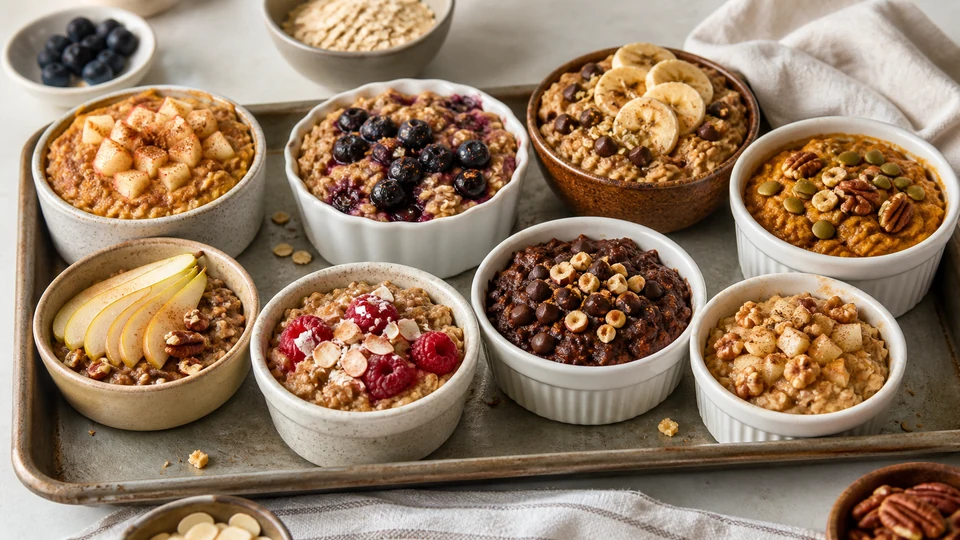
The breakfast hub contains more morning meal formats, while Pancake World connects the broader collection. This page focuses only on choosing, preparing, and storing baked oatmeal responsibly for a US kitchen.
For broader context, continue with Healthy Pancake Guides.
Direct answer: choose by the whole recipe
Start with the eater, not the flavor. Check egg, milk, nut, soy, and gluten requirements. Then compare the source recipe’s serving size and Nutrition Facts when supplied, paying particular attention to added sugars, saturated fat, sodium, and dietary fiber in the context of the entire day. Choose rolled-oat versions when you prefer a distinct oat texture, fruit-forward versions when you want fruit in every portion, and the chocolate version when a measured cocoa-and-chocolate profile is the actual goal. For make-ahead breakfasts, confirm the publisher’s storage instructions and refrigerate promptly.
“Healthy” is not a magic property created by putting oatmeal in the title. It is a broad, personal planning term. Someone managing an allergy, celiac disease, diabetes, kidney disease, or another condition may need advice from a qualified clinician and may not be served by a generic online ranking. For general comparison, FDA label information and USDA MyPlate guidance offer a more defensible basis than slogans.
The eight recipes at a glance
| No. | Recipe path | Main character | Source | Useful when |
|---|---|---|---|---|
| 1 | Blueberry-walnut | Soft fruit, applesauce, optional crunch | University of Maine Extension | You want a straightforward square-pan formula |
| 2 | Apple-cinnamon | Chopped apple and warm spice | Academy of Nutrition and Dietetics | You want an apple-led make-ahead option |
| 3 | Chocolate-banana | Cocoa, banana, maple, flax, chocolate | King Arthur Baking | Chocolate is an intentional part of breakfast |
| 4 | Strawberry-blueberry-banana | Three fruits plus measured chocolate chips | University of Illinois Extension | A mixed-fruit casserole suits the table |
| 5 | Cane-berry | Raspberry, blackberry, or marionberry | Oregon State University Extension | You have fresh or frozen cane berries |
| 6 | Peach | Peach with cinnamon, allspice, and nutmeg | West Virginia University Extension | Fresh or frozen peaches are the priority |
| 7 | Banana-blueberry | Sliced banana, blueberries, and nuts | University of Maryland Extension | You want a substantial fruit-and-nut pan |
| 8 | Pumpkin | Pumpkin, spice, fruit, milk, and egg | US Department of Veterans Affairs | A pumpkin-centered seasonal pan fits |
These are eight separate formulas. Their pan sizes, liquid ratios, sweeteners, egg systems, and bake times are not interchangeable. Select one source and follow it in full.
1. Blueberry-walnut baked oatmeal
The University of Maine Cooperative Extension publishes a baked oatmeal made with dry oatmeal, frozen blueberries, optional chopped walnuts, baking powder, cinnamon, nonfat milk, unsweetened applesauce, egg, and vegetable oil. It is a compact starting point for readers who want recognizable supermarket ingredients and a square-pan breakfast.
Choose this recipe when frozen blueberries are easier to obtain than consistently good fresh berries. Frozen fruit also removes washing and short shelf-life decisions from the morning, although it still needs to be stored and handled according to its package. The source allows old-fashioned or quick oats, which gives the cook an explicit choice rather than an improvised substitution.
The optional walnuts provide texture, but they also introduce a tree-nut allergen. Leaving them out changes the eating experience and the published nutrition information, but it is preferable to casually serving nuts to someone who cannot eat them. If nuts are appropriate, distribute them as the recipe specifies so one portion does not collect most of the topping.
Applesauce contributes moisture, so do not add extra fruit purée and assume the original bake time will still work. Use the University of Maine baked oatmeal recipe for exact quantities, pan, temperature, and directions.
Best decision factors:
- frozen-blueberry availability;
- preference for applesauce in the liquid system;
- whether walnuts are safe and wanted;
- old-fashioned versus quick-oat texture within the source’s allowed choices.
2. Apple-cinnamon baked oatmeal
The Academy of Nutrition and Dietetics publishes an apple-cinnamon version built around rolled oats, chopped apples, cinnamon, milk or soy milk, brown sugar, baking powder, margarine, and an egg-white or egg-substitute component. The apple is folded through the oat mixture rather than treated as a separate pie-style layer.
Choose it when apple pieces and cinnamon are the desired profile and the recipe’s egg and milk options match the diners. “Milk or soy milk” is an explicit choice in that formula; it is not permission to assume every plant beverage behaves identically. A sweetened or flavored beverage can alter added sugars and flavor. Check the product label and use the option the source supports.
The recipe’s use of egg substitute or egg whites deserves a careful label review. Liquid egg products vary, and a carton’s serving or storage instructions remain relevant. Soy milk introduces soy as a major US allergen; dairy milk introduces milk. The finished pan should be labeled accurately if it is shared.
Use the Academy’s apple-cinnamon baked oatmeal recipe for the actual formula. Its published nutrition information applies to the recipe and serving described by the source, not to a larger square or a version with extra nuts, syrup, or yogurt.
Best decision factors:
- preference for chopped apple rather than berries;
- compatibility with the specified milk and egg options;
- willingness to measure brown sugar rather than sweeten by eye;
- interest in a firm, portionable square-pan breakfast.
3. Chocolate-banana baked oatmeal
King Arthur Baking’s chocolate baked oatmeal uses oats, cocoa, flax meal, baking powder, salt, dairy-free milk, mashed banana, maple syrup, oil, vanilla, chocolate chips, and optional nuts for serving. It is deliberately a chocolate recipe, not plain oatmeal with a dusting of cocoa on top.
Choose it when chocolate is the priority and the household wants a source-designed dairy-free structure. The formula uses banana as part of the wet mixture and flax as part of its set, so deleting either can affect more than flavor. King Arthur also provides a separate, explicit non-vegan adjustment involving milk and eggs. Follow the applicable version rather than trying to combine both.
This recipe illustrates why “naturally sweetened” is not the same as “free of added sugars.” FDA explains that maple syrup counts within added-sugar labeling even though it is a single-ingredient syrup. Chocolate chips can contribute additional added sugars. Readers comparing breakfast options should evaluate the whole formula and intended serving, not treat maple syrup as nutritionally invisible.
King Arthur gives specific overnight guidance and distinguishes old-fashioned oats from quick oats for that preparation. That is source-specific testing guidance worth preserving. Do not transfer the overnight method to one of the egg-heavy extension recipes without confirmation from its publisher.
Use the King Arthur chocolate baked oatmeal recipe for weights, pan, baking endpoint, overnight method, and its documented alternatives.
Best decision factors:
- a genuine preference for a chocolate breakfast;
- need for the source’s dairy-free base;
- acceptance of banana and flax in the structure;
- careful comparison of maple syrup and chocolate-chip contributions.
4. Strawberry-blueberry-banana oatmeal casserole
University of Illinois Extension documents a casserole with rolled oats, brown sugar, baking powder, cinnamon, chocolate chips, strawberries, blueberries, banana, nonfat milk, egg, margarine, and vanilla. Three fruits create a different result from a single-fruit pan: pieces, juices, and sweetness are distributed across the dish.
Choose this formula for a shared brunch where a mixed-fruit profile is more appealing than one dominant fruit. It is also a useful option when smaller amounts of several fruits need a planned use. That does not mean any arbitrary fruit combination can be substituted at the same volume. Strawberries, blueberries, and banana behave differently from diced apple, canned pineapple, or watery melon.
The chocolate chips are a measured ingredient in the source, not an unlimited garnish. If your reason for seeking a “healthy” breakfast includes comparing added sugars, keep that quantity visible in the decision. Removing or changing the chips will make the published nutrition panel no longer exact, though the source formula remains a useful reference.
Fresh fruit should be rinsed under running water and prepared on clean equipment. If using frozen fruit instead, do so only when the recipe or product directions support it; frozen fruit may release moisture differently.
Use the Illinois Extension baked oatmeal berry casserole for its exact fruit amounts, pan, baking time, and storage note.
Best decision factors:
- desire for three distinct fruits in one pan;
- suitability of dairy and egg;
- whether measured chocolate chips fit the plan;
- a group large enough to use the casserole safely.
5. Cane-berry baked oatmeal
Oregon State University Extension’s Food Hero recipe centres on cane berries: raspberries, blackberries, or marionberries, fresh or frozen. The formula pairs old-fashioned rolled oats with baking powder, cinnamon, salt, eggs, brown sugar, vanilla, milk, melted margarine or butter, and optional walnuts.
Choose this version when tart or aromatic cane berries are the main attraction. OSU explicitly names fresh or frozen fruit, making it a practical year-round option without inventing the substitution. The source also suggests other seasonings such as nutmeg or powdered ginger, so those are documented variations rather than guesses.
Cane berries can break during mixing and colour the liquid. Stir as gently as the source directs. Frozen fruit may cool the mixture, but do not compensate by increasing oven heat without evidence. Use the published endpoint and timing range.
The formula contains egg and dairy unless a tested source alternative is used, and optional walnuts add a tree-nut issue. Butter and margarine differ in ingredients and saturated-fat profiles; the source allows either, but a reader comparing packaged products should consult the Nutrition Facts label rather than assuming they are identical.
Use the OSU Extension baked berry oatmeal recipe for quantities, directions, food-handling steps, and its stated seasoning options.
Best decision factors:
- access to raspberries, blackberries, or marionberries;
- preference for a berry-led rather than banana-led pan;
- comfort with the recipe’s eggs and milk;
- whether optional walnuts and alternative spices fit.
6. Peach oatmeal bake
West Virginia University Extension publishes a peach oatmeal bake made with old-fashioned rolled oats, baking powder, cinnamon, allspice, nutmeg, milk, egg, honey, and fresh or frozen sliced peaches. Its fruit-and-spice profile is distinct from apple-cinnamon oatmeal even though both use warm spices.
Choose it when peaches are available frozen or in season and you want fruit slices rather than purée. The source’s fresh-or-frozen choice is useful; it avoids the need to improvise with canned peaches packed in syrup. If canned fruit is all that is available, find a recipe written for it instead of importing extra liquid and sugar into this formula.
Honey is an added sugar in FDA labeling context, even though it comes from a single ingredient. Measure it as written. The presence of fruit does not cancel its contribution, and “no white sugar” is not a meaningful substitute for reading the complete recipe.
The recipe uses a square pan and serves a group. Arrange fruit with reasonable distribution so portions are comparable, but do not rebuild the formula as a decorative peach layer unless the source directs it.
Use the WVU Extension peach oatmeal bake for the exact amount of peach, spice mixture, liquid, pan, and baking schedule.
Best decision factors:
- fresh or frozen peach availability;
- preference for honey within the documented formula;
- desire for cinnamon, allspice, and nutmeg together;
- need for a simple, fruit-forward square pan.
7. Banana-blueberry baked oatmeal
University of Maryland Extension’s SNAP-Ed recipe combines whole rolled oats, chopped nuts, brown sugar, baking powder, cinnamon, milk, egg, melted margarine or butter, optional vanilla, blueberries, and sliced bananas. Unlike a recipe that uses mashed banana as a binder, this one uses visible banana slices as fruit.
Choose it when you want two fruits and nut texture without the strawberry and chocolate-chip components of recipe four. This distinction matters: “banana-blueberry” is not simply a shorter name for the Illinois mixed-berry casserole. It has its own ratios, pan, temperature, and serving information.
Bananas at different ripeness levels bring different sweetness, firmness, and moisture. Use fruit suitable for slicing if the source calls for slices; very soft bananas may be better reserved for a formula that specifies mashing. Rinse blueberries, remove damaged fruit, and keep preparation surfaces clean.
The source supplies a Nutrition Facts panel for its stated serving. That is useful for comparison, but the figures should not be copied onto an altered version. Changing milk, nuts, sugar, fat, portion size, or fruit quantity changes the calculation.
Use the University of Maryland banana-blueberry baked oatmeal recipe for exact quantities and directions.
Best decision factors:
- preference for sliced banana rather than mashed banana;
- blueberries plus nuts in every portion;
- a need for a source-published Nutrition Facts reference;
- compatibility with milk, egg, and tree nuts.
8. Baked pumpkin oatmeal
The US Department of Veterans Affairs publishes a baked pumpkin oatmeal formula through its Nutrition and Food Services recipe collection. It uses oatmeal with pumpkin, spices, fruit, milk, egg, and optional nuts in the quantities and sequence specified by the document.
Choose it when pumpkin is the defining ingredient and a government nutrition-service formula fits your needs. Pumpkin purée changes moisture and body, so it should not be added freely to one of the berry recipes. Likewise, pumpkin pie filling and plain pumpkin are different packaged products; follow the ingredient identity in the VA recipe and read the label.
Spice blends can contain only spices or can be sold in other prepared products with sugar and additional ingredients. Use the exact type the recipe requires. If nuts are optional, make the allergy decision before mixing, not after the pan reaches the table.
Pumpkin versions are often described as seasonal, but canned pumpkin can make the formula possible at other times. Availability and price vary, so this article does not promise either. Confirm the can size and storage directions rather than keeping an open container indefinitely.
Use the VA baked pumpkin oatmeal recipe for the complete ingredient list, amounts, and directions.
Best decision factors:
- pumpkin as the central flavor and texture;
- preference for the specified fruit and spice combination;
- accurate identification of plain pumpkin versus pie filling;
- a plan for any unused canned ingredient.
What “healthy” can responsibly mean here
For this comparison, “healthy” means making an informed choice from the complete recipe and the eater’s broader needs. It does not mean that every square should be marketed with a health claim.
Look at the grain
USDA MyPlate encourages making at least half of grain choices whole grains and names oatmeal as a whole-grain breakfast option. That supports choosing oats as one possible whole-grain food. It does not prove that every oat bake has the same nutrition, nor does it rank baked oatmeal above all other breakfasts.
Check the oat product’s ingredient statement. Old-fashioned rolled oats, quick oats, and steel-cut oats are processed into different shapes and do not absorb liquid on the same schedule. Use the form named by the recipe. Instant flavored packets can bring sweeteners, salt, and flavorings not accounted for in a formula written for plain oats.
Compare added sugars instead of arguing about sweetener names
Brown sugar, maple syrup, honey, chocolate chips, sweetened plant beverages, and some dried fruits can affect total or added sugar. FDA distinguishes total sugars from added sugars and requires added sugars on most packaged-food Nutrition Facts labels. The agency’s general guide treats 5% Daily Value or less per serving as low and 20% or more as high for an individual nutrient.
Use that label framework to compare packaged ingredients and finished commercial products. A homemade recipe without a validated nutrient analysis does not acquire an accurate %DV because someone entered approximate ingredients into a casual calculator. Portion size also matters: doubling the square doubles what is consumed from that pan.
Consider the whole breakfast
A baked oatmeal square can be served alone or alongside plain yogurt, milk, fruit, eggs, or another food. Additions change allergens, energy, saturated fat, sodium, added sugars, and other nutrients. They may be useful or unnecessary depending on the person and portion.
Avoid “protein hacks” that the source has not tested. Protein powders, extra eggs, large quantities of nut butter, and strained yogurt can change liquid absorption, set, flavor, and allergen profile. If a specific nutrition target matters, choose a formula developed for it or work with a qualified professional.
Ingredient decisions that affect the result
Rolled oats versus quick or steel-cut oats
Most recipes in this list specify rolled or old-fashioned oats; the University of Maine explicitly permits old-fashioned or quick oats. Quick oats generally create a softer, more uniform texture because their pieces are smaller. Steel-cut oats need substantially different hydration and time and should not replace rolled oats unless the recipe publisher gives a tested method.
Use volume or weight as the source presents it. Packing oats into a cup or using a differently sized scoop can change the balance. Keep the measuring method consistent across the batch.
Fresh, frozen, dried, and canned fruit
These forms are not automatically equivalent. Fresh and frozen berries may work in a recipe that explicitly permits both. Dried fruit is concentrated and absorbs or releases moisture differently. Canned fruit can bring packing liquid. Fruit purée participates in the wet structure, while slices remain distinct.
Use the form named by the recipe. When a publisher offers an alternative, follow its quantity. Drain, thaw, or rinse only as directed by the source or product label.
Eggs and milk
Several formulas rely on egg to set the oat mixture. Omitting it can produce a loose pan unless the recipe provides a tested binder such as flax. King Arthur’s chocolate formula is structurally different from the egg-based extension formulas; its flax-and-banana system cannot be copied blindly into all seven.
Dairy milk, soy milk, and other beverages differ in protein, sugar, flavor, and fortification. Use an option supported by the selected recipe. If an allergy is involved, check every label and manage cross-contact in the kitchen.
Nuts and seeds
Walnuts, almonds, and other nuts can add crunch, but they are not a neutral garnish for people with allergies. Decide before mixing whether a nut-inclusive pan is appropriate. Serving nuts in a bowl on the side may reduce unwanted inclusion, but it does not solve cross-contact if the same utensils or surfaces are used.
Seeds are not universally safe substitutes and may change texture or hydration. Only make substitutions supported by the recipe or an appropriate professional resource.
Gluten-free and allergen checks
Oats do not contain wheat, rye, or barley as an inherent ingredient, but gluten cross-contact and labeling still matter. FDA states that oats may bear a gluten-free claim only when the food meets the federal definition, including less than 20 parts per million of gluten. For a person who needs a gluten-free diet, choose oats and every other packaged ingredient with suitable labeling; ordinary oats should not be declared safe merely from the grain name.
Check baking powder, spices, chocolate chips, plant beverages, egg substitutes, and toppings as well as the oats. A finished recipe is only as suitable as all its ingredients and the preparation environment.
The major allergens most likely to appear across these eight recipes include milk, egg, tree nuts, and soy. Products can add others. A “dairy-free” formula may still contain nuts or soy, and “vegan” does not automatically mean gluten-free. Make only claims that the actual labels and kitchen controls support.
Make-ahead workflow without a soggy or unsafe pan
Begin by reading the chosen source recipe completely. Confirm the pan, oven temperature, oat type, fruit form, and whether overnight assembly is explicitly allowed. King Arthur supplies an overnight method for its chocolate version; that does not establish an overnight method for every other recipe.
For most plans, a safe practical approach is to bake the complete recipe, cool it promptly, portion it with clean equipment, cover it, and refrigerate. FoodSafety.gov lists baked egg casseroles at three to four days in a refrigerator maintained at 40°F (4°C) or below. Some source pages may state a different quality window; use the more cautious applicable safety boundary and assess the exact ingredients.
Do not leave a large hot pan sealed on the counter for an extended period. Divide or portion as appropriate so food cools efficiently, without placing unsafe loads in the refrigerator. Refrigerate perishable food within two hours under ordinary conditions, following current government guidance.
Reheat only the portion needed. If using a microwave, spread the oatmeal in a microwave-safe dish, rotate or stir when practical, and allow standing time so cold spots are reduced. Toppings such as yogurt or fresh fruit can be added after reheating.
Freezing may preserve a source-approved recipe for longer, but texture changes. Freeze portions in suitable containers, label the date and recipe, thaw under refrigeration, and reheat safely. Do not rely on smell alone to validate food that exceeded safe storage limits.
How to choose among the eight
Use this short sequence:
- Eliminate conflicts. Remove any recipe that cannot meet the diner’s allergy, gluten, egg, dairy, or other requirements without an untested structural change.
- Choose the fruit or flavor. Decide whether the goal is blueberry, apple, chocolate-banana, mixed berry, cane berry, peach, banana-blueberry, or pumpkin.
- Check the oat form. Buy the form named by the recipe rather than assuming every oat cooks alike.
- Compare sweetness transparently. Review measured sweeteners and packaged-ingredient labels. Do not let honey or maple disappear from the comparison because its name sounds less processed.
- Match the pan and time. Verify oven capacity, pan dimensions, preparation time, and cooling time before the morning you plan to serve it.
- Plan portions and storage. A pan that serves eight is only convenient if the household can refrigerate or freeze leftovers safely.
For the simplest frozen-fruit path, start with the University of Maine blueberry formula. For apple, use the Academy recipe. For an intentionally chocolate profile and explicit overnight option, use King Arthur. For a three-fruit brunch pan, use Illinois. For raspberries or blackberries, use OSU. For peach, use WVU. For visible banana and blueberry, use Maryland. For pumpkin, use the VA formula.
Common baked-oatmeal problems
The centre is wet while the edges are firm
Confirm that the pan dimensions, oat type, fruit amount, and oven setting match the source. A smaller or deeper pan changes the distance heat must travel. Extra fruit or purée adds moisture. Continue only according to a reliable recipe endpoint; do not assume browned edges mean an egg-containing centre is done.
The oatmeal is dry and crumbly
The pan may be too large, the oats mismeasured, the fruit changed, or the bake extended beyond the source range. Use the specified oat form and liquid. A glass pan and metal pan can brown differently, so follow the publisher’s pan guidance when supplied.
The result is sweeter than expected
Check every source of sweetness: measured sugar or syrup, ripe fruit, chocolate, sweetened milk, dried fruit, and toppings. Next time choose a recipe designed with a different sweetness profile rather than reducing structural liquids without evidence. At the table, use unsweetened accompaniments if they suit the eater.
Portions fall apart
The pan may not have cooled enough to set, or an egg, flax, or liquid component may have been changed. Baked oatmeal can be spoonable rather than bar-like; the source photograph and serving description can clarify the intended texture. Do not turn a soft casserole into a “failed bar” simply because it does not slice like cake.
The family dislikes reheated texture
Test one refrigerated portion before freezing the entire batch. Add a small amount of milk during reheating only if appropriate for the recipe and diner. Alternatively, choose a smaller batch or serve the oatmeal cold if the source supports it.
Final recommendation
There is no evidence-based need to crown one of these eight recipes the healthiest for everyone. The responsible choice comes from the full formula, actual serving, labels, dietary context, and preparation plan.
Pick the recipe whose structure already fits rather than performing a chain of substitutions. Use its primary page for exact instructions. Read Nutrition Facts and ingredient labels, measure sweeteners, keep allergen claims precise, refrigerate leftovers promptly, and treat published nutrition figures as specific to the published version. That approach is more practical—and more honest—than attaching a universal health promise to a pan of oats.
Explore related Pancakes World guidance on American Pancakes, American Breakfast: Pancakes, Diner Plates and Brunch, and Maple Syrup.
Sources and editorial references
- USDA MyPlate: Make Half Your Grains Whole Grains —
https://www.myplate.gov/sites/default/files/2024-06/TipSheet-4-Make-Half-Your-Grains.pdf - FDA: Added Sugars on the Nutrition Facts Label —
https://www.fda.gov/food/nutrition-facts-label/added-sugars-nutrition-facts-label - FDA: Questions and Answers on Gluten-Free Food Labeling —
https://www.fda.gov/food/nutrition-food-labeling-and-critical-foods/questions-and-answers-gluten-free-food-labeling-final-rule - FoodSafety.gov: Cold Food Storage Chart —
https://www.foodsafety.gov/food-safety-charts/cold-food-storage-charts - University of Maine Cooperative Extension: Baked Oatmeal —
https://extension.umaine.edu/food-health/recipes/baked-oatmeal/ - Academy of Nutrition and Dietetics: Apple Cinnamon Baked Oatmeal —
https://www.eatright.org/recipes/breakfast/apple-cinnamon-baked-oatmeal-recipe - King Arthur Baking: Chocolate Baked Oatmeal —
https://www.kingarthurbaking.com/recipes/chocolate-baked-oatmeal-recipe - University of Illinois Extension: Baked Oatmeal Berry Casserole —
https://extension.illinois.edu/sites/default/files/baked_oatmeal_berry_casserole.pdf - Oregon State University Extension: Baked Berry Oatmeal —
https://extension.oregonstate.edu/imported-publication/baked-berry-oatmeal - West Virginia University Extension: Peach Oatmeal Bake —
https://extension.wvu.edu/food-health/recipes/2020/01/27/peach-oatmeal-bake - University of Maryland Extension: Banana-Blueberry Baked Oatmeal —
https://extension.umd.edu/programs/family-consumer-sciences/snap-ed/eat-smart/recipes/banana-blueberry-baked-oatmeal - US Department of Veterans Affairs: Baked Pumpkin Oatmeal —
https://www.nutrition.va.gov/Recipes/PartiesHolidays/docs/Baked-Pumpkin-OatmealNOV2021.pdf