50 calorie breakfast
At Pancakes World, a 50-Calorie breakfast is best treated as a precisely measured food portion, not as a complete universal breakfast. The most auditable example here is approximately 137 grams of raw strawberries when calculated from USDA FoodData Central record 2346409 using its 36.4-kilocalorie-per-100-gram Atwater General value: 137 × 36.4 ÷ 100 = 49.868 Calories. That result belongs only to that record, energy field and weighed amount. A package can also supply a label-based 50-Calorie portion, but FDA rounding means the printed value is not an exact laboratory measurement. Add other food groups when a fuller meal is appropriate for your individual needs. This page answers the numerical intent without turning 50 Calories into a diet recommendation. Current federal guidance emphasizes whole, nutrient-dense protein foods, dairy, vegetables, fruits, healthy fats and whole grains, and says calorie needs vary with age, sex, height, weight and activity. It does not prescribe a 50-Calorie breakfast. If a clinician gave a precise pre-procedure, diabetes, medication or other medical instruction, follow that written instruction and ask the clinical team what counts; do not substitute this calculation. Browse the American Breakfast: Pancakes, Diner Plates, and Brunch Context for complete formats, or visit the editorial platform for the wider editorial library.
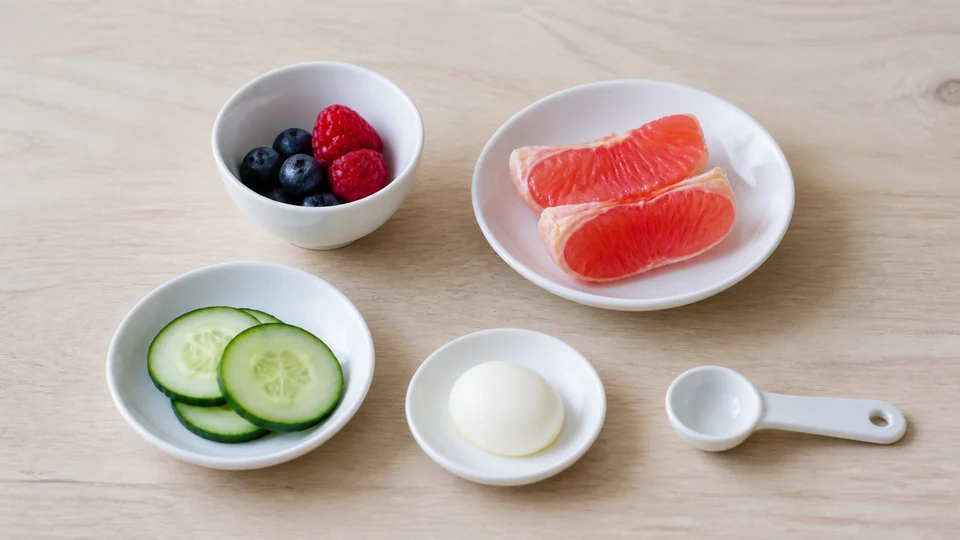
For adjacent decisions around 50 calorie breakfast, compare a flexible healthy breakfast framework, five-morning breakfast preparation, and breakfast from pantry staples.
For broader context, continue with American Breakfast: Pancakes, Diner Plates and Brunch.
First decide what “50 Calories” is meant to do
The phrase can refer to different tasks:
- measuring one fruit portion for a food log;
- finding a small item before a later planned meal;
- satisfying a clinician-defined instruction;
- checking whether a package portion is near a numerical threshold;
- scaling one component within a larger breakfast;
- pursuing severe restriction for weight or body-shape reasons.
These purposes are not interchangeable. A database calculation can solve a measurement task. It cannot establish nutritional adequacy, diagnose a condition, set a personal calorie target or replace a medical instruction.
If the target came from an imaging center, surgical team, diabetes educator, dietitian or prescriber, ask whether the instruction means exactly 50 Calories, no more than 50, a specific carbohydrate amount, a clear-liquid rule, fasting, or something else. Calories alone do not identify ingredients, fiber, fat, protein, carbohydrate, allergens or gastric-emptying requirements.
If the target reflects fixation on keeping meals extremely small, fear of eating, escalating restriction, body-weight obsession, compensatory exercise, purging or distress, stop using this page as a restriction tool and talk with a healthcare professional. The National Institute of Mental Health describes severe restriction and fixation on weight, shape or controlling intake as possible signs of an eating disorder. A single search does not establish a diagnosis, but persistent restrictive behavior deserves professional attention.
Why 50 on a label is not laboratory-exact
FDA requires calorie declarations to use rounding rules. At or below 50 Calories, values are expressed in the nearest 5-Calorie increment; amounts above 50 use a different increment. Therefore a label that prints “50 Calories” supplies a regulated declaration for the labelled serving, not an unrounded assay result of exactly 50.000.
The correct household statement is:
This amount is 50 Calories according to the package declaration and serving basis.
Do not claim:
This amount contains exactly 50.000 Calories.
Food composition also varies. A strawberry lot, apple variety, yogurt batch or homemade loaf does not have perfect uniformity. A home scale has finite resolution. Trimming, drainage, cooking and water loss can change the amount being measured. Precision in arithmetic cannot remove uncertainty in the underlying food data.
Use “about 50 Calories,” “label-based 50 Calories,” or “50 Calories using the named FoodData record and energy field.” Those phrases preserve the evidence boundary.
Method 1: use one exact FoodData Central record
USDA FoodData Central is not one homogeneous table. It includes Foundation Foods, SR Legacy, survey foods and branded foods, each with a different purpose. Match the food identity, preparation state and data type before calculating.
For the worked example, use:
- description: Strawberries, raw;
- data type: Foundation;
- FDC ID: 2346409;
- chosen energy field: Energy (Atwater General Factors), nutrient 2047;
- published value: 36.4 kilocalories per 100 grams.
The target-weight formula is:
target grams = target Calories ÷ Calories per 100 grams × 100
For 50 Calories:
50 ÷ 36.4 × 100 = 137.3626 grams
A household scale reading of 137 grams gives:
137 × 36.4 ÷ 100 = 49.868 Calories
Rounded for ordinary communication, that is about 50 Calories by the selected record and method.
Prepare and weigh the strawberry portion
- Confirm that the food is raw strawberry, not sweetened frozen strawberry, strawberry sauce, dried strawberry or another preparation.
- Wash the intact fruit under appropriate running water.
- Remove inedible tops consistently without soaking the cut fruit.
- Put the serving bowl on a gram scale and tare it to zero.
- Add edible strawberry pieces until the display reads 137 grams.
- Record FDC 2346409, nutrient 2047, 36.4 kcal per 100 grams, the date and the measured 137 grams.
- Serve promptly or refrigerate the cut fruit.
Do not add sugar, syrup, yogurt, cream or another topping while retaining the 49.868 calculation. Every added ingredient needs its own record and weight.
The same USDA record demonstrates method sensitivity
The same strawberry record also publishes Energy (Atwater Specific Factors), nutrient 2048, at 32.7 kilocalories per 100 grams. If that field is selected instead:
50 ÷ 32.7 × 100 = 152.9052 grams
A 153-gram portion calculates to:
153 × 32.7 ÷ 100 = 50.031 Calories
The 137-gram and 153-gram results are not interchangeable. They arise from different energy calculations in the same record. FoodData Central documentation explains the separate Atwater General and Atwater Specific energy fields.
For a reproducible workflow:
- choose one energy field before calculating;
- record its nutrient ID and value;
- use that field for the entire comparison;
- do not average the two values;
- do not quote the smaller weight from one field and the calorie density from the other;
- preserve enough decimals during calculation, then round the final household weight.
This page uses nutrient 2047 for the primary example because the method can be named explicitly. It does not claim that this field is the only valid scientific representation of strawberry energy.
Method 2: scale a packaged food from its label
Use the exact package in hand. Read:
- serving size in grams;
- Calories per serving;
- servings per container;
- whether a second column gives per-package values;
- ingredient list and allergen statement.
If the label declares 50 Calories for one serving, weigh or measure that declared serving according to the label. Describe it as one label-based 50-Calorie serving.
If the label declares another value, use:
target grams = target Calories ÷ labelled Calories per serving × labelled serving grams
For a purely hypothetical arithmetic example, suppose a label states 120 Calories per 40 grams:
50 ÷ 120 × 40 = 16.6667 grams
A scale portion of 16.7 grams is mathematically 50 Calories when the printed ratio is treated as linear. It is not proof of 50 laboratory-exact Calories because the original label value is rounded and real food distribution may not be perfectly uniform.
When label scaling is inappropriate
Do not scale by grams when:
- the product contains visibly separate components that are not evenly distributed;
- liquid has been drained but the label basis is unclear;
- the package gives preparation-as-sold values but water, milk, oil or another ingredient will be added;
- only a per-piece serving is given and individual pieces vary substantially;
- the product is mixed from separate sachets or toppings;
- the portion is too small for the household scale to measure reliably.
In those cases, choose a simpler single food or follow the manufacturer’s complete prepared-product information.
Method 3: calculate a homogeneous recipe from weighed ingredients
A homemade food can be scaled only after its whole recipe has a defensible energy estimate and measured final yield.
- Weigh every edible ingredient in grams.
- Match each ingredient to a correct FoodData Central record or its actual package label.
- Choose and document one energy field for each database food.
- Calculate ingredient Calories from the unrounded values.
- Sum the recipe Calories.
- Weigh the complete cooked or prepared yield after the intended cooling or drainage step.
- Calculate calorie density: total recipe Calories ÷ final yield grams.
- Calculate target weight: 50 ÷ Calories per gram.
This method assumes the finished food is homogeneous enough for energy to be distributed evenly. It is more defensible for blended yogurt mixtures or thoroughly mixed porridge than for a bowl with separate nuts, fruit and granola. If high-energy pieces cluster in one serving, mass alone does not guarantee proportional composition.
No recipe on this page has a project-owned test record, so no homemade 50-Calorie formula or Recipe schema is claimed.
Choose the method by evidence, not convenience
| Situation | Best available method | What the result means | Main limitation |
|---|---|---|---|
| Raw single food with a matched FDC record | grams × named kcal/100 g field | database-estimated energy for that weight | biological and analytical variation |
| Uniform packaged food | scale the labelled serving ratio | label-based estimate | regulated rounding and batch variation |
| Package already declares 50 Calories | use the declared serving | label-based 50-Calorie serving | not an exact unrounded measurement |
| Homogeneous tested recipe | total ingredients ÷ measured yield | calculated recipe estimate | depends on identity, yield and even mixing |
| Mixed plate with separate components | calculate each component separately | sum of component estimates | more measurement steps and accumulated uncertainty |
| Restaurant or buffet food without data | no defensible exact calculation | unknown | recipe, weight and label are missing |
Do not solve missing evidence by searching a visually similar food and copying its number. “Small muffin,” “half banana,” “yogurt spoonful” and “one egg white” are not precise identities or weights.
Candidate 50-Calorie portions that still require verification
The following categories may be practical measurement candidates, but this page does not assign them unverified weights:
Raw fruit
Match the exact raw fruit and edible form to a current Foundation or other appropriate FoodData record. Weigh the edible portion. Do not transfer the strawberry density to blueberries, melon, apple or citrus.
Raw vegetables
Specify peel, edible portion and raw state. A cucumber, carrot, tomato or bell pepper record may have a different energy density. Dips, oils and dressings are separate ingredients.
Plain dairy product
Use the actual Nutrition Facts label. Fat level, straining, flavoring and added sugars make “yogurt” too broad for a generic number. Keep it refrigerated.
Egg white or egg product
Use the package label or an exact FDC preparation record. Raw, cooked, dried and liquid egg products are not interchangeable. Cook according to product and federal safety guidance.
Broth or soup
Use prepared-product values, including required dilution. A concentrate label cannot be applied to a prepared cup without accounting for water and any additions.
Whole-grain cereal
Use the gram serving on the actual package. A very small scaled portion may be mathematically near 50 Calories but should not be described as a complete breakfast or assigned the label’s full serving nutrient values.
Nut, seed or spread
These can require a very small weight for a 50-Calorie target. Use a gram scale capable of that resolution, review allergens and do not estimate with a casual spoonful.
Beverage
Check whether the label is per serving or per container and whether preparation changes the value. “No added sugar,” “fat-free” and “unsweetened” do not automatically mean calorie-free.
From a 50-Calorie item to a fuller breakfast
If 50 Calories is only one tracked component rather than a medical maximum, place it inside a broader meal decision. Current federal guidance prioritizes varied whole, nutrient-dense food groups. Without assigning a universal total, consider whether the breakfast also needs:
- a protein food such as egg, plain dairy, beans, tofu, nuts, seeds, fish or another appropriately prepared option;
- vegetables or fruit beyond the measured component;
- a fiber-rich whole grain;
- a dairy food when used in the individual dietary pattern;
- water or another unsweetened drink.
For example, the measured strawberry portion could accompany plain yogurt and oats, or egg and whole-grain toast. Those additions invalidate the 50-Calorie total by design: the fruit remains the approximately 50-Calorie component, while the entire breakfast is larger. Calculate the total only if the exact products, weights and purpose require it.
Avoid describing this as “earning” additional food or compensating for an earlier meal. Calories are a measurement of energy, not a moral score.
A calculation receipt template
For any claimed 50-Calorie portion, save these fields:
- food name and preparation state;
- brand and product identifier if packaged;
- FDC ID and data type if using USDA data;
- energy nutrient ID and value per 100 grams, or label Calories and gram serving;
- edible weight used;
- formula;
- unrounded result;
- household rounded result;
- scale resolution;
- additions excluded or included;
- preparation and storage date;
- reviewer;
- statement of uncertainty.
Example receipt:
Raw strawberries; FDC 2346409; Foundation; nutrient 2047; 36.4 kcal/100 g; edible weight 137 g; formula 137 × 36.4 ÷ 100; unrounded result 49.868 kcal; reported as approximately 50 Calories; no additions; household scale resolution 1 g.
This receipt lets another person reproduce the arithmetic and see its limits. A bare phrase such as “strawberries, 50 calories” does not.
Error checks before accepting the result
Run these checks:
- Identity: Does the record match raw versus cooked, drained versus undrained and sweetened versus unsweetened?
- Unit: Is the energy value per 100 grams, per serving or per container?
- Field: Did you use one named energy calculation throughout?
- Scale: Was the bowl tared, and can the scale resolve the requested weight?
- Edible portion: Were hulls, peel, pits, shells or drainage treated consistently with the record?
- Additions: Is every topping, spray, milk, oil, syrup or sweetener included?
- Rounding: Were intermediate values kept unrounded until the final step?
- Language: Does the result say approximate or label-based rather than laboratory-exact?
- Purpose: Is the calculation being mistaken for a complete dietary recommendation?
Fail the claim if any required identity or unit is unknown. Choosing another food is safer than manufacturing precision.
Allergen and food-safety boundaries
Calorie math does not establish safety. FDA identifies nine major food allergens for US packaged-food labeling: milk, egg, fish, crustacean shellfish, tree nuts, peanuts, wheat, soy and sesame. Review the ingredient list and Contains statement, and manage cross-contact in the actual kitchen.
For cut fruit, wash intact produce before cutting, use clean tools and refrigerate promptly. Keep cold perishables at 40°F (4°C) or below and return them to refrigeration within two hours, or one hour above 90°F (32°C).
For cooked options, FoodSafety.gov lists 160°F (71°C) for egg dishes and ground meat, and 165°F (74°C) for poultry and leftovers. A tiny portion does not cook faster in a safely predictable way without a tested method; verify the endpoint.
Do not eat a reduced portion of a product that requires full-package preparation unless the instructions support partial preparation. Some sauces, dry mixes and egg products need the complete ratio for safe and accurate handling.
Frequently asked questions
Is 50 Calories enough for breakfast?
This page does not call it a complete or adequate breakfast. Fifty Calories is a measurement target for a small food portion. Individual meal needs cannot be determined from a universal number and depend on the person and full dietary pattern.
What food is exactly 50 Calories?
No ordinary food portion can be promised as exactly 50.000 Calories at home. A package can declare 50 Calories for a serving under FDA rounding rules, or a weighed food can calculate to about 50 using a named database record.
Why does the strawberry example have two possible weights?
FDC 2346409 publishes both Atwater General and Atwater Specific energy values. The primary 137-gram example uses 36.4 kcal/100 g from nutrient 2047. The 153-gram comparison uses 32.7 kcal/100 g from nutrient 2048. Do not mix the fields.
Can I use cups instead of grams?
Grams are more reproducible for scaling. Cup packing, fruit size, cutting and air spaces vary. Use a gram weight tied to the record or label whenever the numerical target matters.
Can I divide a 100-Calorie package in half?
Mathematically, half of the declared serving is 50 label-based Calories if the product is uniformly distributed. The printed 100 is rounded, and heterogeneous pieces may not divide evenly. Weighing half the gram serving improves reproducibility but does not create laboratory exactness.
Does a 50-Calorie item cause weight loss?
No outcome is claimed. Body weight and health cannot be inferred from one item. If weight management is the purpose, seek individualized, evidence-based guidance rather than building a plan around an isolated extremely small breakfast.
When should I stop counting and seek help?
Talk with a healthcare professional if counting is tied to severe restriction, distress, fear of food or weight gain, escalating rules, purging, compulsive exercise or impaired daily functioning. NIMH notes that eating disorders can affect people of any age, sex or body weight and are serious illnesses.
Is this a Recipe page?
No. It is an Article about measurement and decision boundaries. Pancake World has no project-owned tested 50-Calorie recipe, so no Recipe schema, tested yield or universal nutrition panel is claimed.
Explore related Pancakes World guidance on American Pancakes, Maple Syrup, and Maple Syrup Pancakes.
Sources and editorial references
- HHS Office of Disease Prevention and Health Promotion, Current Dietary Guidelines —
https://odphp.health.gov/our-work/nutrition-physical-activity/dietary-guidelines/current-dietary-guidelines - U.S. Department of Health and Human Services and U.S. Department of Agriculture, Dietary Guidelines for Americans, 2025–2030 —
https://cdn.realfood.gov/DGA.pdf - USDA FoodData Central, Strawberries, raw — Foundation Food FDC 2346409 —
https://fdc.nal.usda.gov/fdc-app.html#/food-details/2346409/nutrients - USDA FoodData Central, Foundation Foods Documentation —
https://fdc.nal.usda.gov/Foundation_Foods_Documentation/ - U.S. Food and Drug Administration, Calories on the Nutrition Facts Label —
https://www.fda.gov/food/nutrition-facts-label/calories-nutrition-facts-label - U.S. Food and Drug Administration, How to Understand and Use the Nutrition Facts Label —
https://www.fda.gov/food/nutrition-facts-label/how-understand-and-use-nutrition-facts-label - U.S. Food and Drug Administration, Guide for Developing and Using Data Bases for Nutrition Labeling —
https://www.fda.gov/regulatory-information/search-fda-guidance-documents/guidance-industry-guide-developing-and-using-data-bases-nutrition-labeling - U.S. Food and Drug Administration, Food Allergies —
https://www.fda.gov/food/nutrition-food-labeling-and-critical-foods/food-allergies - FoodSafety.gov, Safe Minimum Internal Temperatures —
https://www.foodsafety.gov/food-safety-charts/safe-minimum-internal-temperatures - USDA Food Safety and Inspection Service, Refrigeration and Food Safety —
https://www.fsis.usda.gov/food-safety/safe-food-handling-and-preparation/food-safety-basics/refrigeration-food-safety - National Institute of Mental Health, Eating Disorders: What You Need to Know —
https://www.nimh.nih.gov/health/publications/eating-disorders