3 ingredient flapjacks
At Pancakes World, choose which three-ingredient flapjack you mean before mixing. For a skillet pancake, use one complete formula built from flour, egg and milk; water, pan oil and toppings may sit outside the three-item batter count only when the recipe says so. For a UK baked oat flapjack, the traditional three-part architecture is oats, butter and syrup, but quantities, pan size, temperature and cooling instructions still must come from a complete source. Do not swap plain and self-rising flour, replace a binder casually, or guess a ratio. Cook flour-and-egg batter completely, and let baked oat bars set as directed before cutting. This page compares the two paths rather than claiming an untested the editorial platform recipe.
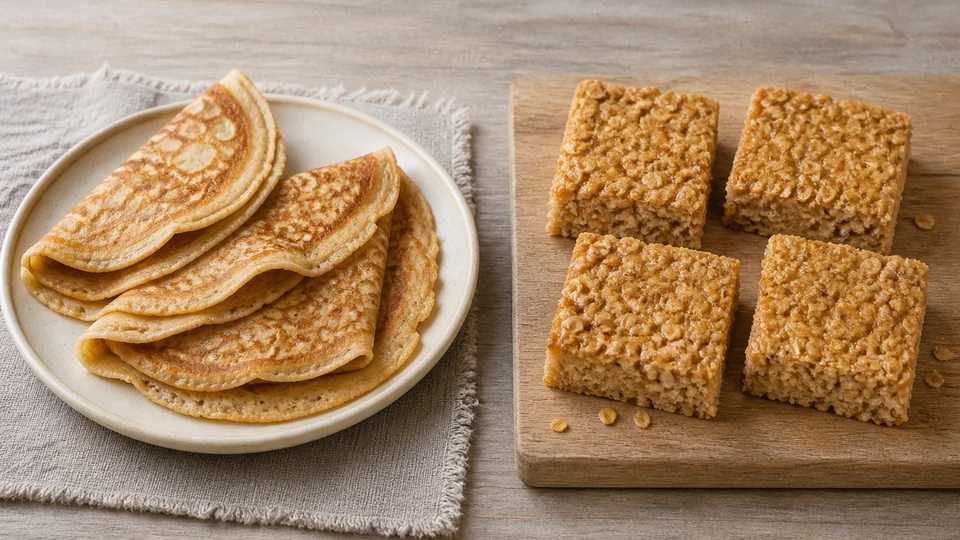
The word “flapjack” has two useful cooking meanings for this query. This page names them “skillet flapjack” and “oat flapjack” in every critical instruction so they cannot be confused. The pancake science hub covers batter mechanics, while Pancake World opens the full collection.
| Guide sections |
|---|
| Two dishes, two three-item systems |
| State the ingredient-count rule |
| Path A: skillet flapjacks |
| Path B: UK oat flapjacks |
For broader context, continue with Pancake Ingredients and Substitutions.
Two dishes, two three-item systems
A skillet flapjack is a pourable batter cooked in a frying pan or on a griddle and turned. The three-item core can be flour, egg and milk. A public NHS recipe documents exactly that core, while also using cold water in the batter, oil in the pan, and lemon and sugar at service. It is therefore a three-component batter under a declared pantry-exception rule, not a literal three-food kitchen project.
A UK oat flapjack is a pressed baked mixture. HM Revenue & Customs describes the traditional product for its narrow tax interpretation as oats, butter and syrup. That government record is strong evidence for what the term can mean; it is not a recipe and supplies no quantities or method. A separate complete cooking source must control the bake.
The two systems should never be merged. Flour, egg and milk form a liquid batter intended to spread and set quickly against a hot surface. Oats, butter and syrup form a coated mass intended to be pressed into a pan, baked and cooled. If a search result does not specify the dish, inspect the method before shopping.
State the ingredient-count rule
“Three ingredient” can mean several things. Pick one rule and disclose it.
Literal count
Every food used in cooking and serving counts. Greasing oil is an ingredient. Water is an ingredient. Salt, sugar, lemon, chocolate and syrup topping are ingredients. Under this rule, many recipes promoted around a three-item core do not qualify.
Batter or base count
Only the three components mixed into the batter or oat base count. Pan fat, water and toppings are listed separately. This is the most useful rule for comparing compact formulas, provided the excluded items are visible before the method begins.
Purchased-product count
A commercial self-rising flour, baking mix or spread counts as one purchased ingredient even though its label lists several components. This convention can produce a genuinely short shopping list, but the exact product type becomes part of the formula. A blend cannot be replaced with plain flour and expected to carry the same leavening or salt.
For every recipe, write: “three-item base; excludes…” and name the exclusions. A minimal title should not hide a fourth ingredient that determines whether the food releases from the pan or holds together.
Path A: skillet flapjacks
What each core ingredient does
The flour supplies most of the dry structure. Its type matters. Plain flour has a different formulation from self-rising flour or a complete pancake blend. Whole-grain and gluten-free products also absorb and set differently. Use exactly the type named by the source.
The egg binds and sets during cooking. It also means the uncooked mixture is raw-egg batter. The FDA advises buying refrigerated eggs with clean, uncracked shells, keeping them refrigerated, and cleaning hands, utensils and surfaces after contact.
The milk hydrates the flour and helps create a pourable batter. The NHS formula also includes measured cold water, demonstrating why the full method matters even when the headline focuses on three foods. Do not omit a specified liquid or substitute another beverage without recipe evidence.
Choose a complete source
The NHS Healthier Families lemon-pancake recipe is a useful benchmark: it provides weights and volumes, yield, preparation and cooking times, batter texture, pan type, portion instruction, turn timing and serving additions. Pancake World does not reproduce its quantities here and has not tested it. Use the source intact if you want that thin pancake.
Reject a three-item formula that lists only flour, egg and milk without stating:
- the flour type;
- egg size or measurable amount;
- milk amount and any additional water;
- mixing order and target consistency;
- resting or chilling allowance, if any;
- pan material or preparation;
- portion size;
- heat level;
- turn cue and second-side completion;
- yield and holding guidance.
The shorter the ingredient list, the more important those process details become. There is no sugar, fat or leavener inside the base to conceal a poorly controlled ratio.
Mix for a smooth thin batter
Follow the source order. The NHS method combines the flour, egg and milk with its stated water and whisks to a smooth, thin batter. A smooth result does not mean endless high-speed mixing. Stop when the source cue is achieved.
If lumps remain, verify that liquid was added as directed and scrape the bowl. Do not add unmeasured milk until the mixture “looks familiar”; familiarity may come from a different pancake style. A thick American-style batter and a thin pan-swirled pancake are not the same target.
Treat flour as raw. The FDA explains that ordinary flour usually has not undergone a kill step. Do not taste the mixture, keep flour and raw batter away from ready-to-eat food, and wash hands, utensils, bowls and work surfaces after contact.
Control the pan
Use the source’s small heavy-based nonstick pan and its oil direction if following the NHS formula. Heat must be stable enough for the underside to set without scorching before the upper surface is ready to turn.
Add the specified portion and move the pan only as the formula directs. A thin pancake relies on controlled spreading; a random extra ladle changes thickness and cooking time. The first piece is an execution check for pan temperature, portion measurement and release, not evidence that Pancake World tested the formula.
Turn when the underside is cooked according to the source cue. Support the pancake with an appropriate spatula. Cook the second side completely. FoodSafety.gov lists 160°F (71°C) for egg dishes, although a very thin pancake can be difficult to probe reliably; follow the complete recipe’s time, thickness and fully cooked-center cues as well. Surface color alone should not excuse raw batter.
Diagnose skillet problems
If the batter does not spread, check flour identity, measurements and any required water before changing the formula. Self-rising flour, plain flour and a blend are not equivalent merely because each is sold as flour.
If the pancake sticks, confirm pan preparation, heat and turn timing. Do not claim that three-item batter is naturally nonstick. Pan condition and the source’s oil instruction still matter.
If it tears, the underside may not be set, the pancake may be too large for the utensil, or the batter ratio may be wrong. Use the specified portion and a broad spatula. Do not “repair” every remaining portion with an unmeasured dry ingredient.
If the first side burns before the top changes, lower the heat and allow the pan to stabilize. A hotter pan does not shorten the whole process if the center remains raw.
Path B: UK oat flapjacks
What the traditional trio does
Oats provide the main dry mass and texture. The recipe must state whether they are porridge oats, rolled oats or another form. Changing the cut can change coating and final structure.
Butter melts to coat the oats and firms differently as the slab cools. A spread or plant fat is not automatically a direct substitute; choose a complete formula developed for it. Nottinghamshire County Council publishes a flapjack recipe using vegetable spread, oats, and syrup or honey, with cinnamon and optional additions. That provides an alternative source architecture, but its full list and method must be followed rather than collapsed into a claim about butter.
Syrup supplies sweetness and helps bind the oat mass. The HMRC terminology record names syrup, not a universal category of every liquid sweetener. Honey, maple syrup and golden syrup should not be treated as identical in a three-item formula without a tested source.
Select a real bake, not only a definition
HMRC’s oats-butter-syrup description resolves the meaning of “traditional flapjack” in a specific tax context. It does not tell a cook how much of each ingredient to use, how deep to press the mixture, how long to bake, or when to cut it. Those controls must come from a complete recipe.
Look for:
- exact oat form and weight;
- exact fat identity and amount;
- exact syrup identity and amount;
- pan dimensions and lining or greasing;
- melting method and heat control;
- mixing cue showing all oats are coated;
- pressed depth;
- oven setting, including fan distinction where relevant;
- bake window and edge or surface cue;
- cooling and scoring instructions;
- yield and storage statement.
If a formula says only “mix oats, butter and syrup and bake until done,” it is not complete enough for a reliable first attempt.
Melt and combine without improvisation
Use the source’s melting sequence and low-heat control. The purpose is to combine the binder ingredients, not to brown the butter or boil the syrup unless the selected formula explicitly requires that. Remove the mixture from heat when directed and coat the measured oats evenly.
Do not taste a hot binder or handle it with bare fingers. Use a spoon or spatula to move the mixture into the prepared pan. Press to the source depth, including the corners, so thin edges do not overcook while the center remains loose.
Bake, cool and cut as one process
Follow the specified temperature and time range. Color can help identify the source’s intended endpoint, but it does not replace its complete method. Remove the pan at the stated cue.
Cooling is part of structure development. Some recipes direct the cook to score while warm and separate only after further cooling. Cutting a hot slab immediately may produce crumbs; leaving a formula that expects warm scoring until completely hard may make neat portions more difficult. Use the source instruction rather than a universal rule.
Do not call the bar shelf-stable merely because it contains no egg or fresh milk. Ingredient labels, recipe water activity, added fruit, substitutions, environment and packaging all affect storage. Follow the complete source and refrigerate when it requires refrigeration.
Diagnose oat-bar problems
If the slab crumbles, check the oat form, binder measurements, coating, pressed depth and cooling stage. Adding more syrup after baking is not a repair. Serve the crumbs as an explicitly relabeled topping if appropriate, or restart with the documented method.
If the center remains very soft, compare the pan size and depth with the source and confirm oven setting. Do not extend the bake indefinitely based only on firmness while hot; some structure may develop during cooling.
If the edges become hard before the center is ready, the layer may be uneven or the pan may differ from the specified size. Correct the press and equipment match next time rather than promising one bake time for every pan.
If the bars are greasy, verify ingredient weights and oat form. A volume substitution for a weighed dry ingredient can shift the balance. Do not add extra oats by eye and preserve a claim that the original three-item ratio was followed.
A decision table in words
Choose the skillet lane when you want food served hot from a pan, have time to cook individual pieces, and want a soft foldable or tender result defined by the source. Your core shopping list is flour, egg and milk, plus disclosed water, pan fat and toppings.
Choose the oat-bar lane when you want a pressed bake cut into portions, can allow a full cooling stage, and want the chewy or crisp style specified by the source. Your traditional core is oats, butter and syrup, plus any disclosed greasing, lining or additions.
If you want a thick leavened breakfast pancake, neither architecture may match. Flour, egg and milk alone do not automatically provide leavening. Use a complete self-rising-flour formula or a recipe with an honestly counted leavener.
If you want an oat pancake cooked in a skillet, do not use the baked-bar directions. Find a dedicated oat-pancake formula; the shared word “oat” is not a conversion method.
Substitutions change the formula
Plain versus self-rising flour
Use the specified flour. Switching from self-rising to plain flour removes components the formula may rely on; adding leavener would create another ingredient under a literal count. Switching the other direction can change lift and salt.
Milk alternatives
A plant beverage may change flavor, solids and batter behavior. It also changes allergen scope. Select a complete formula that names the intended beverage instead of asserting a universal one-for-one exchange.
Egg alternatives
Removing egg changes binding and setting. A flax, chia or commercial replacer is not automatically one ingredient in every counting system, and it may require water. Choose an egg-free recipe developed around the replacement.
Butter alternatives
Vegetable spread, coconut oil and other fats do not necessarily cool, coat or flavor oats like butter. The Nottinghamshire recipe is evidence that a spread-based flapjack can be a documented path; it is not proof that every spread fits a butter formula.
Syrup alternatives
Golden syrup, honey and maple syrup differ. Use the identity specified by the source. An “or” in an authoritative recipe is evidence for that recipe only, not permission to exchange sweeteners in every oat flapjack.
Each substitution also affects allergens. FDA labeling guidance supports checking current ingredient lists and “Contains” statements for wheat, egg, milk, soy, peanuts, tree nuts, sesame and other major allergens. A three-item title does not establish that the food is suitable for a particular guest or free from kitchen cross-contact.
Storage and reheating
For skillet flapjacks containing egg and milk, serve promptly or cool and refrigerate within two hours. FoodSafety.gov shortens that to one hour when the surrounding temperature is above 90°F (32°C). Store at 40°F (4°C) or below.
FDA egg guidance gives three to four refrigerated days for leftover cooked egg dishes, while FoodSafety.gov advises using cooked leftovers within four days. A topping or complete recipe may require a shorter limit. Reheat leftovers to 165°F (74°C).
For an oat flapjack, follow the complete source’s storage directions. Do not borrow the egg-pancake window as a quality guarantee, and do not infer room-temperature safety from the three ingredients. A substitution or wet topping can change the storage plan.
Freezing quality is formula-specific for both dishes. A thin pancake can dry at the edges; a syrup-bound oat bar can change firmness. Do not promise a freeze-thaw result without source evidence.
Frequently asked questions
What are the three ingredients in flapjacks?
For a skillet pancake, an authoritative core is flour, egg and milk, with water, pan oil and toppings disclosed separately. For a traditional UK oat flapjack, the government terminology record identifies oats, butter and syrup. Choose the dish before using any quantities or method.
Is water a fourth ingredient?
Under a literal count, yes. Under a three-item batter convention, water can be a disclosed pantry exclusion. The important requirement is transparency. The NHS thin-pancake recipe uses flour, egg and milk plus measured cold water and other cooking and serving items.
Can I use self-rising flour for the skillet version?
Only when the complete recipe specifies it. The NHS reference uses plain flour for a thin style. A self-rising product creates a different formula and should not be substituted without evidence.
Do three-ingredient skillet flapjacks need baking powder?
Not when the target is the thin style documented by the NHS formula. If you want a thicker lifted pancake, choose a complete recipe that uses self-rising flour or separately counts leavening. Do not promise fluffiness from an architecture that does not provide it.
Can I make oat flapjacks in a frying pan?
The traditional UK architecture is a pressed baked product. A skillet oat pancake is another dish and needs its own formula. Do not move the oat-bar mixture to a frying pan and infer cooking directions.
Can I use honey instead of syrup?
Only when the chosen complete recipe lists that option. Nottinghamshire County Council provides a spread-and-oat recipe that names syrup or honey, but that source also includes other flavor choices and its own method. It does not validate honey in every butter-based formula.
Why did my oat flapjacks crumble?
Audit oat form, weights, binder identity, pan size, coating, pressing, bake cue and cooling instructions. The failure is not evidence for one universal extra-syrup correction. Return to the source formula.
Why did my pancake tear?
Check flour type, batter measurement, portion size, pan preparation, heat and turn cue. A very thin piece needs a cooked underside and broad support. Correct the process variable that differs from the source before changing ingredients.
Are three-ingredient flapjacks allergen-free?
No. The skillet version commonly contains wheat, egg and milk. The oat bar commonly contains milk through butter, and packaged oats or substitutions require their own checks. Current labels and kitchen handling determine the relevant allergen information.
Where are the exact quantities?
This route has no completed project-owned test record, so it does not invent quantities, yield or timing. Use the complete NHS source for the thin skillet style or a complete oat-flapjack source matched to the traditional architecture. The references below document both routes.
Final selection checklist
Accept a three-ingredient flapjack recipe only when:
- it says skillet pancake or baked oat bar;
- its ingredient-count rule is explicit;
- every excluded pantry, pan and topping item is visible;
- each ingredient has an exact identity and amount;
- the flour or oat form is specified;
- pan or baking-tin dimensions are supplied;
- mixing, spreading or pressing cues are practical;
- heat, temperature, time window and endpoint belong to that dish;
- turning or cooling and cutting instructions are complete;
- storage and reheating are not assumed from the short list;
- current allergen labels can be checked;
- no invented guarantee, nutrition result or project test is attached.
Three ingredients can make a concise base. They cannot replace the decisions that distinguish a thin pancake from an oat bar or a complete recipe from a slogan.
Explore related Pancakes World guidance on American Pancakes, American Breakfast: Pancakes, Diner Plates and Brunch, and Maple Syrup.
Sources and editorial references
- NHS Healthier Families, “Easy sugar and lemon pancakes”:
https://www.nhs.uk/healthier-families/recipes/easy-sugar-and-lemon-pancakes/ - HM Revenue & Customs, “VFOOD6200 — traditional flapjacks”:
https://www.gov.uk/hmrc-internal-manuals/vat-food/vfood6200 - Nottinghamshire County Council, “February Half-Term Winter Grant Recipe Book”:
https://www.nottinghamshire.gov.uk/media/2904087/feb-half-term-winter-grant-recipe-book.pdf - U.S. Food and Drug Administration, “Handling Flour Safely: What You Need to Know”:
https://www.fda.gov/food/buy-store-serve-safe-food/handling-flour-safely-what-you-need-know - U.S. Food and Drug Administration, “What You Need to Know About Egg Safety”:
https://www.fda.gov/food/buy-store-serve-safe-food/what-you-need-know-about-egg-safety - FoodSafety.gov, “Cook to a Safe Minimum Internal Temperature”:
https://www.foodsafety.gov/food-safety-charts/safe-minimum-internal-temperatures - FoodSafety.gov, “People at Risk of Food Poisoning”:
https://www.foodsafety.gov/people-at-risk - U.S. Food and Drug Administration, “Food Allergies”:
https://www.fda.gov/food/nutrition-food-labeling-and-critical-foods/food-allergies - USDA Agricultural Research Service, “FoodData Central”:
https://fdc.nal.usda.gov/