3 ingredient banana flapjacks
At Pancakes World, for three-ingredient banana flapjacks, choose a complete formula in which ripe mashed banana supplies moisture and sweetness, egg supplies binding, and the third ingredient supplies either dry structure or leavening. Do not guess the ratio: banana size, egg size and the identity of the third ingredient change the batter. Follow one fully specified source recipe, cook a small test flapjack, and adjust only within that source’s directions. Use moderate heat, wait until the underside can support the soft center, turn once, and cook the egg-containing middle completely. Never taste raw batter, especially when the third ingredient is flour. Count pan fat, salt and toppings consistently before calling the recipe “three ingredient.”
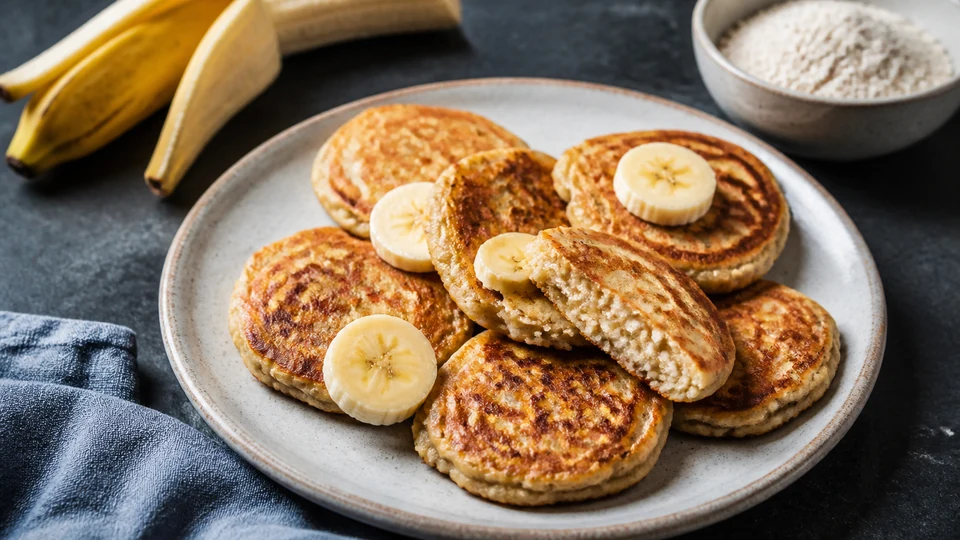
On this page, “flapjack” means a small skillet pancake, not a baked oat bar. This is a formula-selection and troubleshooting guide, not a project-tested recipe. The pancake science hub explains the wider mechanics, while Pancake World opens the full collection.
| Guide sections |
|---|
| Decide what “three ingredient” counts |
| The three jobs the batter must cover |
| What the authoritative banana-pancake reference shows |
| Choose the formula by the result you want |
For broader context, continue with Pancake Ingredients and Substitutions.
Decide what “three ingredient” counts
A short title can conceal a long list of assumptions. Before comparing recipes, choose an ingredient-count rule and apply it to every candidate.
The strict rule counts every food added to the bowl or pan. Banana, egg and a dry structural ingredient already use all three positions; oil or cooking spray becomes a fourth ingredient. Salt, cinnamon, vanilla and syrup also count when used.
The pantry-exception rule counts the three batter ingredients but treats pan fat, water, salt or serving toppings as outside the headline. That convention can be useful, but it must be disclosed. Otherwise, a reader can select a recipe believing nothing else is required and discover that the pan, texture or flavor plan depends on extra items.
The functional rule groups a commercial blend as one purchased ingredient. A self-rising flour or baking mix may contain several components but arrives as one labeled product. That is a legitimate counting convention if the exact product type is stated, yet it is not equivalent to using plain flour. Its ingredient label also matters for allergens and leavening.
Use a one-line declaration such as: “Three batter ingredients; pan fat and toppings excluded.” This article uses that editorial convention when discussing candidate formulas. It does not convert any candidate into a tested Pancake World recipe.
The three jobs the batter must cover
Ingredient minimalism works only when the remaining ingredients perform several jobs. A useful three-item formula must account for moisture, binding and structure. Lift, browning, sweetness and pan release may be limited or handled by one of the same items.
Banana: moisture, solids and flavor
Mashed banana brings water and fruit solids into the batter. Its ripeness, size and degree of mashing change the mixture, so “one banana” is not a precise universal measurement. A complete recipe should describe the banana amount in a reproducible way and give a visual batter cue.
Ripe fruit is easier to mash smoothly. A few small pieces can remain if the source recipe expects them, but large lumps make a tiny flapjack uneven: one area may be mostly egg while another is a wet fruit pocket. Mash before adding the other ingredients so the cook can assess consistency.
Banana flavor is prominent in a three-item batter because there are few competing ingredients. This is not a neutral base that can be treated like a classic flour pancake with a small fruit garnish.
Egg: binding and cooked structure
Egg connects the banana solids and sets as the flapjack cooks. It also makes the batter a raw-egg food before cooking. FDA guidance recommends buying refrigerated eggs with clean, uncracked shells, keeping them refrigerated, and washing hands, utensils and work surfaces after contact with raw egg.
The egg proportion influences whether the result behaves more like a tender pancake or a sweet banana omelet. That is why a universal banana-to-egg ratio would be misleading. Select a complete formula whose outcome matches the texture you want.
The third ingredient: choose the missing function
The third position defines the formula family.
- A grain flour or oat-based ingredient can absorb moisture and provide dry structure. It may introduce wheat or another allergen concern depending on the product.
- Baking powder can add leavening but does not provide the same bulk as flour. A banana-and-egg base with baking powder should not be expected to become a conventional flour pancake merely because it rises.
- A prepared baking blend can combine flour, starch, salt and leavening in one purchased item. Its exact label and directions control; it is not interchangeable with plain flour.
- A ground seed or nut ingredient may absorb liquid or add body, but it changes flavor and allergen scope. It requires its own tested formula rather than a casual swap.
Choose the family first. Then choose a source recipe within that family. Do not borrow the ratio from one family and the cooking directions from another.
What the authoritative banana-pancake reference shows
Utah State University Extension hosts a Nourish Smart banana-pancake card built around ripe mashed bananas, eggs and baking powder. The card also lists vanilla, salt and pan fat, and suggests flour as an optional adjustment for a more cake-like pancake. The source describes the basic pancakes as relatively thin.
That reference is useful for three reasons. First, it documents that a banana-and-egg batter with leavening is a real published approach, not a formula invented for this page. Second, it shows why ingredient counting must be explicit: the prominent functional core does not mean the entire preparation literally uses only three items. Third, it makes the expected style clear. A thin banana-egg flapjack is a different target from a thick flour pancake.
The card is not copied here, and Pancake World has not tested it. Readers who want that particular result should use the complete source for quantities, timing, yield and its optional adjustment. A different three-item formula needs its own complete source.
Choose the formula by the result you want
Soft and egg-forward
Look for a complete banana-and-egg formula whose third ingredient is leavening. Expect the source to describe a thin, delicate result and a cautious turn. Reject a page that promises a tall, bread-like interior without dry structure or evidence explaining how it is achieved.
This family suits a cook who accepts banana and egg as the dominant texture and flavor. It is not a substitute for a wheat-flour pancake simply because both are round and cooked on a griddle.
More pancake-like body
Look for a complete formula in which the third ingredient is flour, ground oats or a defined baking blend. It should state the exact ingredient form: rolled oats are not the same instruction as oat flour, and a commercial mix is not the same as plain wheat flour.
The recipe should supply enough information to judge hydration before cooking. If the only direction is “add flour until right,” the three-ingredient promise has shifted the essential measurement onto the reader. A good minimal recipe still needs precise quantities and observable cues.
Egg-free candidate
Banana can appear in egg-free pancake formulas, but removing egg changes the binding system. Do not take a banana-egg recipe, omit the egg and assume the remaining two items will work. Choose a complete formula developed around its egg replacement and count every component honestly.
An egg-free formula is not automatically safe for every diner. Flour or blends may contain wheat; oat products may require a separate gluten-related decision; nut or seed binders introduce their own allergen questions.
Gluten-related requirement
“Three ingredient” says nothing about gluten. Use only a formula and products that fit the guest’s specific requirement. Read the current package label and avoid substituting a different flour family without evidence. This page does not declare any formula gluten-free.
A reliable cooking workflow
The exact quantities and times must come from the selected source. The workflow below helps execute and evaluate that recipe without replacing it.
1. Read the whole formula
Confirm banana amount, egg size or amount, third ingredient, pan fat, batch yield, portion size, heat instruction, cooking cues and storage advice. If any of those controls are missing, choose a better documented recipe before starting.
Check whether “three ingredient” excludes cooking spray, oil, salt or toppings. Gather those items now rather than improvising over a hot pan.
2. Prepare the pan and tools
Use the pan type and heat level specified by the source. A wide spatula supports a fragile banana flapjack better than a narrow utensil. A small ladle or measuring tool helps keep portions consistent, which makes cooking behavior easier to compare.
If pan fat is required, apply it as the source directs. “Nonstick” describes cookware, not a guarantee that a wet, low-flour batter will release without correct heat and timing.
3. Mash before combining
Mash the measured banana until it matches the source cue. Add egg and the third ingredient in the stated order. Scrape the bowl so dry pockets do not hide at the bottom.
When flour is present, treat it as raw. The FDA says flour usually has not received a treatment that kills harmful bacteria. Keep it away from ready-to-eat foods, clean hands and work areas after handling, and never taste the uncooked batter. Home heat-treatment attempts are not a supported shortcut.
4. Assess, but do not redesign, the batter
Compare the mixture with the complete recipe’s description or image. A banana-egg-leavening batter may be much looser than a flour-based batter. Do not “correct” one family until it looks like the other.
If the consistency is outside the source range, verify measurements and ingredient identity. Was the banana amount larger? Was oat flour replaced with whole rolled oats? Was plain flour used where a baking mix was required? Correct an execution error before adding unlisted ingredients.
5. Cook one small trial piece
A small first portion reveals whether the pan is too hot, the flapjack is too large to turn, or the batter was measured incorrectly. This is an execution check, not a claim that the recipe has been formally tested by Pancake World.
Place the portion without crowding the pan. Keep the diameter within the source guidance. Minimal banana batters are often easier to turn when small because the spatula can support most of the underside.
6. Use structural turn cues
Do not turn merely because a timer elapsed. Look for the source’s cues: an underside with enough color and structure to release, edges that no longer flow, and a top surface whose wetness has begun to change. Slide the spatula fully underneath and turn decisively.
If the flapjack folds or smears, it may have been too large, turned too early, cooked on an unsuitable surface, or made from a batter outside the formula. If the bottom darkens before the top begins to set, reduce heat according to the source method rather than rushing the turn.
7. Cook the center completely
Raw egg and raw flour batter should not remain in the center. FDA egg guidance says egg dishes should reach 160°F (71°C), and FoodSafety.gov lists the same category. A very thin flapjack can be awkward to probe accurately, so also follow the complete recipe’s size, time and fully set-center cues. Do not use surface color alone as proof that a thick center is cooked.
For higher-risk diners, FoodSafety.gov advises avoiding raw or undercooked eggs and raw batter. If the selected style is deliberately soft or undercooked, select another preparation rather than presenting uncertainty as a preference.
Diagnose the first flapjack
It spreads into a thin sheet
First verify the portion size and ingredient amounts. A banana-egg formula may intentionally be thin. If the source promises more body, check whether the third ingredient was the required flour form or blend and whether the banana amount was measured correctly.
Do not add a random spoonful of flour and continue calling the result the same three-item tested recipe. Use only an adjustment explicitly provided by the source, or stop and choose a complete formula built for more structure.
It tears during the turn
Make the next portion smaller if the recipe allows, wait for stronger edge and underside structure, and support it with a wider spatula. Confirm the pan is at the specified heat. A wet top plus an over-browned bottom signals a heat mismatch, not a need to turn immediately.
The outside browns too quickly
Banana batters can darken before a thick center finishes. Reduce the heat, keep portions within the specified size and allow the pan to stabilize before the next one. Do not stack an undercooked piece where its center becomes invisible.
The result tastes strongly of egg
That may be the intended character of a banana-and-egg formula. If it is not the desired result, change formula families rather than hiding the texture beneath toppings. Select a complete version with dry structure and a documented outcome.
It is dense rather than fluffy
Three ingredients impose tradeoffs. Verify that the leavening product is the exact type the source requires and that the mixing order was followed. If the formula does not include leavening or enough dry structure, a tall classic crumb may not be a supported expectation.
Toppings and variations without changing the claim
Fresh banana slices, fruit, yogurt, nut or seed butter, syrup, cinnamon and other additions can change the serving experience, but each becomes an additional ingredient. List them as optional toppings outside the three-item batter claim.
Do not stir multiple extras into the batter and preserve the headline as if nothing changed. A variation with vanilla, salt, spice and chocolate may be worthwhile, but it is no longer a literal three-ingredient preparation under the strict count.
When serving guests, verify allergens independently. Egg is present in the primary formula family. Wheat may be present in flour or mixes. Milk, soy, peanuts, tree nuts or sesame may appear in pan fats, blends and toppings. FDA labeling guidance supports checking the current ingredient list and “Contains” statement; it does not establish that a home kitchen or an unlabeled serving station is free from cross-contact.
Batch, hold and store safely
Three-ingredient flapjacks are best planned as a small-batch skillet item unless the selected formula provides a tested larger-batch method. Multiplying a batter can change mixing and holding time, while a crowded pan makes consistent turning harder. Scale only using source guidance.
Serve cooked pieces promptly or use a documented hot-holding method. Do not leave egg-containing flapjacks at room temperature indefinitely. FoodSafety.gov advises refrigerating perishables within two hours, or within one hour when the surrounding temperature is above 90°F (32°C).
Cool leftovers promptly in a shallow container and refrigerate at 40°F (4°C) or below. FDA egg guidance gives three to four refrigerated days for leftover cooked egg dishes; FoodSafety.gov advises using cooked leftovers within four days. Use the shorter applicable limit when a topping or complete recipe requires it.
Reheat leftovers to 165°F (74°C). Freezing quality is formula-specific: a flour-based flapjack and a thin banana-egg version may not thaw to the same texture. Do not promise freezer performance unless the complete source has documented it.
Frequently asked questions
What are the three ingredients in banana flapjacks?
There is no single universal trio. The common structure is banana, egg and a third ingredient chosen for dry structure or leavening. Some published formulas also use salt, vanilla, pan fat or optional flour, so inspect the full list and the counting convention before choosing one.
Can I get exact amounts here?
No. This route has no completed project-owned test record, so publishing invented quantities, yield and timing would violate its evidence boundary. Use a complete authoritative recipe, such as the Utah State Extension reference listed below, or another fully specified source whose ingredient count and expected texture match your goal.
Are banana and egg enough by themselves?
Published banana-and-egg approaches exist, but this page does not validate a two-item ratio or outcome. Without a dry structural ingredient, expect a different style from a flour pancake. Choose a complete formula and its stated texture rather than assuming equivalence.
Can oats be the third ingredient?
Only with a source formula that specifies the form and amount. Rolled oats, quick oats and oat flour do not create identical batters. A gluten-related requirement also needs product-specific verification; “oat” alone is not a complete suitability decision.
Can baking powder be the third ingredient?
Utah State Extension documents a banana, egg and baking-powder core, while also listing other seasonings and pan fat. Its card describes relatively thin pancakes and offers flour as an optional adjustment. Use that complete card if that is the style you want; do not infer a universal ratio from the ingredient names.
Why do my banana flapjacks fall apart?
Check the formula family, banana and egg measurements, third-ingredient identity, portion size, pan heat and turn timing. A fragile batter may need a smaller portion and more underside structure before turning. Do not repair it with unmeasured additions and then claim the original recipe was followed.
Can children taste the batter?
No. FDA guidance says not to eat or taste raw dough or batter. Flour is raw, and eggs can also carry harmful bacteria. Cook the flapjacks completely and clean hands, utensils and surfaces after raw batter contact.
Are these flapjacks healthy?
This page makes no health claim. Nutrition depends on exact ingredient identities, quantities, pan fat, toppings and portion size. USDA FoodData Central can support values for specified food records, but there is no project-tested formula here from which to calculate a serving.
Can I make them allergen-free?
No single “allergen-free” conclusion follows from a three-item list. Egg is an allergen, flour or blends may contain wheat, and toppings or pan products may contain milk, soy, peanut, tree nuts or sesame. Check the guest’s exact needs, all current labels and cross-contact controls.
Explore related Pancakes World guidance on American Pancakes, American Breakfast: Pancakes, Diner Plates and Brunch, and Maple Syrup.
Sources and editorial references
Use a candidate only when it provides:
- an explicit ingredient-count convention;
- reproducible banana, egg and third-ingredient amounts;
- the precise form of flour, oats, leavener or blend;
- pan type, heat level and pan-fat direction;
- portion size or diameter;
- mixing order and batter cue;
- turn cues and a completely cooked center;
- yield and formula-specific timing;
- allergen information that can be checked against current packages;
- storage and reheating guidance when leftovers are expected;
- an expected style, such as thin and tender or more bread-like;
- no unsupported claim of guaranteed fluffiness, nutrition benefit or universal suitability.
A three-ingredient headline is useful only when the recipe remains complete. Minimalism should reduce the shopping list, not remove the information required to cook the food safely and recognize the intended result.
- Utah State University Extension, “Nourish Smart: Banana Pancakes Recipe Card”:
https://extension.usu.edu/hsi/files/NourishSmart-Banana-Pancakes-Recipe-Card.pdf - Utah State University Extension, “Nourish Smart Wasteless Plate Recipes”:
https://extension.usu.edu/hsi/nourishsmart-wasteless-recipes.php - U.S. Food and Drug Administration, “Handling Flour Safely: What You Need to Know”:
https://www.fda.gov/food/buy-store-serve-safe-food/handling-flour-safely-what-you-need-know - U.S. Food and Drug Administration, “What You Need to Know About Egg Safety”:
https://www.fda.gov/food/buy-store-serve-safe-food/what-you-need-know-about-egg-safety - FoodSafety.gov, “Cook to a Safe Minimum Internal Temperature”:
https://www.foodsafety.gov/food-safety-charts/safe-minimum-internal-temperatures - FoodSafety.gov, “People at Risk of Food Poisoning”:
https://www.foodsafety.gov/people-at-risk - FoodSafety.gov, “Cold Food Storage Chart”:
https://www.foodsafety.gov/food-safety-charts/cold-food-storage-charts - U.S. Food and Drug Administration, “Food Allergies”:
https://www.fda.gov/food/nutrition-food-labeling-and-critical-foods/food-allergies - USDA Agricultural Research Service, “FoodData Central”:
https://fdc.nal.usda.gov/